Ashes of Innocence - Chapter 2: Mithras
The guards moved with practiced efficiency.
No hesitation in their movements, no uncertainty. They had done this before, in a dozen other towns, before a dozen other crowds. They knew exactly how to seize a prisoner, exactly how much force to apply, exactly how to break resistance without killing—not yet, not until the blade fell. Professionals. This was their craft.
From the heretics' group, soldiers began grabbing people and dragging them toward the platform. They weren't gentle about it. Arms and collars and hair seized, prisoners yanked forward without regard for age or infirmity. A merchant struggled and received a gauntleted fist to the kidney that doubled him over. An old man stumbled and fell; a guard kicked him in the ribs, once, twice, three times, until he got up. One young soldier—barely older than Petro, his face drained of color beneath his helmet—reached down as if to help the old man rise. A sergeant grabbed his arm and yanked him back. The young soldier's jaw tightened, but he stepped away and rejoined his squad. Whatever mercy he'd intended died unspoken. A woman screamed for her children—"My babies! Please, let me say goodbye to my babies!"—and another guard silenced her with a backhanded blow across the face that snapped her head to the side and dropped her to her knees.
The crowd watched in horrified silence. Some turned away. Some covered their eyes. Most just stared, frozen, unable to move or speak or even breathe as their neighbors and friends were dragged away to die.
The first to be taken was the Duke himself.
Two guards grabbed him by the arms and hauled him forward. He didn't struggle—not because he was afraid, but because he knew it would be pointless. Head high, bruised face composed, his one good eye swept over the crowd as if committing every face to memory. Looking at his people—the people he had ruled and protected and fed during lean times—with something Petro couldn't quite read. Sadness, perhaps. Or regret. Or maybe just a final goodbye.
Whatever else he might be—heretic, demon worshipper, enemy of the Church—he was still a nobleman. Raised from birth to face death with dignity. He would not give them the satisfaction of seeing him grovel.
Behind him came the Duchess, stumbling on bare feet. Her shoes had been taken, and the cobblestones were rough and cold. Crying silently, tears streaming down her ashen cheeks, but she didn't beg. Spine straight, chin raised. Even now, even stripped of title and dignity and hope, she carried herself like the woman who had brought blankets to the poorest quarters in winter. The woman who had organized the feeding stations when the mines ran dry. She'd always been like that—helping people not because anyone was watching, but because it was who she was. Even now, they couldn't take that from her.
Then the Guard Captain, still wearing his torn uniform, his face a mask of controlled fury. Walking without assistance, shrugging off the guards who tried to grab him. They let him. They knew he wasn't going anywhere.
After him came others—nobles and merchants and craftsmen. Some Petro recognized. Thomas the cloth merchant, who had once given him a blanket during a cold winter—not a castoff or a rag, but a proper woolen blanket, thick and warm, pressed into Petro's hands with the quiet words "No child should be cold." The baker's wife, who sometimes left day-old bread in the alley behind her shop where the street children could find it—never making a show of it, never claiming charity, just leaving the bread where it would be found, as if by accident. A young apprentice from the blacksmith's forge, barely older than Petro himself, who had once shared an apple without being asked.
Small kindnesses. The things good people did. And every one of them about to die.
And near the end of the line, still among the remaining prisoners, Suzanne.
She stood frozen, watching the others being led away. Her face was white, her lips trembling. So small among the adults—so fragile, so helpless. Just a child. She didn't even know what Mithras was. She didn't worship any god.
She was innocent.
And they were going to kill her anyway.
Pushing forward through the crowd, trying to get closer to the platform. He had to do something. Had to save her. Couldn't just stand here and watch while they—
The Duke was led to the headsman's block first.
The guards forced him to his knees before the stained oak, pressing his neck into the curved groove. The priest stepped forward, positioning himself beside the Duke, and raised his hands to the sky.
"Lord, we offer You this heretic that You might forgive these good people. Will you find it in Your heart to accept our offering?"
The crowd was silent. No one breathed. The only sounds were the distant rumble of thunder and the crackle of torches.
The priest turned to the Duke.
"If you have any final words, speak them now and be damned."
Looking up at the priest, the Duke's face was calm. Resigned. He'd known this was coming from the moment the Imperial soldiers had arrived. He'd had time to make his peace.
When he spoke, his voice was clear and strong, carrying across the silent square:
"Your God is silent, priest. Remember that when you go to your bed tonight. Remember that and ask yourself if there really is an afterlife for you."
A murmur rippled through the crowd. The priest's expression didn't change, but anger flickered in his dark eyes, or doubt quickly suppressed.
"I know of the Kingdom of Heaven," the priest replied smoothly, "promised to all who offer their heart to Him. What has your God promised you?"
The Duke smiled. It was a thin smile, cold and knowing.
"More than you could ever imagine."
The priest's jaw tightened almost imperceptibly. "Then perhaps you can prove me wrong. When you arrive there, come back and tell us if Mithras kept his word."
He gestured to the guards.
They seized the Duke's shoulders and held him fast, pressing his neck deeper into the groove of the block. The wood was stained dark—old blood from previous executions that had soaked into the grain.
The Duke didn't struggle. Lay still, his one good eye staring out at the crowd, his breath misting in the cold air.
The crowd was silent. Absolutely silent. Petro's own heartbeat pounded in his ears, a drum rhythm of terror.
The priest nodded to the executioner.
A guard in a black hood stepped forward and lifted the great axe from its iron stand. He raised it high—the blade catching the torchlight—and brought it down.
The axe fell.
It made a sound like thunder—a heavy crash of steel striking wood that seemed to echo across the entire square, the entire town, the entire world. That sound would haunt Petro's nightmares for the rest of his life. The wet, meaty thunk of the blade hitting home. The split-second of silence that followed. And then—
The Duke's head separated from his body cleanly, rolling from the block and thudding onto the wooden platform below. It tumbled several feet, leaving a dark trail across the wood, before the priest put his foot on it, stopping it in place like a man stopping a wayward ball.
For a moment—just a moment—the Duke's face was visible. His one good eye was still open. His lips were still moving. Petro could have sworn the man's mouth formed a word—a name, perhaps, or a prayer—before the light faded and there was nothing left but meat.
Blood fountained from the severed neck, spraying across the platform in arterial jets that painted everything crimson. The metallic stench hit the crowd a heartbeat later—iron and salt and copper—death itself, stripped of ceremony. The smell of death. The executioner's boots. The priest's pristine white robes. The wooden block that would hold a dozen more necks before this day was done. Blood pooled and spread, dripping off the edge of the platform, pattering onto the cobblestones below with sounds like rain on a roof.
The Duke's body slumped forward, still held in place by the wooden block, twitching and jerking as the last signals from the severed nerves fired and died. Hands clenched and unclenched. Legs kicked against nothing. The movements were horrible to watch—so human, so alive, even though the man was dead. Even though his head was under the priest's boot, three feet away from his body.
The crowd erupted.
Some screamed—raw, primal sounds torn from throats that had never made such noises before. Women collapsed, fainting, caught by people nearby before they hit the ground. Men who had never cried in their lives had tears streaming down their faces. Children wailed, not understanding what they were witnessing but knowing instinctively that it was wrong, that this was the stuff of nightmares made real.
Some wept silently, their bodies shaking with sobs they couldn't voice. Some turned away, unable to look, pressing their faces against the shoulders of whoever was nearest. Others stared with wide, horrified eyes, transfixed by the sight, unable to look away even though every part of them screamed to do so.
And some—the Church's supporters, the faithful, the ones who had been positioned in the crowd to lead the response—cheered. They raised their fists and shouted praise to the Lord of Light. They clapped and stamped their feet. They acted as if they had just witnessed a miracle instead of a murder.
Bile rose in Petro's throat. He'd seen death before. His father beating men bloody in drunken rages. Animals slaughtered for food, their blood draining into buckets while they kicked and screamed. Bodies in alleys, homeless men who had frozen to death or been stabbed for a few coins.
But this was different.
This was cold. Calculated. Ceremonial. Death dressed up in religious robes and presented as justice. Murder with the full weight of Church and Empire behind it, murder that the crowd was supposed to celebrate.
Evil dressed as righteousness.
The priest looked down at the Duke's severed head. The Duke's eyes were still open, staring up at nothing. For a moment—just a moment—something seemed to linger in those eyes. Understanding. Horror. Awareness.
Then it was gone.
The priest cocked his head to the side, as if listening for something.
"I hear nothing," he announced to the crowd. "Perhaps he never made it to his other side. Perhaps Mithras was never there at all."
A few nervous laughs from the crowd. The priest smiled.
"Next!"
The guards dragged the Duke's body away, tossing it off the back of the platform like a sack of garbage. They hauled the Duchess forward.
She was fighting now—struggling against their grip, screaming, kicking. Her composure had shattered. Just a woman now, terrified and desperate, fighting for her life with everything she had.
The guards were stronger. They forced her to her knees, forced her neck into the groove. The wood was still wet with her husband's blood, still warm.
"Do you renounce Mithras?" the priest asked.
Looking up at him, her face twisted with rage and grief and hatred.
"Fuck you," she spat. "Fuck your false god and fuck your Church. You're murderers. All of you. My husband gave you shelter when the Church in the capital exiled you for stealing from orphans. He gave you a position here, gave you respect, and this is how you repay—"
The priest nodded. The axe fell.
The Duchess's head rolled across the platform.
Eyes closed, but the sounds remained. The crash of the blade. The thump of the head. The wet gurgle of blood pouring from the severed neck. The coppery reek intensified, mixing with the torch smoke and fear-sweat until the air itself seemed thick with death.
When eyes opened again, they were bringing forward the next prisoner.
Thomas the cloth merchant. A middle-aged man with kind eyes and gentle hands. He'd given Petro a blanket three winters ago, when the boy had been shivering in an alley during a snowstorm. Asked nothing in return. Just seen a child in need and helped.
Now being forced to his knees before the block, his head pressed into the bloody groove.
"Do you renounce Mithras?" the priest asked.
"I... I do," Thomas said quickly. His voice shook, cracked with terror. "I renounce him. I accept the Lord of Light. Please, I have children—"
"Your renunciation comes too late," the priest said. His voice was calm, almost gentle. "For years you have harbored heresy in your heart. For years you have supported the Duke's false worship. Your repentance now is born of fear, not faith. The Lord sees through such hollow words."
"No! Please! I mean it! I'll do anything—"
The axe fell.
Thomas's head dropped from the block and rolled to join the growing pile at the platform's edge. His body was dragged away and thrown from the platform, landing in the heap of the dead with a sound that was somehow worse than the blade itself—the wet, heavy thud of a human being treated like refuse. His blood joined the rivers running across the wood, the platform now so slick that the guards' boots left crimson footprints wherever they stepped.
One after another, the prisoners were brought forward. The baker's wife who'd left bread for street children—she whispered "It was just bread" before the blade took her. An old scholar who told the crowd to remember what was done here in God's name. A young mother torn from her infant, who declared that Mithras asked only for love where the Church demanded fear.
Each death was the same. The question. The answer—whether defiant or pleading. The axe. The thud. The blood. The growing pools of crimson spreading across the platform, dripping through the cracks, forming sticky puddles below that reflected the torchlight like dark mirrors.
A teenage boy, an apprentice at the smithy, was dragged forward last of the common prisoners. He'd shared an apple with Petro once, behind the forge—just split it in half and offered the bigger piece without a word. Such a small kindness. Such a small thing to remember as the guards dragged the boy toward the headsman's block.
Shaking so hard he could barely stand. Tears and snot streamed down his face.
"Do you renounce Mithras?"
"Y-yes," the boy stammered. "Yes, I renounce him. I was wrong. I was stupid. Please, I'll do anything. I'll join the Church. I'll become a priest. I'll serve the Lord of Light my whole life. Please. Please."
"Your words come too late," the priest said gently, almost kindly. "Sin must be paid for. The Lord demands it."
"No. No, please. I don't want to die. I'm only sixteen. Please. Please!"
The boy kept begging even as they forced his head into the block. Kept begging even as the executioner raised the axe.
The blade fell mid-plea.
Blood pooled on the platform, dripping down onto the cobblestones below, running in rivulets between the gaps in the stone. The priest's white robes were more red than white now, soaked and splattered. He seemed not to notice, or perhaps not to care. His face remained calm, serene even, as he presided over the slaughter.
More followed. Too many to count. The crowd stopped screaming, stopped crying. They just watched, silent and hollow-eyed, as their neighbors, their friends, their leaders died one after another. The initial shock had given way to numb horror, and the numb horror had given way to something worse—a terrible acceptance, as if this was simply the way the world worked. As if this had always been inevitable.
Petro felt it too—the numbness creeping in like cold water, dulling the edges of his horror, turning the screams into background noise. Some part of his mind was trying to protect him, trying to build walls between his consciousness and the carnage unfolding before him. But another part—the part that would define him, that would drive him for the rest of his life—refused the numbness. Refused to look away. Forced himself to watch, to witness, to remember every face and every cry and every wet thud of the falling blade. Because someone had to remember. Someone had to carry the truth of what was happening here, even if that someone was a ten-year-old boy with nothing but his eyes and his memory and his rage.
The count was lost. Ten. Twenty. More. Each execution blurred into the next, until the faces became interchangeable and the cries all sounded the same.
Then they brought forward the Guard Captain.
Hank's father.
Last adult in the line, walking without assistance. The guards tried to grab him but he shrugged them off, climbing the platform steps under his own power. A big man, broad-shouldered and strong, and even beaten and bloody he moved with the confidence of a trained fighter.
Standing before the headsman's block, looking out at the crowd.
His eyes found Hank.
The boy was staring at the priest with such hatred that heat seemed to shimmer in the air between them.
Standing near the front of the remaining prisoners—the children who hadn't yet been called. His face white, his body shaking. Tears streamed down his cheeks as he watched his father.
The Guard Captain held his son's gaze for a long moment. Something passed between them. Even Petro could see it—love and goodbye and everything a father could say without words. A whole lifetime compressed into a single look—every bedtime story, every scolding, every shared meal, every lesson about honor and duty and the right way to hold a sword. All of it passing between them in the space of a heartbeat, because there would be no more heartbeats after this.
Then turned to face the priest.
"You mock, priest," he said, his voice rough but clear, "and the mockery makes you a coward."
The crowd stirred. Whispers rippled through the masses. No one had spoken to the priest like that. No one had dared.
The priest stepped forward, his blood-soaked robes rustling. Looking at the Captain the way one might look at an insect.
"I mock that which is beneath my contempt," the priest said. "And your insult means nothing when it comes from a heretic. You reside beneath my contempt and consideration. You are nothing. A scavenger on the desires of other men. You prey upon their weakness and turn them away from their only chance of salvation. You consort with demons and drink the blood of virgins."
The Captain laughed. It was a harsh, bitter sound.
"You are clearly as ignorant as you are self-righteous."
"Spoken like a man afraid to die."
Shaking his head slowly.
"No, I am not afraid to die. I've made my peace. What you do today is out of fear and stupidity. You accuse me of the manipulation which you have perfected."
Turning slightly, addressing the crowd as much as the priest.
"These people you shepherd over? You make them into sheep. Mithras makes us strong. All of us. He doesn't force some into poverty so you can lord over them like a child with an ant hill."
Turning back to the priest, eyes burning.
"And this is why, priest, you and yours will fail."
The priest took a step forward, smiling. But it was a cruel smile, cold and predatory.
"Will I? Maybe. But not today."
Leaning in close to the Captain, voice dropping to a whisper that somehow still carried across the silent square.
"I'm sorry, but today it is not my head on the chopping block."
Stepping back, gesturing to the guards.
"Do you have any last words?" the priest asked, the formal question already a dismissal.
Looking out at the crowd one final time. His gaze found Hank again.
When he spoke, his voice was ragged but clear enough to carry:
"Mithras is the true god. The Lord of Light is a fiction created by weak men to control the masses."
His voice grew stronger, more defiant.
"My son knows the truth. He carries—"
The priest nodded.
The axe fell mid-sentence.
The Captain's head tumbled from the block and across the platform. His body slumped forward, blood pouring from the severed neck.
For a moment, silence. Total, absolute silence. Even the wind seemed to die.
Then Hank screamed.
It wasn't a scream of grief or horror. Something else. Something primal and raw, torn from the deepest part of him—from the place where love lived, where the bond between father and son was anchored so deep that severing it tore something loose that could never be repaired.
Pushing through the remaining prisoners, shoving them aside, running toward the platform. The guards moved to intercept but he was fast, dodging between them.
"MITHRAS!" Hank shrieked.
The name tore from his throat like a battle cry.
"MITHRAS IS MY GOD!"
Reaching the edge of the platform, standing at the base of the steps, his whole body rigid with fury and grief.
"I WORSHIP MITHRAS! DO YOU HEAR ME? MITHRAS!"
The guards started moving toward him. The priest stepped back, his eyes widening.
But before anyone could reach him, something happened.
The air changed.
It grew thick and hot, pressing against skin like a physical weight. The torchlight flickered and dimmed. The shadows deepened. A vibration ran through the cobblestones—subtle at first, then stronger, as if the earth itself was responding to the boy's anguish. The hair on Petro's arms stood upright. His teeth ached. The taste of copper flooded his mouth, sharp and electric, the taste of a world about to tear itself open.
And Hank was glowing.
A faint light surrounded his body, pulsing in time with his screams. It started soft—barely visible—but grew brighter with each passing second. His eyes were blazing, white and terrible. The power came from somewhere deep inside him—from his grief, his rage, his love for his father. It answered emotion the way a fire answers wind, feeding on the rawness of his pain, growing stronger with every scream. This was magic as the old texts described it: not a tool to be wielded, but a force that erupted when the soul could no longer contain what it held.
The priest's face went pale. For the first time, he looked afraid.
"Seize him!" he ordered.
The guards rushed forward.
But the priest made a mistake. In his fear, in his haste, he reached for the boy himself. Perhaps thinking to grab him. Perhaps thinking to silence him before worse things happened.
His hand closed on Hank's shoulder.
And then the priest was on fire.
Not slowly. Not gradually. Instantly, the man burst into flames, his robes igniting like oil-soaked kindling. Screaming—a sound so terrible that it would haunt nightmares for years to come—stumbling backward, arms flailing, trying desperately to put out the flames.
But it wasn't normal fire. Blue, tinged with white at the core, and it didn't spread across the surface of his robes. It erupted from within, pouring from his mouth and nose and eyes, consuming him from the inside out. The stench of burning flesh mixed with the coppery blood-smell, a nauseating combination that made stomachs heave.
Falling from the platform, still burning, still screaming.
A guard rushed to help him and caught fire too. Then another. Anyone who touched them burst into flames.
Hell broke loose.
Everyone was screaming.
The crowd erupted into panic. People ran in every direction, trampling each other in their desperation to flee. The guards were shouting orders but no one was listening. Some of them were drawing weapons, others were running, others were on fire.
Hank stood at the base of the platform, still glowing, his eyes blazing white. The light around him was growing brighter, spreading outward like ripples in a pond.
But the panicking crowd missed this: Hank's hands were blistered and raw, the skin cracked and weeping as if he'd thrust them into a forge. Blood ran from his nose, dark and thick. His whole body was trembling, not with rage but with exhaustion, like a man who'd run for miles without rest. The magic was drawing from Hank himself—from his blood, his strength, his life. Every flame that consumed a guard took something from the boy in return. A terrible exchange, power purchased with the wielder's own flesh.
The priest was still alive—still burning—crawling across the cobblestones and leaving a trail of flames behind him. His screams had become a high, thin wail that cut through all the other noise. His flesh was melting, sloughing off his bones, revealing the muscle and fat beneath.
Reaching a horse trough and trying to throw himself in. The water boiled away the moment he touched it.
The guards were in chaos. Some trying to restore order. Others fighting the crowd. Others had caught fire and were running, screaming, spreading the flames to everything they touched.
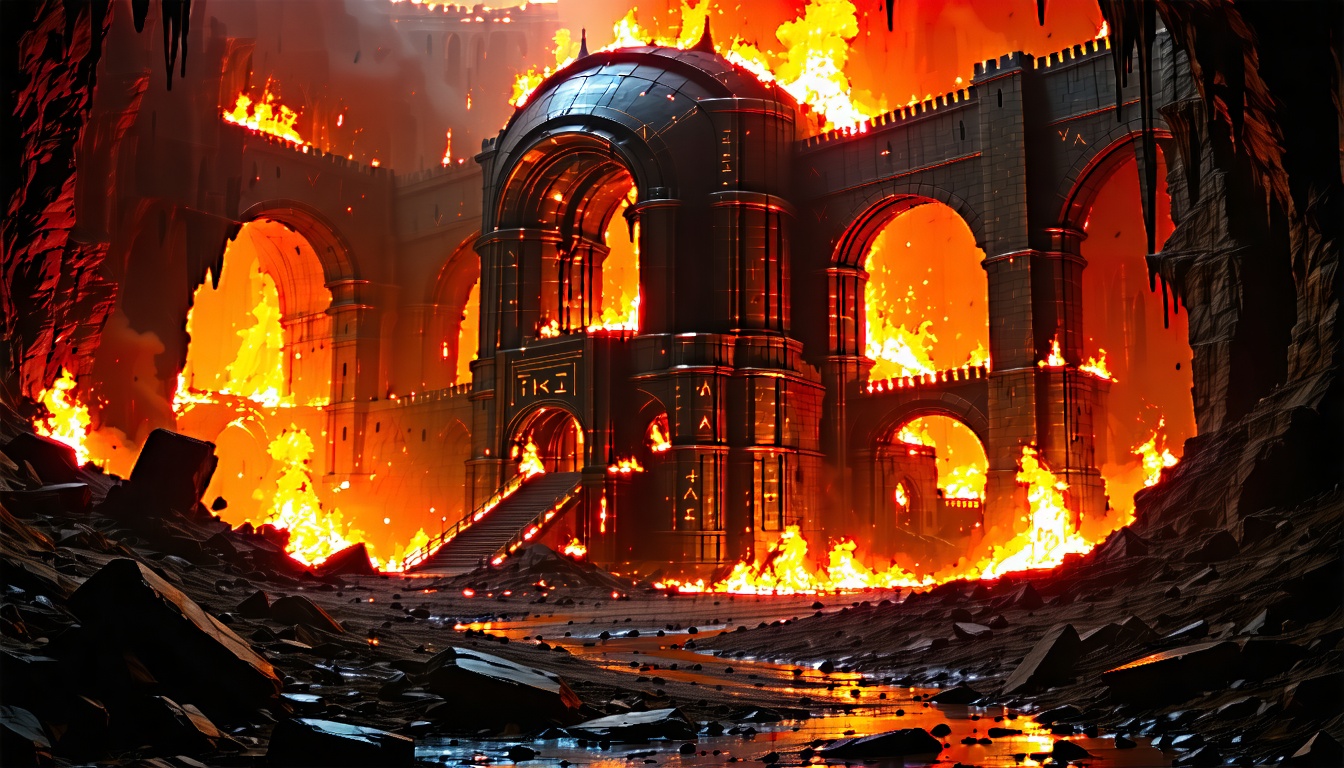
A building caught. Then another. The flames spread faster than should have been possible, leaping from structure to structure as if guided by an invisible hand. The fire had a hunger to it—not the indiscriminate appetite of natural flame, but a directed hunger that sought timber and thatch and anything that would burn. Within minutes, half the square was ablaze. The heat drove people back, forced them into alleys and side streets, crushed them together in the narrow passages where the fire hadn't yet reached.
Standing frozen in the chaos, unable to move, unable to think. The world had gone mad. Everything was burning. People were dying all around. The screams blended into a single unbroken wail—the sound of a town dying, of a world ending, of everything Petro had ever known being consumed by a power he couldn't understand.
Then—Suzanne.
She was standing near the platform, alone, forgotten in the chaos. The prisoners had scattered when the panic started, but she hadn't moved. Just standing there, staring at the burning priest, her face blank with shock. The flames were creeping closer—a wooden cart nearby had caught, its contents already consumed, the fire reaching toward the cobblestones where she stood. Sparks drifted around her like malevolent fireflies, landing on her clothes, her hair. She didn't brush them away. Didn't move. Didn't blink.
Running. Pushing through the stampeding crowd, fighting against the tide of bodies, dodging flailing limbs and trampling feet. Someone elbowed Petro in the face and his vision exploded with stars, but he kept going. Had to reach her. Had to save her.
Grabbing her hand.
"Suzanne! We have to go!"
She looked at him with empty eyes, her mind somewhere far away. The heat from the spreading fires was intense now, pressing against his skin like an open furnace. A timber cracked overhead—a balcony on the nearest building, weakened by fire, sagging toward the street.
"Suzi!" Shaking her. "We have to run!"
Something sparked in her eyes. Recognition. Fear. Life returning to a face that had gone blank with trauma. She gasped—a sharp intake of breath, as if surfacing from deep water—and her hand tightened around his.
She nodded.
They ran.
Behind them, the world was ending. Fire and screams and death. The buildings around the square were fully engulfed now, the flames roaring so loud they drowned out even the screaming. Smoke poured through the streets in thick black clouds that turned day into night and filled lungs with ash. Ahead of them, the streets were filling with panicked people—fleeing, fighting, dying. A woman carrying two children stumbled past, her dress smoking. An old man sat in a doorway, coughing blood, his eyes glazed. A dog ran in circles, whimpering, its tail singed.
But they ran.
Hand in hand.
Together.
Two children, ten years old, fleeing through a burning town while the world they knew collapsed behind them. Not knowing where they were going. Not knowing what would happen next. Not knowing that this moment—this desperate flight through smoke and fire, hand gripping hand—would bind them together for the rest of their lives. Would become the foundation of everything they built. Every trust, every argument, every kiss, every child they raised.
It started here. In fire and blood and the ashes of a world that had failed them both.
They ran, and they survived, and nothing was ever the same again.
---



Join the Discussion