Echoes in the Void - Chapter 1: Landfall
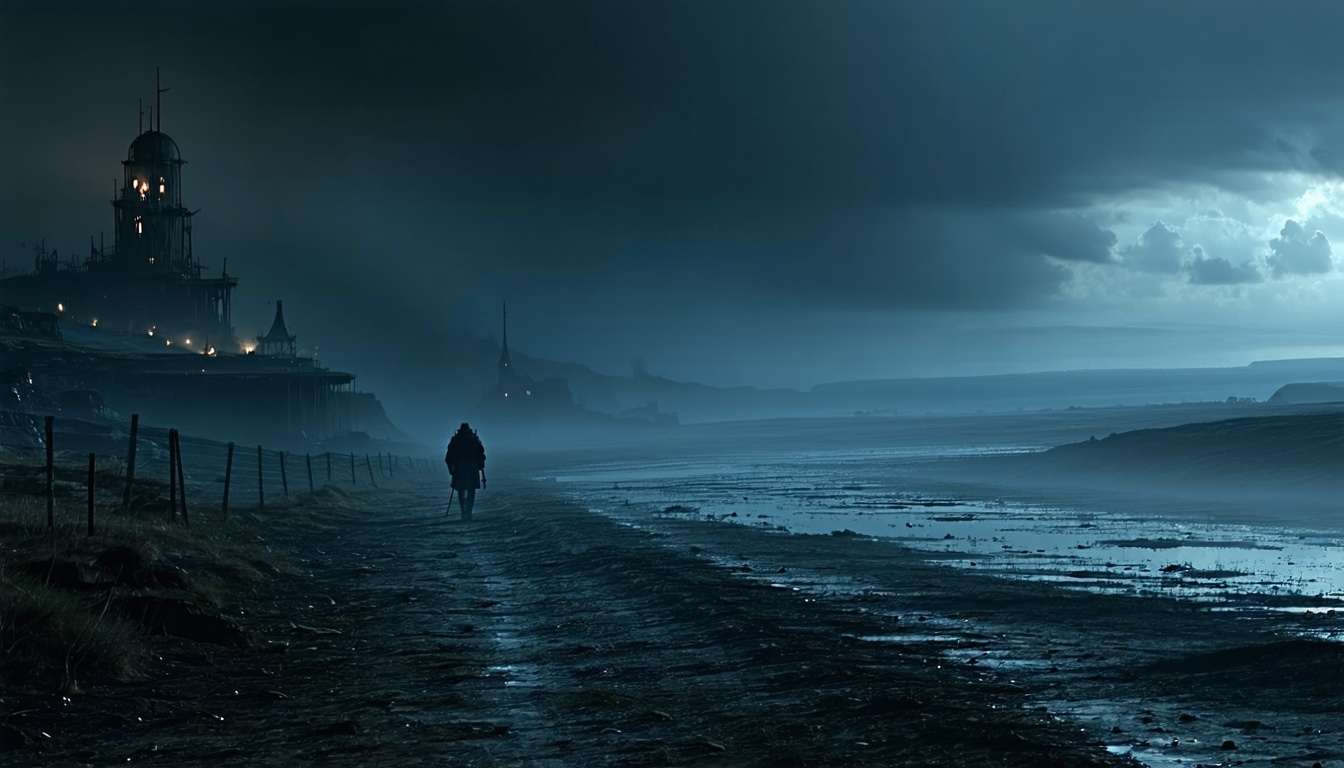
The descent through atmosphere felt like falling into a grave.
Marcus had experienced atmospheric entry dozens of times during his career—the bone-rattling vibration, the flash of heat against the shuttle's hull, the momentary terror that never quite faded no matter how many times he survived it. But this was different. This planet felt wrong in ways his instruments could not measure but his gut caught before he could name it.
The cloud cover was too uniform. The surface readings were too stable. Everything about this world suggested preservation rather than activity, stasis rather than life. It was as if the planet itself had been frozen mid-motion, waiting for something to arrive and disturb its eternal stillness.
"Contact in thirty seconds," Rylee said, her voice cutting through the static in Marcus's helmet.
Marcus gripped the armrest of his harness. His free hand moved to his chest pocket, confirmed the recorder was running, and his thumb caught on the edge of something smaller beside it—not the recorder. He released it without looking down. The shuttle shuddered as it pierced the upper atmosphere, and through the small viewport beside him, the planet's surface emerged from the haze—brown and grey and utterly still.
Team 2's signal had led them here. Three months of following that automated ping across dead space, their ship's transit drives folding space in ways that physicists still couldn't fully explain. Humanity had possessed interstellar capability for barely two centuries—long enough to spread across a thousand worlds, not long enough to truly understand the forces that made such travel possible. The drives worked. That was enough for most people. But Marcus had always wondered what else might be moving through those folded spaces, what other forces might be watching when ships punched holes in the fabric of reality.
Now, on this world that shouldn't exist in the Void, he suspected he was about to find out.
The landing gear deployed with a hydraulic whine. Chelsea sat across from him, her fingers flying over a tablet, pulling data from the shuttle's sensors. Lucas had his rifle across his lap, the barrel pointed at the deck, his jaw tight. Marcus had worked enough missions with Lucas to read the tells without asking—the stillness that came over the soldier when his combat instincts fired, the way his eyes tracked the viewport even when there was nothing to track. Whatever Lucas was reading in this environment, it registered as threat.
Lucas's gaze swept the viewport, then returned to the deck. Even on barren moons, a flicker of movement or distant sound held a soldier's attention. Here there was nothing. Just that unnatural stillness pressing against the shuttle's hull.
Lucas's grip on his rifle tightened. Nigel muttered calculations under his breath—atmospheric composition, pressure differentials, nitrogen ratios that didn't match any catalogued world.
"Touchdown," Rylee announced.
The shuttle settled with a soft crunch. Through the viewport, Marcus saw dust rise in lazy spirals, then hang motionless in the air. No wind. The particles just... stopped.
"Readings?" Rylee asked.
"Breathable," Chelsea said. "Barely. Oxygen at eighteen percent, nitrogen heavy, trace elements I don't recognize. Temperature sits at twelve Celsius. No biological signatures in immediate range." She paused, frowning at her screen. "Actually, no biological signatures at all. Nothing. Not even bacteria."
"That's not possible," Nigel said.
"I'm telling you what the sensors say."
Marcus activated his helmet's recording function and spoke quietly. "Personal log, Marcus Reeves. Day one on planet surface. Coordinates correspond to Team 2's last known transmission point. Initial scans indicate a sterile environment. Team preparing for external survey."
The rear hatch cycled open with a pressurized hiss. Grey light flooded the compartment—not sunlight, exactly, but something diffused through the thick cloud cover above. The air that rushed in carried no scent. No moisture. No temperature variation from what the sensors predicted.
Rylee went first, as she always did. Her boots hit the ground, and she turned a slow circle, rifle raised, scanning horizons that stretched flat and featureless in every direction.
"Clear," she said. "If you can call this clear."
Marcus descended the ramp behind Chelsea. The ground beneath his feet was packed earth, grey-brown and uniform, without a single crack or variation. He crouched, ran his gloved fingers across the surface. Dust clung to the fabric but didn't scatter. When he lifted his hand, the particles remained exactly where they settled.
"The dust doesn't move," he said aloud, for the recording.
"Wind's dead," Lucas observed, stepping past him. "Like, completely dead. I've been on barren moons with more atmosphere than this."
But it wasn't the lack of wind that made Marcus's chest tighten. It was the silence. Complete, absolute silence. No distant rumble of geological activity. No hiss of escaping gases. No hum of electronics beyond their own equipment. He had stood in vacuums quieter than this, but vacuums were supposed to be quiet. This planet had an atmosphere. It should have sound.
"Team 2's beacon is one point three kilometers northeast," Chelsea said, checking her tablet. "Strong signal. Automated, like we thought."
"Then we move," Rylee said. "Standard formation. Lucas on point, Nigel rear guard. Marcus, keep that recorder running. I want documentation of everything."
They walked.
The landscape revealed itself in gradual increments—flat plains giving way to gentle rises, then to structures that emerged from the haze like bones from sand. Marcus saw them first: low buildings, angular and utilitarian, their surfaces the same grey-brown as the earth. No markings. No windows. No visible entrances.
"Habitation structures," he narrated. "Approximately forty units visible from current position. Construction appears uniform—prefabricated, possibly modular. No signs of damage or decay."
"No signs of anything," Lucas muttered.
They passed the first building at a distance of twenty meters. Marcus studied its blank walls, searching for seams or joints, any indication of how it was assembled. The surface was smooth but not polished, as if it grew from the ground rather than being built upon it.
"I don't like this," Nigel said from behind them. "The engineering doesn't make sense. No foundation visible, no support structures, no weathering despite what must be centuries of exposure—"
"Focus," Rylee cut in. "We get to the beacon, we assess the situation, we report back to the Void. That's the mission."
But Marcus noticed that her grip on her rifle had tightened. Her steps had shortened. She was scanning the buildings with the same unease that crawled up his own spine, even if she wouldn't name it.
The beacon signal strengthened as they walked. Chelsea adjusted their heading twice, compensating for what she called "minor positional drift," though Marcus suspected the signal itself was moving. Not quickly—centimeters per hour, maybe—but enough to throw off their navigation if they weren't careful.
They reached the beacon site forty minutes after landing.
The equipment sat in the center of a cleared space, surrounded by the same low buildings they had passed for the last kilometer. A transmitter array, a solar collection unit, a backup power cell, all connected by cables that ran in precise parallel lines across the ground. Everything was pristine. Not a speck of dust on any surface, not a single wire out of place.
"This is it," Chelsea said. "Team 2's beacon. Broadcasting for—" She checked her tablet. "Fourteen months."
"Where's Team 2?" Lucas asked.
No one answered.
Marcus walked a slow circuit around the equipment, recording every angle. The transmitter was military-grade, the kind of unit designed to survive atmospheric reentry and continue functioning. Its status lights glowed green—power stable, signal strong, message on loop.
"Can you access the message log?" Rylee asked.
Chelsea knelt beside the transmitter, pulling a cable from her tablet. Her fingers worked the interface with practiced efficiency, and after a moment, she nodded. "Got it. Forty-seven entries, starting fourteen months ago. Last entry is—" She stopped.
"Chelsea?"
"Last entry is an automated system reset. No human input. Just the beacon recognizing that no one's checked in for thirty days and switching to emergency broadcast mode."
Marcus's throat went dry. "So Team 2 set up the beacon, transmitted for thirty days, then... stopped."
"Looks that way."
"And the equipment just kept broadcasting. Automatically. For over a year."
Chelsea didn't respond. She was staring at the transmitter as if it might offer an explanation, but the green lights just blinked their steady rhythm, indifferent to questions.
Rylee turned to survey the surrounding structures. "They had to go somewhere. Shelter, resources, something. Chelsea, can you pull location data from the beacon's logs?"
"Already on it." More typing. "The last manual transmission originated from—" She pointed toward a larger structure at the edge of the cleared space, set slightly apart from the others. "That building. Four hundred meters."
"Then that's where we go."
They approached in formation. The larger structure rose two stories high, its walls the same featureless grey-brown as everything else on this planet. As they drew closer, Marcus slowed.
A door.
Not a sealed hatch or an automated portal—an actual door, rectangular and hinged, standing slightly ajar. Dark space visible beyond.
"Hold," Rylee said softly.
Everyone stopped. Rifles came up. Marcus's hand drifted to the recorder at his chest, confirming it was still running.
"Nigel, readings?"
Nigel checked his scanner. "Nothing. No life signs, no energy signatures beyond residual heat from our own bodies. Interior temperature matches exterior—twelve Celsius exactly."
"Lucas, take point. Chelsea, you're with me. Marcus, Nigel, hold position until we clear the entry."
Lucas moved forward in a crouch, his rifle light cutting into the darkness beyond the door. He paused at the threshold, then pushed the door wider with his boot.
It swung open without sound. No creak of hinges. No scrape of metal on stone.
"Clear to three meters," Lucas reported. "Corridor, straight line, no visible—wait." He stopped. His shoulders tensed. "Commander, you're going to want to see this."
Rylee moved up beside him. Her silhouette filled the doorway. Her body went rigid. Her rifle lowered by a fraction of an inch.
"Everyone inside," she said. "Slowly."
The corridor extended ten meters before opening into a larger space—a common area, Marcus realized. Tables. Chairs. Storage units along the walls. Everything arranged with geometric precision, every surface clean, every object in its designated place.
And on one of the tables, positioned exactly in the center of the room: a cup.
A cup of coffee. Still steaming.
Marcus stared at it. Steam rose from the dark liquid in lazy curls, dissipating into the stale air. The cup sat on a coaster, aligned perfectly with the table's edge. A spoon rested beside it, parallel to a napkin that showed no creases or stains.
"That's not possible," Nigel whispered.
Chelsea approached the cup, scanner raised. She took readings from every angle, her face pale in the grey light filtering through a high window. "Temperature is sixty-eight Celsius. Liquid is—" She paused, checking her results. "Liquid is coffee. Standard freeze-dried reconstituted coffee, the kind you'd find in any long-haul vessel. It's... fresh."
"Fourteen months," Lucas said. "The beacon's been running for fourteen months."
"I know."
Marcus forced himself to move, to record, to document. He walked through the common area, narrating in a low voice that sounded steadier than he felt. "Central habitation space, approximately fifty square meters. Standard furnishings—tables, chairs, storage units. Food preparation station visible along western wall. One cup of coffee, still hot, positioned on central table. No occupants. No sign of struggle or hasty departure. Everything is... organized."
He reached the food preparation station. The counter was spotless. A meal tray sat beside the heating unit, containing what looked like a half-eaten portion of protein substitute and a sealed nutrient pack. The protein substitute was warm.
"Same here," he reported. "Food in preparation. Still warm."
"Commander," Chelsea called from across the room. She stood before an open doorway leading to what appeared to be sleeping quarters. "You need to see this too."
They gathered at the doorway. The quarters beyond contained four bunks, military-style, with personal effects arranged on adjacent shelving. Photographs. Data tablets. A child's drawing, taped to the wall above one of the lower bunks—stick figures holding hands beneath a yellow sun.
One of the bunks showed signs of recent use. The blanket was turned down. A book lay open on the pillow, spine cracked at a particular page.
"Someone was reading," Marcus said. "Someone was in the middle of reading, and they just—"
"Left," Rylee finished. "They left everything and walked away."
"But where?" Lucas demanded. "Where did they go? There's no bodies, no blood, no damage to any of the equipment. They didn't die here. They didn't fight their way out. They just... stopped existing."
Marcus looked at the child's drawing. The stick figures smiled with simple curved lines. The yellow sun radiated optimism.
Beside him, Nigel had gone still. His hand had drifted to the collar of his suit, fingers closing around something beneath the fabric—a gesture so practiced it looked involuntary. He held whatever it was for a long moment, jaw tight, then let go and turned back to his scanner.
Team 2 had families with them.
The weight of that realization settled in his chest like a stone. Fourteen months ago, people lived here. Parents and children. Scientists and soldiers. They ate warm meals and read books and drew pictures for the walls of their quarters. They set up a beacon to call for help, and they transmitted for thirty days, and then they vanished so completely that even the coffee they poured stayed hot in their absence.
"We need to search every building," Rylee said. "Document everything. There has to be a record, a log, something that explains what happened."
"Commander," Nigel said quietly, "what if there isn't?"
Rylee met his gaze. In the grey light of this dead world, her expression revealed nothing. "Then we keep looking until we find something. That's what we do. That's what we've always done."
Marcus activated his recorder's secondary backup function—redundant storage, encrypted transmission to the shuttle's black box. Whatever they found here, whatever happened to Team 2, he was going to make sure someone knew.
"Personal log, supplemental," he murmured. "We've reached the beacon site. Team 2's equipment is functional, but Team 2 is gone. All of them. The settlement shows signs of instantaneous departure—no warning, no preparation, no time. Meals left mid-bite. Books left mid-sentence. It's as if everyone simply ceased to exist in the space between one heartbeat and the next."
He paused, searching for words that might capture the wrongness of this place, the suffocating silence that pressed against his eardrums like a physical weight.
"What happened here defies every framework I have. The departure was instantaneous and total—no struggle, no warning, no trace. And I don't think it's finished."
Outside, in the motionless air of this dead world, the dust hung exactly where it fell.
Waiting.


Join the Discussion