Echoes in the Void - Chapter 2: Empty World
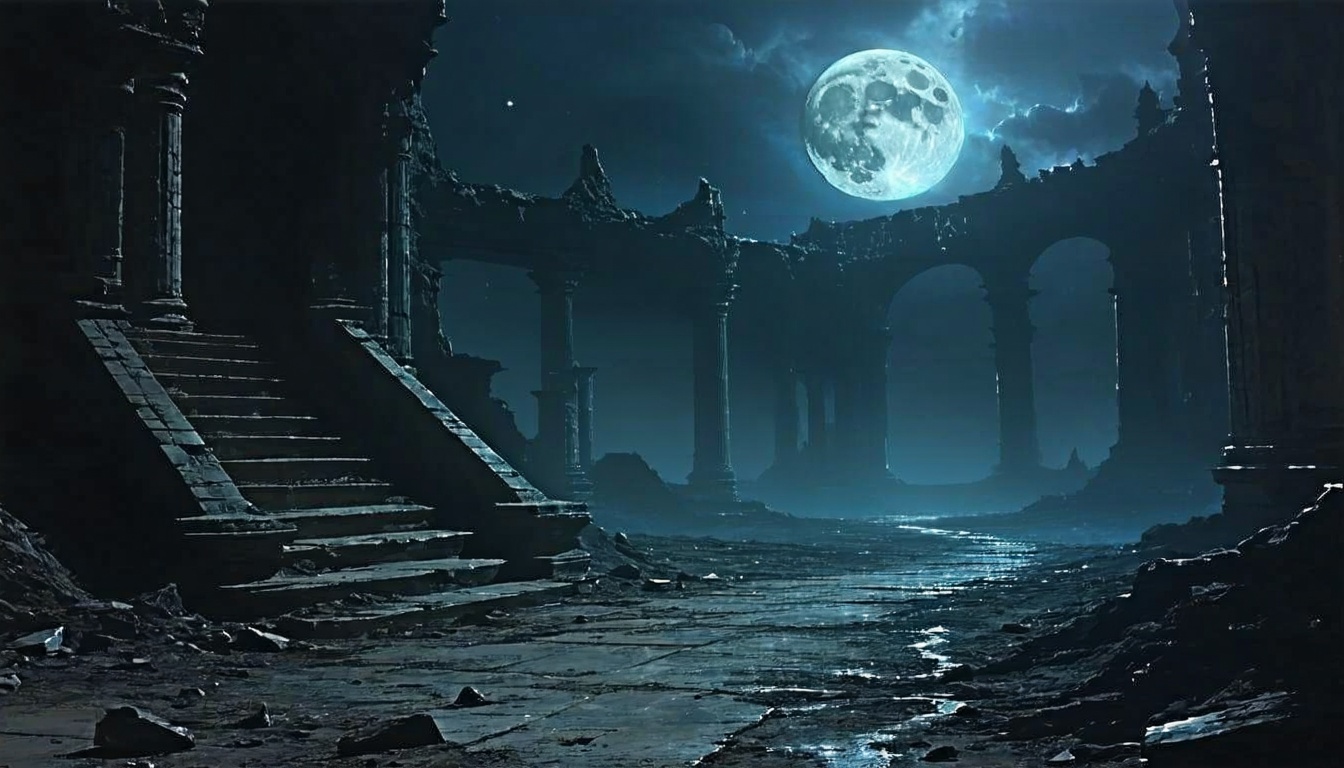
The settlement refused to make sense.
Rylee had led teams through abandoned outposts before—mining colonies evacuated during market crashes, research stations left behind when funding dried up, military installations decommissioned after wars that nobody remembered. Fifteen years of command experience had taught her to read the signs of departure, to understand the narratives that empty places told through their silence and decay. Abandonment had patterns. Decay had logic. You could read the story of a place's ending in the dust on its surfaces and the deterioration of its structures.
But this place had no story she could read. No pattern she could recognize. It was wrong in ways that made her skin crawl with instincts she could not explain.
"Check the northern quadrant next," Rylee ordered, pointing toward a cluster of structures half-obscured by the permanent haze.
Three hours since landing, and they had cleared eleven buildings. Every one told the same story: warm meals, open books, personal effects arranged with care. Lives interrupted mid-motion, preserved like insects in amber.
No bodies. Not a single one.
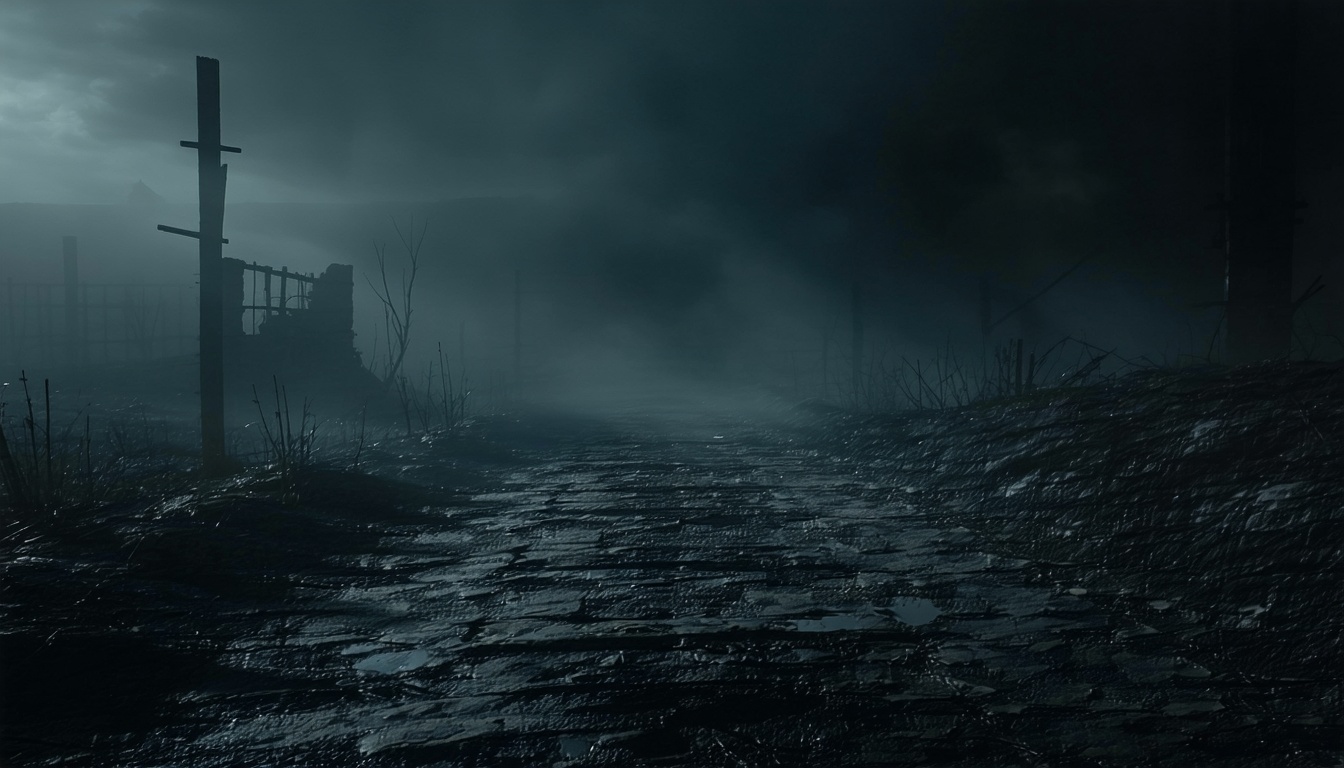
Rylee led her team through the settlement's central avenue—if you could call it that. The path between buildings was wide enough for vehicles, packed earth the same uniform grey as everything else on this planet, but there were no tire tracks. No footprints. No evidence that anyone ever walked these paths except the marks her own team left behind.
Those marks disturbed her more than they should. Their boot prints remained exactly where they stepped, sharp-edged and permanent. The dust didn't drift to fill them in. The wind didn't blur their outlines. Each footprint was a record, a testament, an accusation: you were here.
"Commander." Nigel's voice crackled over the comm. He had taken rear position, fifty meters behind the main group, running continuous scans of the surrounding structures. "I'm picking up residual power signatures from the building on your two o'clock. Low-level, consistent with standby electronics."
"Define low-level."
"Life support on minimum draw. Environmental controls cycling at intervals. Whatever's in there, it's been running on automatic for a long time."
Rylee signaled the team to halt. Lucas moved to her left shoulder, rifle raised, eyes scanning the building Nigel indicated. It was larger than most—three stories, with what might be observation windows on the upper floors, dark glass reflecting nothing but grey sky.
"Chelsea, what do you see?"
Chelsea adjusted her scanner, sweeping the building's facade. "Nigel's right. Power draw matches a standby configuration. No thermal signatures beyond ambient. If there's anyone in there, they're not generating body heat."
"Then they're not alive."
"No. They're not."
Rylee took a breath, held it, released. The air tasted of nothing—no dust, no moisture, no organic compounds. Training and instinct had taught her to trust her senses, to gather information through channels that instruments could not measure. This place defeated those instincts. The sterile atmosphere gave her nothing to work with, no subtle clues, no environmental hints about what had happened here. It was like breathing inside a sealed container, sterile and recycled and profoundly unnatural.
"We clear the building," she said. "Standard protocols. Lucas takes point, I'm second, Chelsea and Marcus provide cover. Nigel, maintain external surveillance and keep that comm link open."
"Understood."
They approached in formation. The building's entrance was a set of double doors, hinged like the one they found at the beacon site, standing open precisely fifteen centimeters. Through the gap, Rylee saw darkness—not the absence of light, exactly, but a quality of shadow that suggested depth.
Lucas paused at the threshold. He clicked on his rifle light, painting a stripe of illumination across the floor beyond the doors. Grey tile. Dust-free. Absolutely still.
"Pushing through."
He shouldered the door open and stepped inside. Rylee followed three seconds later, her own rifle light joining his as they swept the entrance hall. It was a lobby, she realized. Reception desks along one wall, seating areas arranged in the opposite corner, information displays mounted at regular intervals.
The displays were active.
Blue text scrolled across each screen in a language she didn't recognize—angular symbols, geometric patterns, nothing resembling any human alphabet she had encountered. The text repeated on a loop, the same sequence of characters appearing every eight seconds.
"Marcus, are you getting this?"
"Recording," Marcus confirmed from his position by the doors. "Linguistic analysis will take time, but I can tell you this isn't any known human language. The character set is too uniform—no variation in letter height, no apparent punctuation, no spacing between words. If it is a language, it's one designed for machine reading, not human eyes."
"Or not designed for humans at all."
Rylee didn't respond to that. She moved deeper into the lobby, checking corners, clearing spaces. Everything here followed the same pattern they had seen throughout the settlement: order without occupation, maintenance without maintainers. The seating areas were arranged with mathematical precision. The reception desks held stacks of blank tablets, aligned in perfect rows. A water dispenser in the corner showed a temperature reading of precisely room temperature—no warmer, no cooler.
"Stairwell to the right," Lucas reported. "Elevator bank to the left. Both appear functional."
"Take the stairs. I don't trust elevators that have been running on their own for fourteen months."
They ascended in silence. The stairwell was as pristine as everything else—handrails polished, steps uniform, emergency lighting casting a pale glow from recessed fixtures. Rylee counted the steps: fifteen per flight, three flights per floor. The precision bothered her in ways she couldn't articulate.
The second floor opened onto a corridor lined with doors. Office spaces, by the look of them—small rooms containing desks, terminals, chairs. Each room they checked revealed the same story: terminals displaying that same looping text, personal effects arranged on desks, half-finished work left in neat stacks.
In one room, Rylee found a photograph.
It sat in a frame on the desk beside the terminal, positioned to face whoever occupied the chair. The image showed two adults and a child, standing in front of what appeared to be a prefabricated structure—not on this planet, judging by the blue sky and visible vegetation in the background. The adults wore matching jumpsuits with corporate insignia she didn't recognize. The child, perhaps eight years old, held a stuffed animal and grinned at the camera with gap-toothed enthusiasm.
"Commander?"
Rylee realized she had stopped moving. She was standing in front of that photograph, staring at the child's smile, her chest tight with something she refused to name.
"I'm fine. Move out."
The third floor was different.
The corridor here was wider, the doors spaced farther apart. These weren't offices—they were laboratories. Rylee saw microscopes through observation windows, specimen containment units, analysis equipment arrayed on reinforced benches. The sterile aesthetic she had come to expect was amplified here, everything chrome and white, surfaces gleaming as if freshly cleaned.
"Chelsea, I need you up here."
Chelsea appeared at her shoulder within minutes, breathing slightly hard from the stairwell climb. Her eyes widened as she took in the laboratory setup.
"This is a research facility," she said. "Biological research, from the equipment profile. Gene sequencing units, pathogen containment, tissue cultivation—this is serious infrastructure."
"What were they researching?"
Chelsea moved to the nearest workstation, pulling up displays that glowed with the same angular text. "I can't read the labels, but the samples are still here." She pointed to a row of specimen containers mounted along one wall, each one containing a dark mass suspended in preservation fluid. "Whatever they were studying, they didn't take it with them."
Rylee approached the containers. The masses inside were irregular, organic-looking, with textures that suggested tissue rather than mineral. Some were spherical, others elongated. The smallest was the size of her fist; the largest approached a meter in length.
"Biological samples," she murmured. "From where?"
"From here, maybe? If this planet supports life—"
"Chelsea. The planet doesn't support life. You said it yourself. No bacterial signatures, no microorganisms, nothing. This world is sterile."
"Then these samples came from somewhere else."
Rylee stared at the containers. The preservation fluid within each one was slightly cloudy, obscuring details, but she thought she could make out structures within the tissue masses—not random growth patterns, but organized arrangements. Chambers. Channels. Something that might be vascular architecture.
"Commander." Lucas's voice came from across the laboratory. He was standing in front of a larger containment unit, this one built into the wall, its observation window frosted with condensation. "You need to see this."
She crossed the lab. The containment unit Lucas found was a cryo-preservation chamber, maintaining interior temperatures well below freezing. Through the frost-hazed glass, she could see a shape—large, irregular, definitely organic.
"Can you clear the window?"
Lucas scraped frost from the glass with his gloved hand. It fell away in crystals, revealing the interior centimeter by centimeter.
The shape inside was humanoid.
Or it was, once. Rylee could make out the rough outline of a body—torso, limbs, head—but the proportions were wrong. The limbs were too long, the torso too narrow, the head misshapen in ways that suggested either deformity or transformation. The skin, if it could be called skin, had a waxy quality, semi-translucent, revealing darker structures beneath.
"Is that..." Lucas started.
"I don't know what that is."
Chelsea joined them, scanner raised. She took readings through the glass, her face cycling through shock to clinical detachment to something that might be fear. "Biological tissue, definitely. Cellular structure is—" She paused, checking her results. "Cellular structure is unlike anything in our databases. Not human. Not any species we've catalogued. It's... new."
"Or old," Nigel said over the comm. "Transmission from orbital telemetry came through while you were inside. This settlement isn't the only one on the planet. There are seventeen additional sites with similar infrastructure, distributed across the continental landmass. Fourteen show active power signatures. The other three appear abandoned—damaged, possibly destroyed."
"How long have they been here?"
"Best estimate based on geological surveys? The oldest structures predate human space travel by approximately six hundred years."
Rylee turned away from the cryo-chamber. Her mind struggled to process the implications. A species established colonies here six centuries ago. A species that wasn't human, that didn't match any known intelligent life, that built cities and research facilities and then—what? Vanished?
"Nigel, anything else from those surveys?"
"One more thing. The settlements aren't randomly distributed. They form a pattern—a geometric pattern, radiating outward from a central point approximately two hundred kilometers northwest of our current position. Something's at the center of that pattern, but orbital imaging can't penetrate the atmospheric interference in that region."
"Something."
"That's all the data tells us."
Rylee looked at her team. Lucas gripped his rifle like a lifeline. Chelsea stared at her scanner as if the numbers might rearrange themselves into an explanation. Marcus recorded everything in silence, his face unreadable behind his helmet visor.
They came here following a distress beacon. They expected to find survivors or bodies, answers or closure. Instead they had found a world that shouldn't exist, built by beings that shouldn't exist, preserved in a state of suspension that defied every physical law they knew.
"We return to the shuttle," she said. "Full mission report to the Void. Whatever happened here, whatever's at the center of that pattern—we're not equipped to investigate alone."
No one argued. They filed out of the laboratory, down the pristine stairwell, through the lobby with its looping displays. Outside, the grey light hadn't changed. The dust still hung motionless. The silence still pressed.
Rylee paused at the building's entrance, looking back at the research facility. Somewhere inside, that humanoid form waited in frozen suspension, neither alive nor clearly dead. Somewhere beyond the haze, a pattern of settlements pointed toward something her instruments couldn't see.
Team 2 found this place. Team 2 set up their beacon and transmitted for a month and then stopped. Team 2 was gone, but their coffee was still hot.
She didn't understand. She didn't know if understanding was possible.
But she knew one thing: whatever happened here wasn't finished. Whatever took Team 2—whatever emptied these buildings and left the meals warm and the books open—was still present. Waiting. Watching.
She couldn't see it. She couldn't measure it. She couldn't fight it.
But she could feel it, somewhere beyond the edge of perception, patient and vast and utterly, terrifyingly silent.
"Move out," she ordered. "Double time. We're not staying here a minute longer than necessary."
They walked back toward the shuttle, leaving boot prints in dust that would never scatter, marking their passage through a world that remembered everything and explained nothing.

Join the Discussion