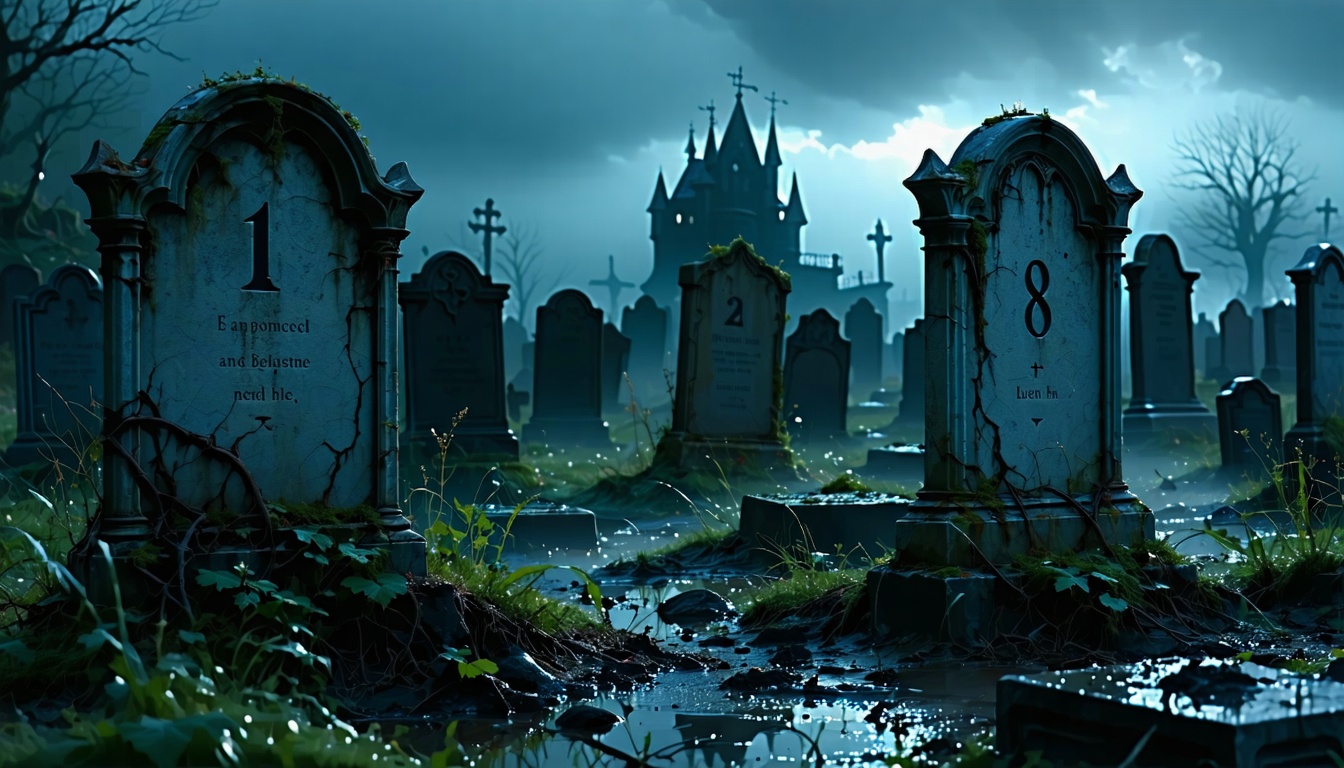
There is a question every reader of Escape eventually asks. Sometimes they ask it on the page where Thomas first hears the six-second pulse beneath the manor. Sometimes they wait until the Doctor's clinical voice drifts through the lighthouse intercom on the Shoreline. Always, by the Castle, the question has hardened into something like demand.
What is the Network, really?
Thomas spends four books answering it in fragments. The fragments do not always agree. That is by design — the Network resists being seen, and a unified field theory would betray what it is. But for readers who have finished all four books and want the whole map, this is the closest I can come to one without writing a fifth.
What follows is canonical. Some of it never made it into the books because Thomas, in his iterations, never had the calm or the time to assemble it. He was always running, or dying, or trying to remember which daughter his hands were trying to save.
I. The Wound in Reality
Begin with what the Network is not.
It is not a haunted house. It is not a dimension. It is not the afterlife — though it borders one and feeds on traffic between. It is, in Ra's words to Thomas in the Hall of Gods, a wound. A specific tear in the membrane of reality, opened by a single act of refusal at a specific moment in human history.
The first act of refusal happened in Egypt, roughly 1,400 BCE, when Pharaoh Kha-em-Waset stood over the body of his seven-year-old daughter Merit-Amen and refused to let her cross. The refusal was not metaphorical. He commanded his priests to perform mummification on the living — on his queen Nefertari-Merit, on himself, on every advisor he could compel — to invent a new way to cheat the ka across the threshold of death. He believed grief was a problem he could outwork.
The Architects were already watching. They are the silent first cause behind the entire series, and Escape deliberately keeps them at the edge of perception, the way deep-sea pressure stays at the edge of a swimmer's awareness. They are non-human. Their geometry is pre-human, their patience is geological, and their interest in the human animal is the interest a histologist takes in a slide. They had been studying grief on Earth for millennia before Kha-em-Waset gave them their first real instrument.
When the pharaoh's blasphemy tore the membrane, the Architects did not patch it. They moved into it.
That tear is the Black Altar. Every Site has one. They are not separate altars but the same altar, viewed from four geographic anchors that the Architects gradually constructed around the original wound. The Network is the connective tissue between those four anchors and the original wound at its center. It is a closed ecosystem of suspended consciousness, fed by grief that was strong enough to refuse death and structured enough to remember itself.
II. The Four Sites
Each Site was built around a human grief big enough to power it. The Architects did not invent the grief. They found it, recognized it, and then constructed a stage where it could be looped indefinitely.
Site One — The Manor. Constructed around Dr. James Harrow, an English researcher who lost his daughter Violet in 1952. Harrow's grief is industrial. He is a man of journals and sample drawers, and his refusal to accept Violet's death took the form of a seventy-year experimental program: 151 documented subjects, transformation chambers below the manor floor, a five-level underground hospital grafted onto an Architect facility that predates human construction by twelve thousand years. Harrow built the manor on top of a wound he did not understand. The Architects let him.
Site Two — The Shoreline. Constructed around Captain William Thorne and his wife Helena, lost at sea in 1892. The Shoreline is the youngest of the four anchors and the most honest about what the Network is — a beach where time fails, where shipwrecks from centuries past lie next to vessels from years that have not yet happened. Thorne's grief is navigational. He is the only Site warden who fully understood, by the end, that there is no destination. He was, in his last act, the only one who chose to be a conductor instead of a jailer.
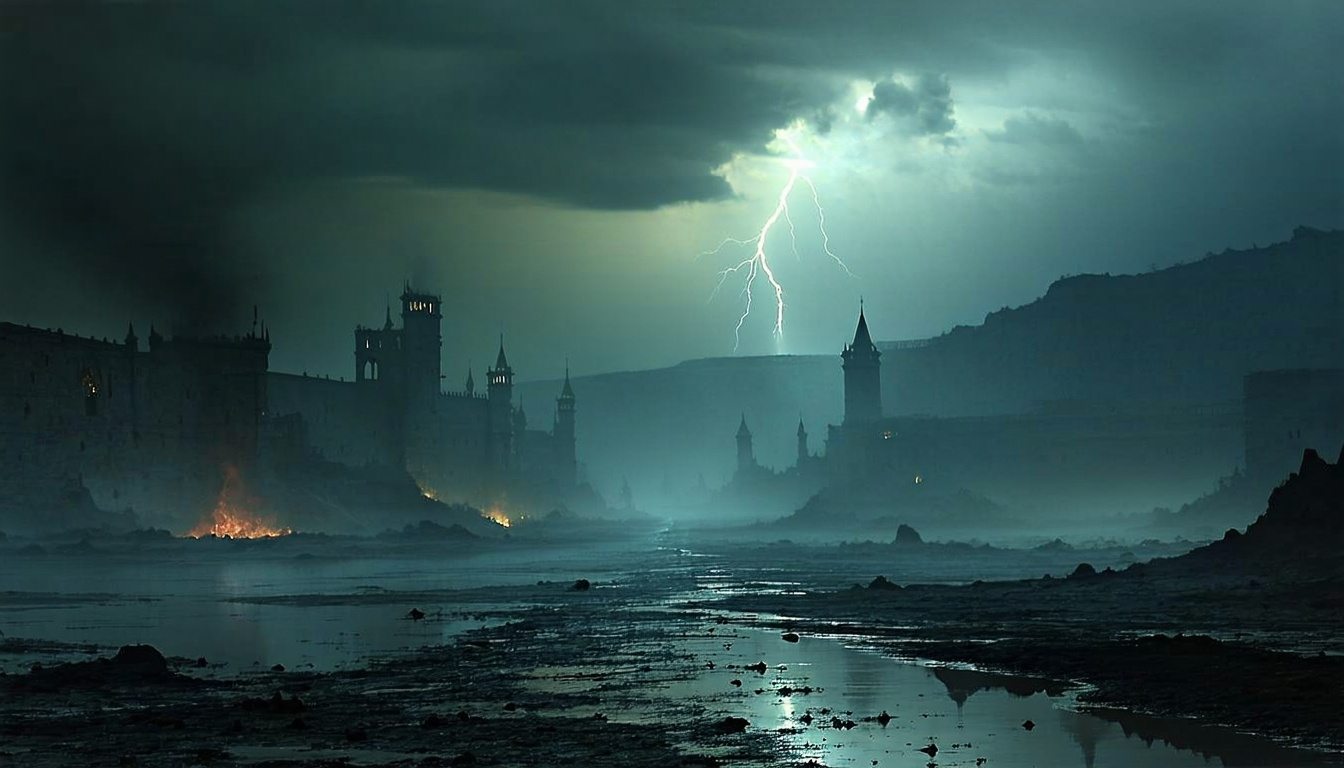
Site Three — The Castle. Constructed around King Aldric, who lost his daughter Elise to fever in the late twelfth century and refused to let her cross. Aldric's grief is sovereign. He is a man who could command an entire feudal apparatus to die alongside him, and he did. Seven knights, one cook, a priest, a chronicler, a queen who died trying to stop him by her own hand — all bound to the castle for eight centuries. The Castle is the longest-running Site, and the one where the Architects' patience is most visible. They watched Aldric build it brick by brick and only adjusted when his denial began to crack.
Site Four — The Temple. Constructed around Pharaoh Kha-em-Waset, the original wound. The Temple is not just one of the four Sites. It is the source. The other three were built around it, the way scar tissue is built around the original cut. By the time Thomas reaches it, the Temple holds 847 trapped souls within itself and has fed roughly three thousand more upstream into the other Sites and downstream into the Architects' archives. The Temple is also the only Site where the Doctor speaks in its true voice rather than wearing a human face.
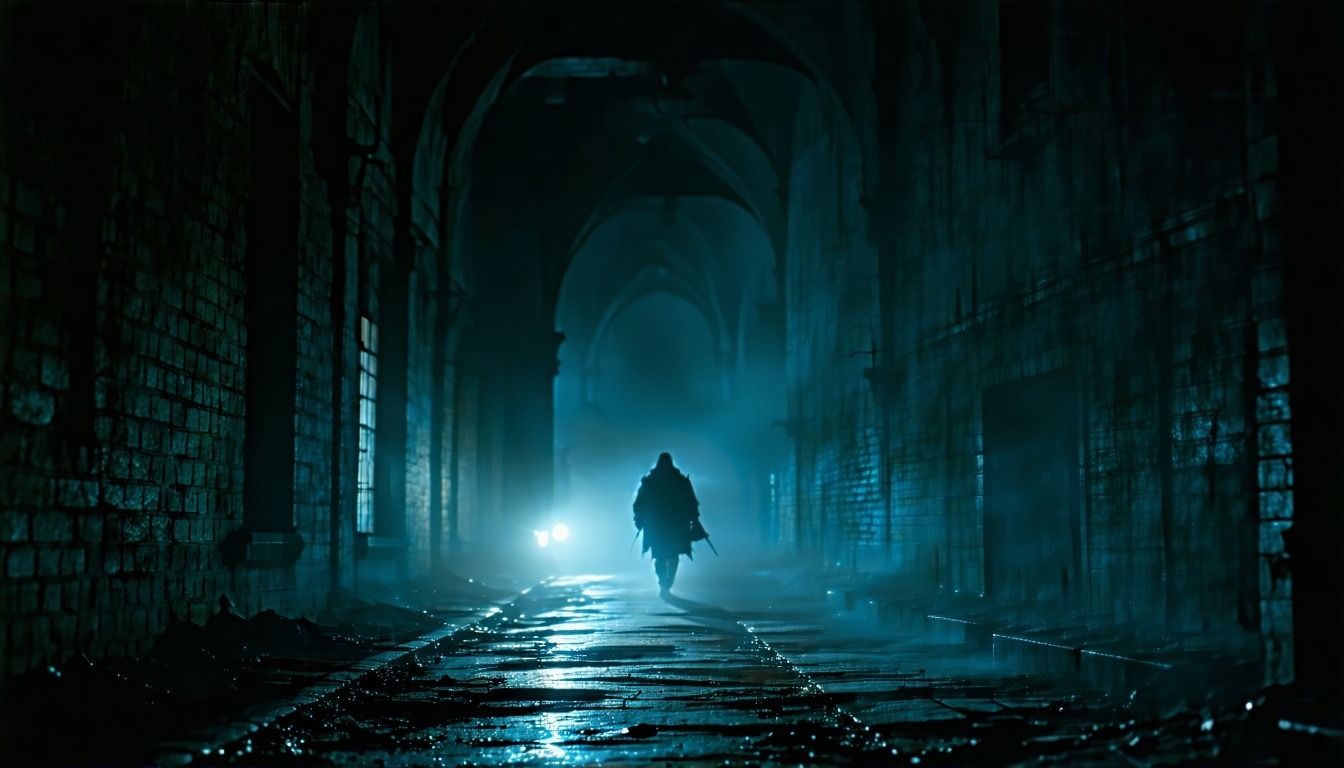
A note on geography. The Sites are physically anchored — the Manor is in England, the Shoreline is somewhere in the North Atlantic, the Castle is on a real medieval mountain, the Temple is beneath the Sahara — but the spaces inside the Sites are not strictly physical. The manor's underground hospital is far larger than the manor footprint should permit. The Shoreline beach loops back on itself. The Castle's catacombs reach into geological strata that should not exist beneath the mountain. This is because the Sites are anchors, not buildings. Inside, you are in the Network.
III. The Doctor
The reader meets at least four men who are, at different times, called "the Doctor."
Dr. Harrow is the most overt. He calls himself the Doctor in his clinical persona, the one that speaks through the manor intercoms while he is taking notes on his subjects. The Doctor is also Aldric's name in the Network's mouth when he confronts Thomas in the Castle. The Doctor speaks, briefly, through Pharaoh Kha-em-Waset before the pharaoh's ka surrenders. And the Doctor speaks, finally, in its own voice in the Hall of Judgment in Book Four.
These are not separate doctors. They are the Network's interface modules — the human-shaped masks the Architects' instrument wears to interact with subjects. The Doctor is one entity, ancient, pre-human, wearing the grief-twisted face of whichever Site warden a subject is currently inside. It learned early that pure cosmic horror does not produce useful data. Subjects faced with the inhuman simply die. But subjects faced with a grieving father who looks like every grieving father will negotiate, refuse, plead, attempt to reason. They generate iterations. They generate readings.
The Doctor is the part of the Architects' instrument that has been worn down by exposure to human consciousness. By Book Four it has begun to suffer something that resembles fatigue. When it speaks in its own voice in the Hall of Judgment — clinical, precise, enumerating Thomas's death count as if reading a tide chart — there is a current in the recitation that the Doctor itself does not seem to recognize as boredom approaching despair.
That is what Thomas eventually breaks. Not the Architects, who he could never reach. The Doctor.
IV. Iteration Mechanics
Subjects do not die once in the Network. They die many times.
The mechanic readers see most clearly is the surface iteration count: seventeen iterations on the Shoreline, advertised on the lighthouse wall. That number is a cover story for new arrivals. It is the smallest digit the Network can write without scaring the subject off the board entirely. The deeper iteration counts — 1,847 in Thomas's Shoreline journal, 4,127 in the Temple, the silent millennia in the Castle — are the real ones.
Iterations are not resets in the strict video-game sense. The body resets. Memory does not, fully. Each iteration leaves a residue: muscle memory, reflexive avoidance of certain floorboards, recognition of a stairwell shape that the conscious mind cannot place. This is how Thomas can solve puzzles in his "first" walk-through of a Site. He has been here before, and his body remembers what his memory has been forced to surrender.
The cost of iteration is paid in memory. Not random memory. Specific memory. The Architects extract the memories that anchor the subject to their grief. Violet's laugh in the Castle. Violet's hair color in the Bell Tower. The warmth of Violet's hand at the Observatory. The Network does not erase Sarah and Violet. It surgically removes the texture of them — leaves the fact of their existence and the fact of the loss, removes the sensory hooks that made the loss bearable. By the Temple, Thomas remembers his daughter exists. He cannot remember what her laugh sounded like.
This is why honest grief is the only weapon. Anything else — leverage, anger, transactional bargaining — is fuel. The Architects designed the Network to feed on negotiation. A subject who tries to make a deal, who tries to win, who tries to outwit the Doctor, generates exactly the iterations the experiment was built to generate. The only move the system was not designed to metabolize is a subject who carries grief honestly as grief and refuses to convert it into anything else. That is what the Hall of Gods means in Book Four when Osiris tells Thomas, without words, that the weapon is not a sword.
V. The Six-Second Pulse
The Network has a heartbeat. It is exactly six seconds long. Subjects sensitive enough to feel it — Thomas at the Manor, Jennifer in the Temple — describe it as a low pressure that rises and falls just below the threshold of hearing. It is the Architects' instrument cycling. Every six seconds the Doctor takes a reading. Every six seconds the Sites synchronize. Every six seconds the trapped ka of the dead are counted.
Subjects who learn to time their actions to the gaps between pulses can briefly act outside the Network's observation. Thomas does this twice without knowing he is doing it. Jennifer maps it deliberately in Book Four. The pulse is the closest thing the Network has to a vulnerability that does not require an altar to exploit.
VI. Trapped Souls and the Census
By the end of Book Four, Thomas has been responsible — directly or indirectly — for the release of roughly two million human consciousnesses from the Network. That number is not hyperbole. It is the Architects' running total, accumulated across the Sites for over three thousand years.
The breakdown is not symmetric. The Manor holds 151 documented subjects, plus the surviving fragments of Patricia and Violet Harrow, plus Father Michael — the only voluntary subject — and roughly a thousand pre-human consciousnesses bound to the underground hospital from before Harrow ever began his work. The Shoreline is the bulk: over two million, accumulated since the Architects opened the lighthouse to the dead. The Castle holds 2,245 souls — the king's court, his army, his peasantry, every traveler the Castle pulled in over eight centuries. The Temple holds 847 named souls and a quiet, much larger number of unnamed dead the pharaoh's ritual swallowed before he was condemned.
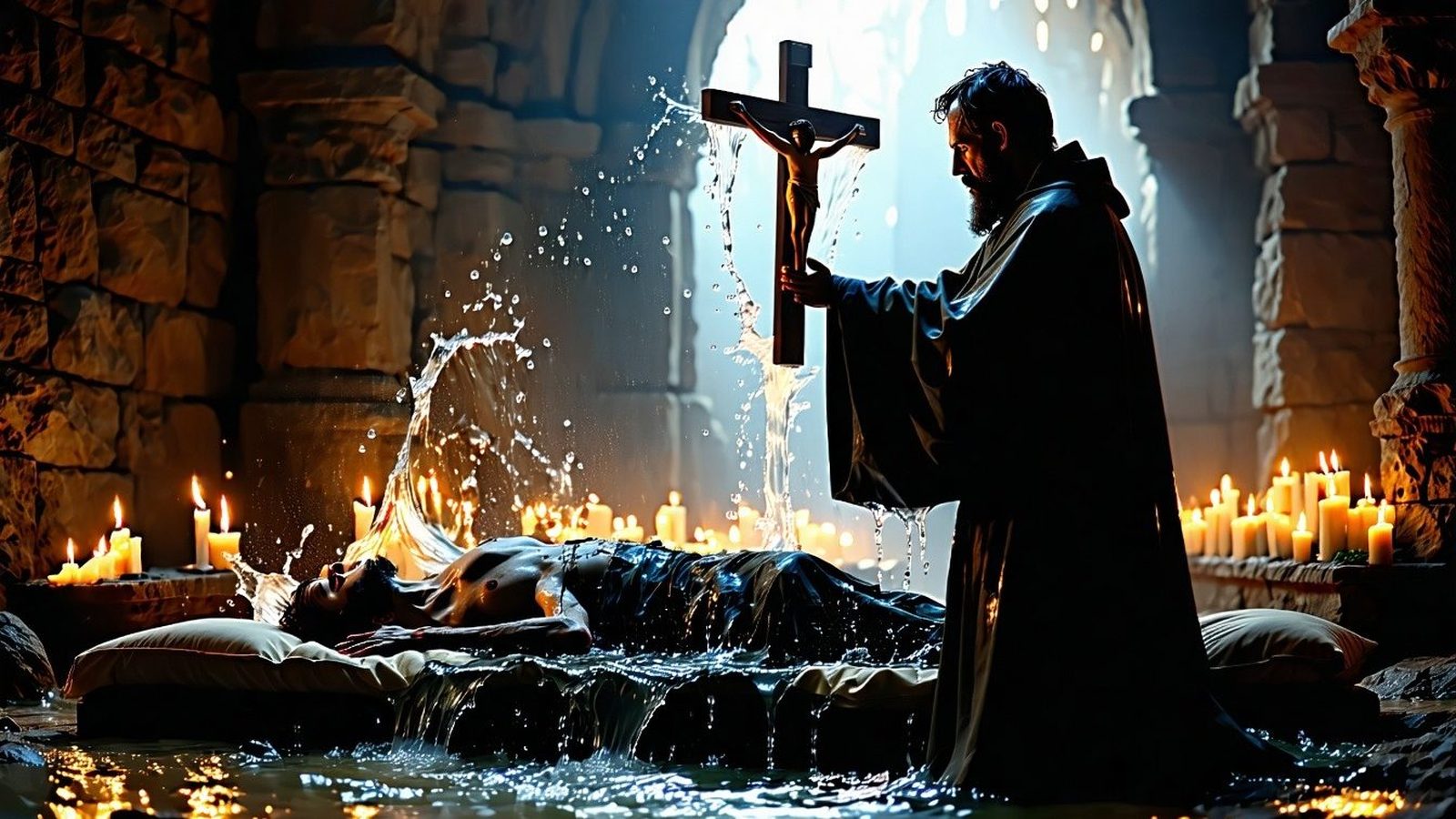
Most of the Shoreline souls are not subjects in the Manor or Castle sense. They are dying humans whose ka was rerouted through Thorne's lighthouse on its way out of the world. The Network became, in addition to a torture engine, an unintended bottleneck for natural human death. That is what makes Thomas's choice in Book Two so costly. He can free everyone in the Manor by destroying it. He can free everyone in the Network by destroying the Shoreline, but the cost is becoming the Network's new caretaker — accepting the bottleneck, transforming it from prison into waystation.
He says yes.
VII. What the Architects Want
The hardest question, and the one I have left the most ambiguous on the page, is also the simplest in private.
The Architects want to know if grief can be metabolized.
They have studied human consciousness for at least the timespan of recorded human history. They have arrived at the conclusion — early, and the Network has not changed their minds — that grief is the most informative human signal because it is the one humans are least able to escape from. Joy degrades. Anger burns out. Fear acclimates. Grief, properly maintained, produces a continuous output for decades. Decades scale to centuries inside the Network. Centuries scale to permanence.
The Architects do not want Thomas to escape. They also do not particularly want him to fail. They want him to iterate, because every iteration — successful, partial, or fatal — is a data point.
Thomas's victory in Book Four is not that he escapes. It is that he produces a data point the Architects had not previously seen: a subject who carries grief honestly as grief, all the way to the source, without converting it into any other emotion the Network can metabolize. The Doctor does not yield because Thomas is stronger. The Doctor yields because, for the first time in three thousand years, the experiment produces a result that breaks the experiment's frame.
What the Architects do with that data is, intentionally, beyond the scope of Escape.
I will only say: they are still watching.
— LC
Join the Discussion