Legacy of Iron - Chapter 3: First Contact
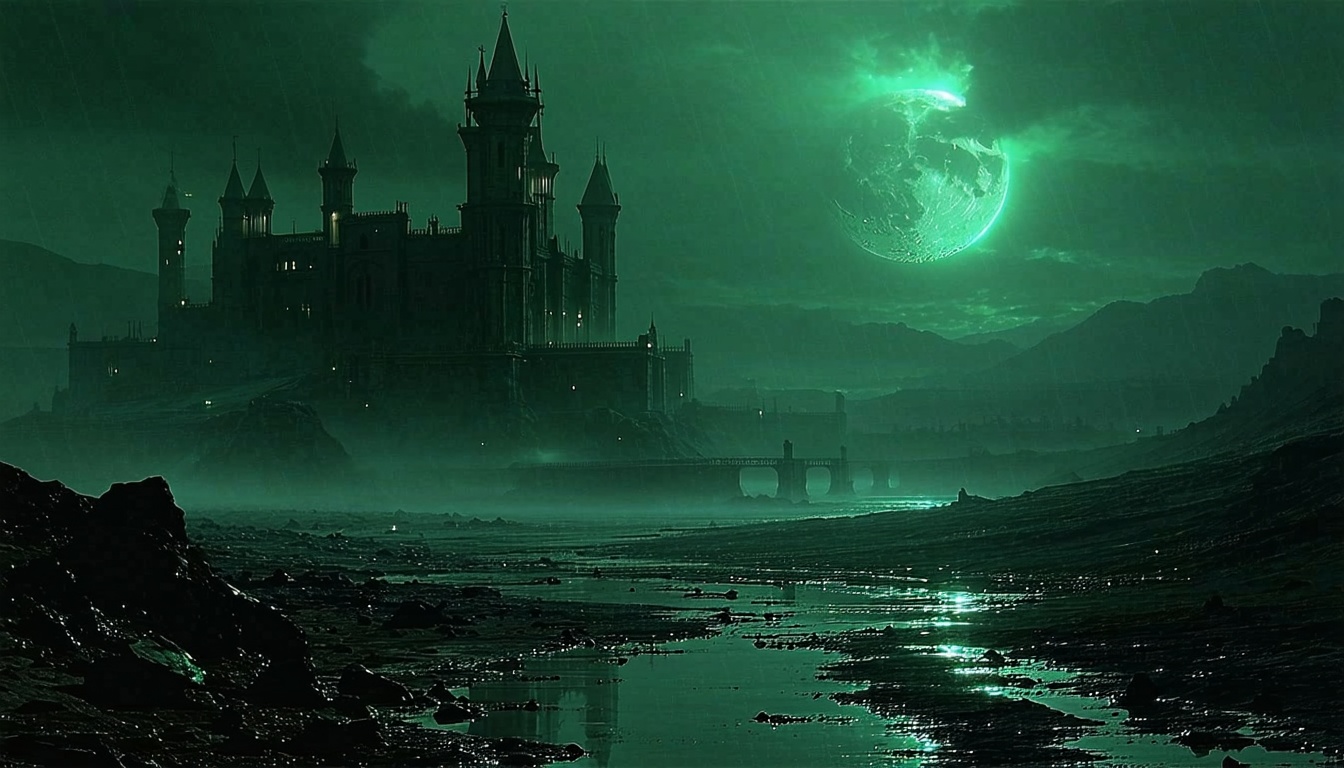
Theron began the day as every Scavenger began every day—with the Calibration.
He knelt beside the narrow cot in his assigned quarters, laid his instruments on the pressed cloth before him in the prescribed order: datapad, diagnostic scanner, personal toolkit, sidearm. Each item inspected. Each surface checked for contamination, moisture, wear. The datapad's housing was machined titanium—not cast or hammered but milled to tolerances that made Confederation metalwork look like children's clay. Its surface bore the Scavenger maker's mark: three concentric circles, the sign of a Master Fabricator whose workshop had produced the device to specifications measured in micrometers. The diagnostic scanner nested into a carrying case whose interior had been custom-molded to its exact dimensions—no padding needed, no rattling, every cubic centimeter of space serving a function. The personal toolkit unfolded from a case the size of his palm into sixteen precision instruments, each one slotting into the next with interlocking joints that clicked with the satisfied finality of a lock engaging. Even the sidearm's grip had been fitted to Theron's hand measurements during a Personalization Protocol performed at age fourteen, when every Scavenger received their first assigned equipment, shaped to their body as precisely as a second skeleton. The ritual took four minutes—always four minutes, never more, never fewer. His father had taught him at age six. His father's mother had taught her son at the same age. The Calibration predated the Collective's political structure by centuries, stretching back to the first Scavengers who'd realized that the machines they'd inherited would outlast them only if tended with absolute consistency.
"Precision sustains. Negligence erases." The words were spoken aloud, as tradition demanded. Even here, in a Confederation guesthouse that smelled of damp stone and improvised plumbing, the Calibration held. A Scavenger without his morning ritual was a Scavenger who'd forgotten what kept the darkness at bay.
He packed his instruments and rose. Through the thin wall, he could hear Mara running her own Calibration—the soft click of components being inspected, the murmured recitation. Kaelos would have completed his twenty minutes ago. The hardliner rose before dawn. Efficiency in all things, even sleep.
Kaelos. Theron's jaw tightened. The Collective Council had sent three representatives, and the faction politics had followed them across the wastes like a smell that wouldn't wash out. Kaelos represented the Ascendancy bloc—Scavengers who believed the Progenitor legacy made them humanity's rightful stewards. Integration meant absorption. Partnership meant hierarchy with the Collective on top. Mara leaned moderate, a pragmatist who followed evidence. And Theron—Theron was the scholar the Council sent when they wanted uncomfortable truths delivered in careful language.
Three factions. Three agendas. One assessment mission. The Collective's internal politics were as precisely maintained as its power grids, and twice as likely to overload without warning.
"They built this in six months?"
Mara's question cut through Theron's concentration. He'd been cataloging structural deficiencies—the mismatched building materials, the lack of proper spacing, the improvised infrastructure that violated every Scavenger planning protocol.
"Apparently." He stopped at a market stall where traders haggled without central authority. The smell of roasting meat and unwashed bodies filled the air. Smoke drifted from a makeshift chimney—ventilation that would never pass Collective safety standards. An improvised currency system. Pure market chaos. "No centralized distribution. No optimization."
"But it works." Mara gestured at the busy streets. Her pulse rifle stayed powered down—respect for their hosts. "People have food. Shelter. Medicine."
The streets were narrow. Unplanned. Buildings clustered in patterns that made no architectural sense. Materials varied building to building—stone, timber, salvage. A two-story structure of quarried limestone leaned against a wooden frame house that had been reinforced with scrap metal. The resulting architecture looked like a fever dream. Nothing matched. Nothing optimized.
Inefficient. But functional.
Theron pulled out his datapad and began recording observations. The Collective Council required detailed assessment. Every deficiency cataloged. Every weakness documented. Ammunition for the integration argument—proof that these people couldn't sustain themselves without Scavenger infrastructure.
A priority alert flickered in the corner of his display. Long-range telemetry from the eastern monitoring stations—the Progenitor structures were broadcasting at increased intensity. Coordinated transmissions between sites that had been dormant for centuries. The pattern analysis flagged it as anomalous but couldn't determine purpose. Theron filed the alert for later review. The Confederation assessment took precedence.
He noted the water system first. Aqueducts cobbled from Progenitor piping and hand-carved stone channels. Joints sealed with tar and hope. At least three points where leakage would create structural erosion within a decade. Possibly sooner if precipitation exceeded projected averages.
A Collective water system would last centuries without maintenance. This one might last years.
Yet it was flowing. Clean water reaching thirty thousand people through an impossible patchwork of engineering decisions that no rational planner would approve.
"The eastern district has a communal bathing facility," Mara said, reading from her own datapad. "Built from a repurposed Progenitor storage tank. Heated by redirecting exhaust from a salvaged generator."
"Redirect efficiency?"
"Twelve percent, maybe. Ninety percent waste heat."
Theron made a note. Waste. Everywhere, waste. Energy lost to friction, to poor design, to desperate shortcuts that prioritized immediate function over long-term sustainability.
They continued walking. Past a blacksmith hammering horseshoes from reclaimed steel. Past a baker pulling bread from a clay oven that leaked heat from three visible cracks. Past children running barefoot through puddles of gray water that pooled in the uneven streets.
Children. Laughing. Playing some game with rules Theron couldn't identify. Chasing each other around stacked crates, ducking under drying laundry strung between buildings. Their clothing was patched, mismatched, worn thin at the elbows and knees.
In the Collective, children were educated in structured learning centers. Monitored for developmental markers. Assigned roles based on aptitude assessments at age twelve—the Sorting, as families called it, though the official term was Optimal Placement Evaluation. A child's entire trajectory determined in a single week of testing: Keeper Caste for the technically gifted, Analyst Caste for the mathematically inclined, Civic Caste for the socially adept, Labor Caste for everyone else. Efficient. Predictable. Final.
These children were not optimized. They were wild. Noisy. Wasting energy on unstructured play that served no measurable developmental purpose.
One girl—perhaps seven, with tangled brown hair and a gap-toothed grin—crashed into Theron's legs at full speed. She bounced off, looked up, and froze. Staring at his Scavenger uniform. At the insignia. At the pulse rifle on his back.
"You're one of them," she said. Not afraid. Curious. "The ones from outside."
"I am Theron val Mechas. Representative of the Scavenger Collective."
"Do you have candy?"
Behind him, Mara stifled a sound that might have been a laugh. His chest loosened—an unfamiliar warmth, unexpected and strange. He wasn't sure what to do with it.
"I do not carry confections."
"That's dumb." The girl assessed him with devastating child-logic. "Everyone should carry candy. In case of emergencies." She thought about it. "Or just because."
Then she was gone, sprinting after her friends, shouting something about rules that Theron couldn't follow. Chaotic. Unpredictable. Entirely without optimization.
He resumed walking. The encounter lingered in his mind like an unresolved equation. In the Collective, a seven-year-old would have been in afternoon educational programming. Would have addressed him with proper protocol. Would have been optimized.
Would not have asked about candy with such devastating simplicity.
No Scavenger child would have crashed into a visiting dignitary and demanded confections. The thought should have confirmed Confederation inferiority. Instead it opened a door Theron hadn't known existed—a question about what was lost when you optimized everything, including the parts of childhood that had no measurable purpose except joy.
Theron dismissed the encounter and continued his assessment.
The market district expanded around a central square where traders displayed goods on wooden tables and salvaged metal shelving. No standardized pricing. No quality controls. No regulatory oversight. Merchants shouted competing claims. Customers argued. Someone was trading dried fish for medical supplies. Another stall offered Progenitor components—small ones, the kind the Confederation scavenged from ruins—alongside hand-knitted scarves and ceramic bowls.
The combinations were absurd. Alien technology next to domestic craft. Weapons beside children's toys. Everything jumbled together in a marketplace that operated on principles Theron couldn't define because they weren't principles. They were survival instincts.
A woman at a food stall noticed their uniforms and beckoned. "Visitors. Come. Try." She held out skewers of charred meat, glistening with some kind of sauce. Her smile was wide and genuine despite missing two teeth. "Best lizard in New Haven. My recipe."
"We don't—" Theron started.
Mara took a skewer. Bit into it. Chewed. Her eyebrows rose. "It's good."
The woman beamed. "Caught this morning. Eastern wall. Good hunting ground since the demons cleared out." She turned her smile on Theron. "The Council people say you want us to join your cities. Use your systems."
Theron accepted a skewer. The meat was tough, heavily spiced, smoky from the crude fire. Nothing like the nutritionally calibrated food in Collective dining facilities. "The Collective offers structured integration. Resource optimization. Infrastructure support."
"My husband died fighting demons." The woman's smile didn't waver, but something hardened behind her eyes. "Under this sky. On these streets. So I could sell lizard meat from my cart. You think I'd trade that for your optimization?"
She said the word like it tasted bad. Like it was the worst thing she could imagine.
"Your infrastructure is failing." Theron weighed each word before releasing it. "Power systems collapse. Medical equipment—"
"Collapses and gets fixed. By us. With our hands." She flipped skewers with practiced efficiency. "Your people hid. Smart, maybe. But we fought. We earned these streets. Earned the right to sell bad lizard meat on them."
Theron opened his mouth. Closed it. Cataloged the interaction. Moved on.
Kaelos would have called the woman an asset-management failure. Would have noted her husband's death as a resource loss, her cart as an inefficiency, her defiance as a behavioral deviation requiring correction through proper incentive structures. The Ascendancy bloc saw the Confederation as a problem to be solved, not a civilization to be understood.
Theron was beginning to suspect the problem was more interesting than any solution.
They stopped at a small plaza where a memorial stood in the center—rough stone carved with thousands of names. The monument rose twice Theron's height, tapering to a rough point. Wildflowers grew from cracks in its base. Someone had left a child's toy at the foot—a wooden horse, painted blue, weathered by rain.
"Tomas Grenn," Theron read. The first name carved at the top, deeper than the others, surrounded by elaborate scroll-work. "Damien the Scholar. Elena Morevan."
Hundreds more. Names stacked in columns that continued around all four sides of the stone. Names of people who'd fought and died so that the rest could argue about candy and lizard meat and bad infrastructure.
Theron's hand moved to his chest—three fingers pressed flat over his heart, then extended toward the memorial. The Acknowledgment. A Scavenger gesture older than the Collective itself, performed when standing before the machinery of the dead. Every decommissioned system, every collapsed facility, every artifact too damaged to maintain received the same gesture. A recognition that something had served its purpose and earned its rest.
He'd never performed it for people before. The gesture was for machines. For the sacred technology they preserved. But standing before these names—carved by hand into rough stone with tools that left irregular marks—the distinction between human sacrifice and mechanical service mattered less than the fact that both had kept something alive.
Mara noticed. Said nothing. But her own hand twitched toward the same gesture before she caught herself.
"These people fought demons." Mara's gaze lingered on the names carved into stone. "Won. Rebuilt civilization. Without our technology. Without our infrastructure."
"At terrible cost." Theron studied the names. His datapad hung forgotten at his side. The cataloging instinct had stopped. Something else was operating now—something he didn't have a protocol for. "Most of these casualties were preventable with proper equipment. Proper retreat strategies. Proper coordination."
"Proper retreat would have meant hiding. Like we did." Mara met his eyes. Held them. "They didn't retreat, Theron. They fought. They activated the Unmaking Engine. Sealed the Wurm Lords. They could have hidden. They chose to stand."
An old man sat on a bench near the memorial. Weathered. Scarred. Missing his left arm below the elbow—the stump wrapped in clean linen. He watched the Scavenger delegation with rheumy eyes that had seen worse than foreign visitors.
"My son's on there," the old man said. He pointed to a name partway down the third column. "Corren. Eighteen years old. Held a breach for seven minutes while evacuating civilians from the lower district." His voice was steady. Matter-of-fact. The grief had long since calcified into something harder. "Seven minutes. Against three demons. So forty-two people could reach the shelters."
Theron ran the calculation automatically. One soldier against three Class-B threats. Survival probability less than two percent. Duration expectation under ninety seconds.
Seven minutes was impossible.
"Your tactical analysis would say he should have retreated," the old man continued. "Preserved himself. Optimized survival."
"Yes," Theron said. "Tactically, retreat was the correct—"
"Forty-two people are alive because he didn't retreat." The old man's eyes were hard. Not angry. Just certain. The certainty of a man who'd paid for truth with something that couldn't be repaid. "My grandchildren are alive because an eighteen-year-old did something stupid and impossible and held a breach for seven minutes."
Theron said nothing. His datapad remained at his side. There were no categories for this. No optimization protocols that accounted for what happened when someone chose to die so others could live.
The Collective's tactical doctrines were built on rational action. Preservation of assets. Optimal deployment of resources. No scenario in which a single soldier holding an indefensible position for seven minutes qualified as anything but waste.
Except forty-two people were alive.
They continued walking. The old man watched them go. His remaining hand resting on his knee. Patient. Permanent. Like the memorial beside him.
Theron considered the memorial. The stone was rough. Unpolished. Names carved by hand with tools that left irregular marks. Not machine-precision. Not optimized. But deliberate. Each letter cut by someone who cared enough to make it permanent. All remembered.
"Maybe efficiency isn't the only measure of civilization," Mara said, breaking a silence that had stretched for two blocks. "Maybe courage counts too. Maybe choosing to fight instead of hide."
The words settled into Theron's mind. Uncomfortable. He cataloged them alongside the other data points from the day—the water system, the market inefficiencies, the food stall—and filed them in a category that didn't exist in his assessment framework. Unclassifiable.
Theron resumed walking. His stride was measured. Deliberate. The same pace he maintained during facility inspections, when emotional responses were irrelevant and only data mattered. He opened his datapad and began recording again, fingers moving over the screen with practiced efficiency.
"Assessment note: Confederation population demonstrates unexplained resilience metrics that exceed projected models. Recommend extended observation period. Cultural variables may affect infrastructure sustainability calculations in ways current models do not account for."
Clinical. Precise. The words of a Scavenger doing his job. They sat on the screen like a wall between Theron and whatever had shifted in the plaza.
The Collective had survived by avoiding the demon war entirely. Sealing territories. Maintaining patrol routes. Waiting for contamination to pass. Preserving infrastructure while the world burned around them. The rational choice. The correct choice.
The Confederation had fought. Lost thousands. Rebuilt from rubble. Their approach violated every optimization protocol the Collective had refined over centuries.
Both survived. The Collective through discipline. The Confederation through something Theron's models couldn't quantify.
He would not call it courage. That was Mara's word—emotional, imprecise, loaded with value judgments that had no place in a technical assessment. He would call it an anomalous survival variable. A factor requiring study before it could be dismissed or integrated into existing frameworks.
"The Council will want quantifiable analysis," he said. His voice was careful. Measured. The voice of a man constructing barriers against conclusions he wasn't ready to reach. "Recommendation: extend the assessment period. One day is insufficient to evaluate a civilization of thirty thousand. Especially one that—" He stopped. Chose his words with the deliberation of an engineer selecting the right tool. "—that deviates from projected behavioral models as significantly as this one does."
"Extended assessment." Mara studied his face. "That's not what the Council sent us to recommend, Theron. They want integration timelines. Control strategies."
"The Council wants accurate data. Premature conclusions serve no one." He heard the rigidity in his own voice and recognized it for what it was—the sound of a man reinforcing doctrine against evidence that threatened to erode it. A Scavenger reflex. When the data doesn't fit the model, question the data. Never the model.
But his hand moved to his chest. Three fingers pressed flat—the ghost of the Acknowledgment he'd performed at the memorial. He caught himself and dropped his hand, but the gesture had already happened. Muscle memory operating beneath conscious control. As if his body had accepted something his mind still refused to examine.
Kaelos would have dismissed everything they'd seen. The candy girl, the lizard vendor, the seven-minute breach. All inefficiencies. All failures of optimization. All proof that the Confederation needed Collective guidance.
Theron wasn't ready to disagree with Kaelos.
But he wasn't ready to agree, either. And for a man who'd spent his career in the clarity of certainty, that ambiguity was more unsettling than anything else he'd encountered in New Haven.
He continued recording observations. The datapad filled with metrics—structural deficiencies, resource waste, infrastructure failures. Clean data. Quantifiable. Safe.
The names on the memorial were none of those things.
He filed them anyway. Under a heading he'd never used before: Unresolved.

Join the Discussion