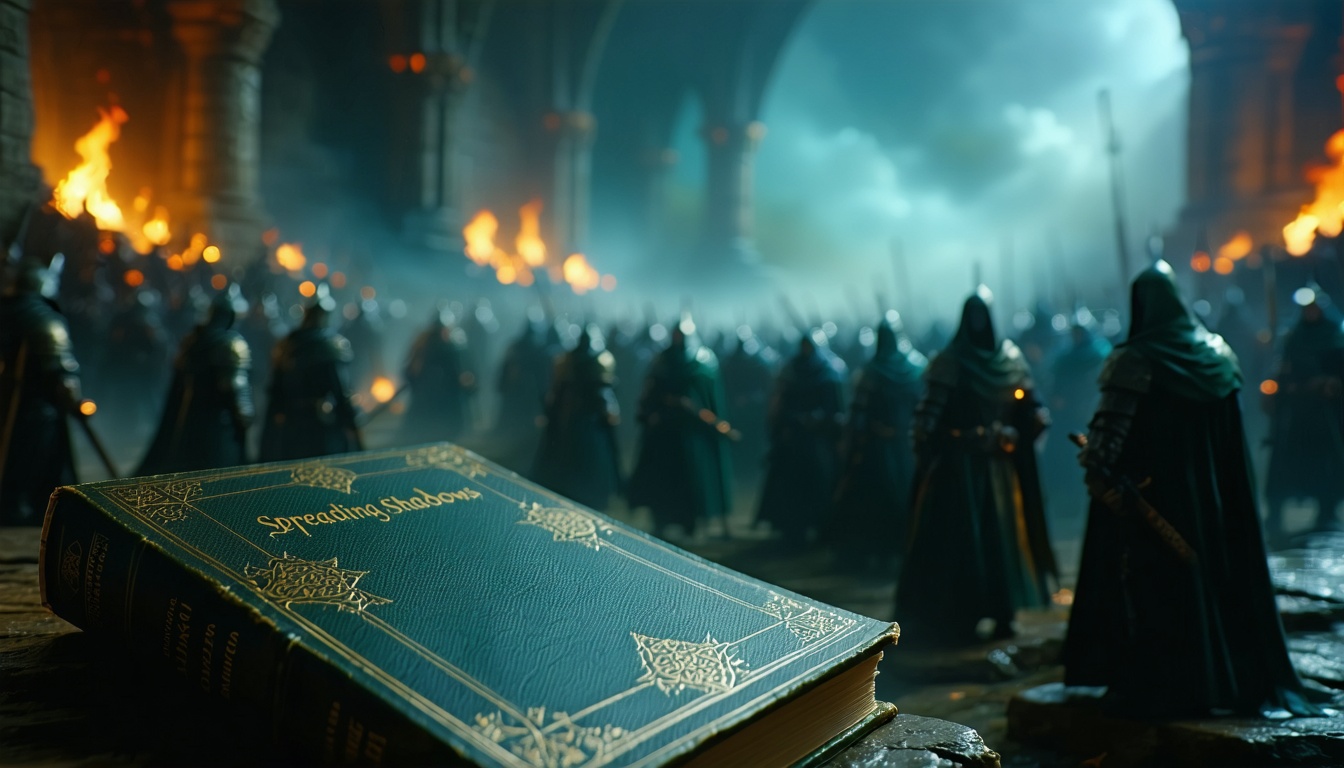
Spreading Shadows - Chapter 1: The War Council
"Eleven ships, Admiral. All confirmed."
Marcus's voice echoed off the polished walls of the war room, his words falling into a silence so complete the soft hum of the air recyclers three floors below reached him. The holographic display at the center of the table cast blue light across the faces of the men and women who controlled humanity's military forces—faces draining of color as his briefing continued.
The war room itself had been built for one purpose: keeping secrets. Nestled in the heart of the newly christened DDI Headquarters, it sat two hundred meters beneath the surface of New Geneva, shielded by layer upon layer of reinforced alloy and the kind of surveillance countermeasures that made even thinking about espionage exhausting. The air tasted sterile, recycled through so many filters it had lost any trace of the world above. The walls were smooth and curved, designed to prevent any corner where shadows might gather, where something might hide.
Three months since Sanctuary. Three months since Marcus had watched good people die in corridors that twisted in directions geometry shouldn't allow. Three months since he'd helped carry a seven-year-old girl out of hell, her eyes holding something ancient and terrible, her small hand gripping his with the strength of absolute trust.
He pushed those memories aside. There would be time for nightmares later. There was always time for nightmares.
Admiral Yoshida leaned forward, her silver hair catching the holographic light. Deep lines bracketed her mouth—lines Marcus was certain hadn't been there at the start of his briefing. "Walk us through the trajectory analysis again, Mr. Reeves."
"Of course, Admiral." Marcus manipulated the holographic controls, and the display shifted. Eleven red markers hung in the darkness of simulated space, each one representing a corrupted vessel. Each one representing thousands of deaths waiting to happen. "Based on deep-space sensor data and the predictive models developed by Dr. Chen's team, all eleven vessels are on approach vectors toward populated systems. The closest—" he highlighted a marker pulsing an angry crimson, "—will reach the Kepler shipping lanes in approximately fourteen months. That's a sector with eighty-three inhabited worlds and a combined population of over two billion people—one cluster among more than two hundred settled systems spanning roughly thirty light-years of human space."
"Fourteen months." Admiral Chen's voice was quiet, but it carried the weight of command. He sat at the head of the table, his uniform immaculate, his expression giving nothing away. Lucas's father. The thought twisted in Marcus's gut every time he saw the man. Lucas, who had stayed behind. Lucas, whose body they'd never recovered. Lucas, whose sacrifice had bought them the minutes they'd needed to escape. "And the others?"
"Staggered arrivals over the following eighteen months. The last vessel won't reach human-occupied space for approximately three years." Marcus pulled up another display—casualty projections, ship capabilities, defensive scenarios. Numbers that made his throat tight. "But Admiral, I need to stress—these projections assume the vessels maintain their current velocities. The data from Sanctuary suggests they can accelerate when pursuing targets. If they detect populated systems..."
He didn't finish the sentence. He didn't need to.
The silence stretched. Outside the war room, Marcus knew, the new DDI headquarters buzzed with activity. Scientists analyzing the fragments they'd recovered from Sanctuary. Engineers working on weapons that might—might—pierce corrupted hulls. Intelligence officers piecing together a picture of an enemy that defied conventional analysis. All of it happening because three months ago, Rylee Voss and her team had limped back from a rescue mission that should have been routine and delivered proof that humanity was no longer alone in the universe.
Proof that something was hunting them.
"The Hollowing." Admiral Peterson spoke the word like a curse. He was the oldest person in the room, a veteran of three colonial conflicts, and his hands shook slightly as he reached for his water glass. "That's what you're calling it."
"That's what the survivors called it." Marcus thought of Kate, her small voice steady as she described what she'd seen. What she'd felt. The way the corruption spread like a living thing, transforming everything it touched. "The name seems... appropriate."
"Names are irrelevant." Admiral Chen's gaze hadn't left the holographic display. "What matters is whether we can stop it."
Marcus hesitated. This was the part of the briefing he'd been dreading.
The part where hope went to die.
"Our current projections suggest conventional weapons are marginally effective against corrupted vessels," he said carefully. "The data from Sanctuary indicates that concentrated fire can destroy smaller craft, but the corruption adapts. Learns. What works once may not work twice."
"Then we develop new weapons."
"We're trying, Admiral. But the Hollowing isn't just a physical threat. The corruption affects..." Marcus struggled to find words that wouldn't sound insane. "It affects reality itself. The geometry of the corrupted areas. The way time flows. Our scientists are working around the clock, but they're dealing with something that breaks the rules we've built our entire technological civilization on."
Admiral Yoshida's jaw tightened. "Are you telling us this thing can't be beaten?"
"I'm telling you that beating it will require us to think differently than we ever have before." Marcus brought up a final display—a small file marked with the highest security classification the DDI possessed. "Which brings me to the survivor."
The weight of their attention settled over him, the sudden intensity that came with discussing the classified details even most DDI personnel weren't cleared to know.
"The Morrison girl." Admiral Chen's voice was flat. Controlled. But something flickered in his eyes—something that might have been interest or might have been calculation. "The seven-year-old."
"Kate Morrison, yes. She was on Sanctuary with her parents when the corruption began spreading. Both parents were lost during the initial outbreak. She survived alone in the compromised sections for approximately six days before Bravo Team located her."
"Impossible." Peterson shook his head. "No one survives that long in corrupted zones. Your own team barely lasted hours."
"Time works differently in corrupted areas," Marcus explained. "Our chronometers showed inconsistent readings throughout the operation. What felt like hours to us may have been days in normal space, or vice versa. Kate spent what she experienced as six days, but the dimensional distortion means we can't be certain how much time actually passed from her perspective."
"Yes, sir. That's precisely why she's significant." Marcus pulled up Kate's file, though he kept the image pixelated. She was a child, not a weapon, no matter what some of the analysts wanted to treat her as. "During her extraction and subsequent debriefing, Kate demonstrated an unusual... awareness of the Hollowing. She could sense it before sensor equipment detected anything. She knew where the corrupted zones would spread before they spread. She warned the extraction team about threats that hadn't manifested yet."
The admirals exchanged glances. Marcus could practically hear the calculations happening behind their eyes, could see the moment when Kate stopped being a traumatized little girl in their minds and started becoming an asset.
He hated himself a little for enabling that transformation. But they needed to know. Humanity needed every advantage it could get.
"How is this possible?" Admiral Yoshida asked.
"We don't know. Dr. Chen—" Marcus nodded toward Admiral Chen, "—has assigned his best researchers to the question. The leading theory is that her extended exposure to the corruption created some kind of... connection. A sensitivity to its presence."
"Can it be replicated?"
The question came from Admiral Chen, and there was nothing soft in it. No consideration for the fact that they were discussing a seven-year-old girl who had watched her parents die, who woke up screaming most nights, who still flinched at shadows in ways that made Marcus's heart ache.
"Unknown, sir. Our scientists are reluctant to attempt replication given the..." He paused, choosing his words carefully. "Given the ethical implications."
"The ethical implications will matter significantly less if eleven corrupted vessels reach populated systems." Chen's expression didn't change. "I want a full study. Complete analysis of her abilities and their potential military applications."
"With respect, Admiral, she's a child—"
"She's a resource." Chen cut him off, voice sharp as a blade. "One we cannot afford to waste. My son—" He stopped. His jaw tightened—there and gone so fast Marcus might have imagined it. "Sacrifices were made to recover this intelligence. We will use every tool at our disposal."
The mention of Lucas hung in the air between them. Lucas, who had been the admiral's only child. Lucas, who had stayed behind so others could escape. Lucas, who Admiral Chen had never once mentioned publicly, never once mourned where anyone could see.
"The girl is currently in our medical wing," Marcus said quietly. "Chelsea Park—one of the survivors from Bravo Team—has been assigned as her primary caretaker. The arrangement seems to be helping Kate's psychological recovery."
"Recovery is secondary to utility." Chen's tone allowed no argument. "I want regular reports on her abilities. Any development, any change, any indication that her sensitivity is growing or diminishing. Is that understood?"
Marcus wanted to argue. Wanted to point out that Kate was a person, not a sensor array. That she'd already lost everything and didn't deserve to be treated like a piece of equipment.
Instead, he said, "Yes, Admiral."
Because this was war now.
And in war, principles became luxuries.
The briefing continued for another two hours. Marcus walked the admirals through defensive scenarios, evacuation protocols, and the preliminary designs for early warning systems that might give populated systems precious hours to prepare before corrupted vessels arrived. He answered questions about the Hollowing's apparent intelligence, its ability to control and direct corrupted vessels, its hunger for human minds. He described the horrors of Sanctuary in clinical terms, stripping away the nightmares to present clean data.
By the end, the admirals looked like they'd aged years. All except Chen, who looked exactly as he had at the start—hard, controlled, and absolutely determined.
"This information doesn't leave this room," Chen said as the briefing concluded. "The general population is not ready to know what's coming. We will release sanitized versions as necessary to prepare for evacuation scenarios, but the full truth of the Hollowing remains classified. Am I clear?"
Murmurs of agreement circled the table.
"Good." Chen stood, and the other admirals rose with him. "Mr. Reeves, I want daily briefings from this point forward. Any development, any change, any new data—I want to know about it immediately."
"Yes, Admiral."
"And the girl. Kate." Chen paused at the door, not looking back. "Schedule an evaluation with my analysts for tomorrow morning. I want to see these abilities for myself."
Marcus's hands curled into fists at his sides. He forced himself to unclench them. "I'll make the arrangements."
"See that you do."
The admirals filed out, leaving Marcus alone in the war room with the blue glow of the holographic display and the weight of everything he couldn't say. Eleven ships in the darkness, approaching like inevitable doom. A seven-year-old girl who had survived the unsurvivable. And a military command that saw her as a tool rather than a person.
He shut down the display and gathered his notes with mechanical precision. Outside the war room, DDI headquarters hummed with purpose—humanity's best and brightest working around the clock to find solutions to an impossible problem. The corridors were clean and well-lit, designed to project an atmosphere of control and competence.
It was a lie, of course. No one here knew what they were really dealing with. Not even Marcus, who had stood in corrupted halls and watched reality itself twist into impossible shapes.
But the lie was necessary. Hope was necessary. And if they had to build that hope on the foundation of a seven-year-old girl's trauma, then that's what they would do.
He found Chelsea in the medical wing's observation area, watching through a one-way window as Kate sat cross-legged on her bed, drawing. The girl's dark hair hung in her face as she worked, her hand moving across the paper with an intensity that belied her youth.
"How is she?" Marcus asked quietly.
Chelsea didn't look away from the window. "She slept for three hours last night. A new record."
"And the nightmares?"
"Every time." Chelsea's voice was hollow. "But she's getting better at waking up quietly. Doesn't scream as much anymore. Just... cries."
Marcus watched Kate through the glass. She'd finished her drawing and was holding it up to examine it, her head tilted to one side. From this angle, he couldn't see what she'd created, but his throat tightened at her expression.
"Admiral Chen wants her evaluated tomorrow. His personal analysts."
Chelsea's reflection in the glass went rigid. "Absolutely not."
"I don't have a choice."
"She's seven years old, Marcus. She watched her parents die. She survived things that would break most adults. And now they want to poke and prod her like she's some kind of—"
"I know." Marcus kept his voice gentle, though anger churned in his gut. "Believe me, I know. But Chen's not asking. And right now, he holds all the cards."
"So we just let them use her?" Chelsea finally turned to face him, and the fury in her eyes was a physical thing. "Let them treat her like a weapon instead of a child?"
"No." Marcus met her gaze steadily. "We protect her as much as we can. We make sure she's treated with care, with compassion. We make sure she knows that someone in this place actually gives a damn about her as a person." He paused. "And we pray that her abilities give us the edge we need to survive what's coming, so this doesn't all be for nothing."
Chelsea stared at him for a long moment. Then she turned back to the window, her shoulders slumping. "Sometimes I hate you for being right."
"Sometimes I hate me too."
Inside the room, Kate had set down her drawing and was staring at the wall. Not at the wall. Through it. Her eyes had gone distant and strange, focused on something no one else could see.
"She's doing it again," Chelsea whispered.
"Doing what?"
"Looking. That's what she calls it. Looking at the dark."
A chill ran down Marcus's spine. "What does she see?"
"Ships." Chelsea's voice was barely audible. "She sees ships in the darkness, Marcus. Moving toward us. Getting closer every day."
Marcus watched Kate's small form, silhouetted against the sterile white of the medical room. A seven-year-old girl, alone and traumatized, carrying knowledge that generals and admirals would kill for.
Humanity's early warning system. Their unlikely hope.
He just prayed it would be enough.
Through the glass, Kate's lips moved. She was speaking, though no sound reached them through the barrier. Chelsea leaned forward, her face pale.
"What is she saying?"
Marcus stepped closer to the glass. Kate's expression had shifted from concentration to something that looked terribly like fear. Her lips moved again, and this time he could read them.
"They see me."






Join the Discussion