The Bishop's Legacy - Chapter 2: The Cabin
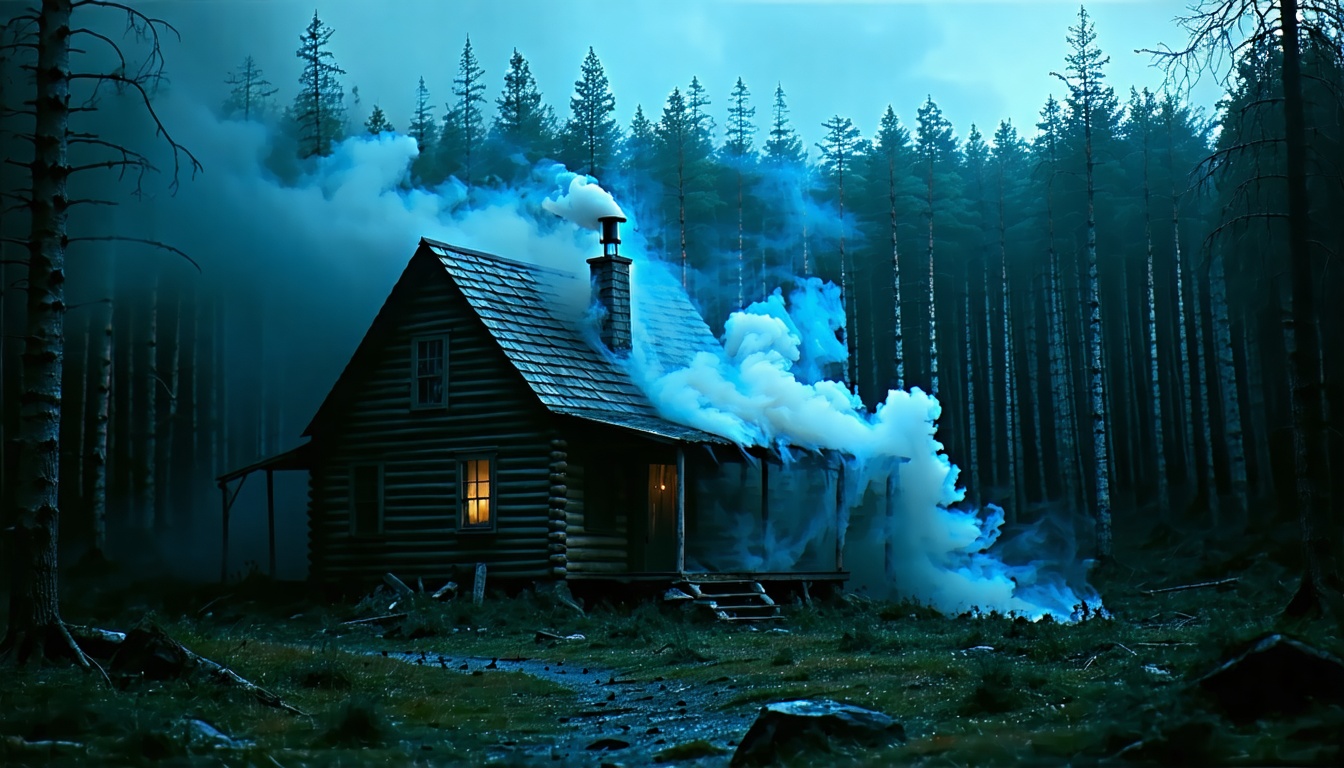
"We're here."
The booming voice of the driver woke Jeremy up from his slumber with a jolt. Blinking, groggy, in the backseat of the black Ford SUV he'd spent the last four days cooped up in. Disoriented—it took him a minute to remember his journey and mission.
Or his father's recent death.
Loss hit him all at once—a hollowing-out behind his ribs, the kind that made breathing feel like work. His throat tightened and his eyes burned. He'd spent the better part of the trip crying, replaying every moment with the Bishop until the memories blurred together and the grief circled back on itself.
He forced his expression to go flat. Composed. The mask his father had taught him to wear.
Empty fast food wrappers surrounded him in the backseat like a disgusting fort and the air smelled musty and rotten—the fast-food wrappers accounted for some of it, but underneath lingered a sulfurous tang that clung to the demon driver like a second skin. He hated every single moment he had spent in this vehicle traveling to Ohio.
Four days of highway monotony, punctuated by drive-throughs and gas station bathrooms and the demon's infuriating silence. Jeremy had spent the first day numb, staring out the window while the California coastline gave way to desert, then farmland, then the flat grey nothing of the Midwest. By the second day the numbness had cracked open and the grief poured through—ugly, convulsive sobbing that he couldn't control, that shook his thin frame until his ribs ached. The demon hadn't reacted. Hadn't offered comfort or even glanced in the rearview mirror. It simply drove, mile after mile, as if the boy weeping in the backseat were cargo.
On the third night, somewhere in Indiana, Jeremy had dreamed of Leopold. Not the Leopold who died on the dock—the earlier one, the one who sat with him in the study and taught him to play chess. In the dream Leopold moved his bishop diagonally across the board and said, "Every piece has a purpose, Jeremy. Even the pawns. Especially the pawns." Dream-Leopold looked up from the board and his face was whole, unmarked, his eyes warm with the particular pride he reserved for Jeremy alone. "You understand this better than anyone."
Jeremy had woken gasping, his face wet, the dream's warmth already evaporating in the sulfurous air of the SUV. He'd pressed his forehead against the cold window glass and whispered the chess lesson back to himself like a prayer. Every piece has a purpose. Even the pawns. He'd spent the rest of that night staring at the ceiling, mapping out his strategy. The children. The distractions. The hospital. Megyn. Each piece positioned on the board Leopold had designed, waiting for the hand that would set them all in motion.
His hand now. No one else's.
"We're here," the driver repeated, looking at him in the mirror.
"I heard you the first time," he said, grabbing a half-empty drink from a cup holder. His mouth tasted horrible, like cotton. He took a sip of the diluted beverage and groaned. "I'm not deaf."
"My apologies, sir."
The driver was the last remnant of what he had from the previous mission out in California. He had guarded Jeremy at the shipyard and dragged him away after the Bishop was killed.
He followed orders well enough. Fighting, though…not so much. A bottom-tier demon in a less than exceptional vessel. The last demon they had summoned before Leopold died, before that sycophantic priest murdered him.
Jeremy hadn't wanted to flee the docks, nor leave his father, but the hunter was the real danger. The Bishop's stories about Arthur Vangeest made it clear—standing in his way meant death.
Demon Hunters: a festering rot as far as Jeremy was concerned. He would have killed him to rid the world of another of his kind. They murdered and butchered everyone, working outside the law. Still, fighting him was problematic: it wasn't a fight he would willingly engage in while he didn't have to.
Jeremy yawned and stretched, rolling down the window. Unfamiliar scenery—and they weren't at a restaurant.
"Where is here, exactly?"
"Akron, Ohio. We're at the location you requested. Megyn Willford's hideout."
Jeremy perked up. He hadn't slept that long, had he? Already at their final destination. Megyn's home away from home. However, when he glanced out the window at the service station, a worn and abandoned building sat off Route 43, miles from the nearest interstate.
It didn't even connect back to I-76 for twenty miles. The building was collapsing in on itself and appeared at least thirty years old. The awning over the old pump island had buckled in the middle, sagging like a broken spine, and weeds had pushed through every crack in the concrete. A faded sign hung at an angle from a single rusted bolt—the letters J-O-H-N still legible, the rest bleached away by years of sun and rain. Johnson's? Johnston's? The station's identity had faded with its paint.
"This is the place?" He leaned forward, squinting at the sagging roof. It didn't look livable at all.
"Yes."
"You're sure?"
"Positive."
Jeremy shrugged. Megyn had been living here for months, hiding away until the time came for the events to begin. She had three loyalists staying with her, caring for her and protecting her from discovery. Jeremy had trained with them for years, back when he and Megyn were learning under the Bishop.
Jeremy, not Megyn, had accompanied the Bishop to Everett. He was the favorite, not her.
Bishop Glasser had recruited dozens of people to his cause over the last forty years, but most of them were normal civilians who believed he did important work. They followed him, but offered little except their blind devotion.
Useless, every last one of them.
Jeremy groaned at the idea of living in the service station. He had spent the last few months living a life of opulence with the Bishop in Everett. This would not do.
At least they wouldn't have to be here for long.
"This dump is the best we can do? There are no other hideaways or safe houses in the area?"
"I don't know, sir."
"How can you expect me to live here even if only for a few days?"
"I don't know, sir."
Jeremy waved his hand in the air. It was a rhetorical question, but sometimes this particular demon was too stupid to understand conversational nuances.
Of course this was the best they could do right now. Anything more elaborate ran the risk of discovery, and even as important as Megyn was to the cause she wasn't worth more resources wasted on her.
"Alright. Come on, let's go."
Jeremy opened the door and stepped out of the car, and the demon moved to follow. They headed across the cracked pavement of the street to the dingy service station that would serve as his home for the next couple of days.
He had to hope that the inside was better than the outside.
***
The door opened before he could knock on it and a woman stood inside. She had a pistol in her hand, hanging down at her side instead of aiming at him.
Mid-fifties in appearance, though from experience she was much younger. A rat face and beady eyes. Bishop Glasser had assured him in the past that she was once a beautiful young woman, but Jeremy didn't believe him. Leathery and awful skin adorned her face and she smelled rancid.
He had requested that Leopold send her with Megyn so many months ago so he wouldn't have to see her anymore. She had a soft spot for him, though, and he could press all the right buttons to get his way.
"Come now, Aunt Sheila. Is that anyway to greet your favorite nephew?"
A moment passed, and then her eyes went wide. "Jeremy?"
"The one and only," he said, smiling at her. "Aren't you going to give me a hug?"
She slipped the gun back into the waist of her pants and rushed out the door to him. She squeezed him tightly, and he squeezed back, careful not to breathe during the embrace. It was worse than normal: she smelled like she hadn't showered in weeks, but it might have been months.
"What are you doing here?" She pulled back, still gripping his arms, her chest heaving from the rush to the door. "Aren't you supposed to be in India by now?"
"That was the plan," he said. "Things have changed though and we have new business to attend to. I'd rather not talk about it out here. Is there somewhere inside we can talk?"
"Certainly. Megyn will be thrilled to see you."
He doubted it. "I can't wait," he lied. "I've been dying to see my sister for months."
Of course, Megyn wasn't his real sister any more than Leopold had been their real father. Nor was Sheila his real aunt. Leopold formed them into a family. His mission became their reality. He offered them a way forward and anchored their extended family together.
Without him, the family was on the verge of disintegration. Jeremy had to hold them together at least a little while longer.
He'd mapped it all out during the drive—every child, every cell, every possible outcome. Thirty children spread across the country, and Leopold had ranked them all privately, confiding only in Jeremy. Tier one was obvious: Jeremy himself, Megyn, and a boy named Elias in Seattle whose telekinetic range exceeded even Megyn's. After that came Curtis in Minnesota, Portia in Memphis, the twins in Denver—strong enough to matter, but not irreplaceable. Everyone else was expendable. Leopold had never used that word, but Jeremy understood the math even when the Bishop dressed it in softer language.
He'd already sent the activation orders. The expendable ones would go first—fires, riots, chaos that the Church couldn't ignore. Most of them would be captured. Some would be hurt. A few might die. Jeremy had turned these possibilities over during the long hours between Indiana and Ohio, the way Leopold used to turn chess pieces in his fingers, and found he could think about dead children with a steadiness that would have pleased his father. Thirty distractions. Even if the Church contained half of them in a day, the rest would keep their resources scattered for long enough.
And days were all he needed.
The hospital in Akron was the real target. Not because of what it was, but because of what it sat on—a convergence point the Bishop had identified decades ago, a place where the barrier between the physical and the spiritual ran thin as tissue paper. Leopold had spent years positioning assets near it, waiting for the right moment. The right catalyst.
That catalyst was Megyn.
She didn't understand it yet. She thought she was a soldier in her father's army, waiting for orders. She didn't understand that she was the weapon—that everything Leopold had done, every ritual, every enhancement, every year of isolation in this rotting service station, had been designed to prepare her for a single act at a single location. Jeremy understood because Leopold had told him, late one night in the Everett study, speaking in the hushed tones of a man revealing a secret he'd carried for decades.
"She won't survive it," Leopold had said, moving his queen across the board. "But what she opens will never close."
Jeremy had nodded as though he understood. He'd been thirteen. He hadn't understood at all. Now, at fifteen, with his father's blood still metaphorically on his hands, he understood perfectly. And the understanding didn't bother him the way it should have.
That was the part that frightened him most.
The memory of that moment on the docks when Bishop Glasser had been shot in the face made Jeremy's fists clench. His vision narrowed until the grimy walls of the service station blurred to nothing and all he could see was the dock, the gun, the spray of red. His lungs locked. His fingernails bit crescents into his palms, and when he finally exhaled the breath came out shaking, ragged, like something torn loose from inside him. For a moment the careful composure he'd built threatened to crack wide open.
He forced himself to breathe. Slow. Measured. The mask couldn't slip. Not here, not now. He would have time to grieve later—time to scream and rage and tear the world apart—but first he had work to do. He needed to hold his family together until they had gotten revenge.
The Bishop's vision died unrealized with him, but as long as Jeremy lived, the plan would continue. It would, in fact, evolve and become even stronger. Jeremy would find a way to finish what Leopold Glasser had started back in Everett.
"Have your driver pull the car out back," Sheila said. "There's a little shed he can park in so he's off the road and out of sight. We've boarded up the windows and locked the place down so we don't want to draw any attention."
Jeremy turned and nodded to the driver, letting him know it was alright to follow Sheila's order. Then he followed Sheila into the service station. Even with how disgusting and rundown the place was, he was glad to be here because it meant the beginning of the mission he'd set for himself after the Bishop died.
He could have gone anywhere—children stationed across the country, any one of them eager to follow orders. But Megyn was the key. The most powerful of them, sitting on the most important convergence point, in the city where the Bishop's enemies had struck hardest. The symmetry of it appealed to Jeremy in a way Leopold would have appreciated.
Leopold had warned against clustering the strong ones together. Two powerful children in one place made an easy target for the Church and its allies. But Leopold hadn't accounted for the other children being willing sacrifices—or rather, sacrifices who didn't know they were willing. The distractions were already in motion. By the time the Church realized where the real threat was, it would be too late.
Jeremy intended to make the Bishop proud. He would make the whole world pay attention.
***
They walked deeper into the grimy service station, pushing a swing door open and moving into the dimly lit storage room. His mind's eye showed a thriving gas station long ago, but now it was a building waiting for a demolition crew.
The shelves that once held motor oil and windshield wiper fluid were bare except for a few sleeping bags rolled up against the wall and a camping stove balanced on an upturned milk crate. Someone had strung a clothesline between two support posts—a pair of small socks and a faded t-shirt hung from it, still damp. The domesticity of it, the pitiful attempt at normalcy in a place that smelled of dust and decay, turned Jeremy's stomach.
"Megyn," Sheila said, holding up her hand to warn Jeremy to stop moving. "You can come out now, honey."
The familiar click of a pistol cocking from off to his left. Jeremy froze in place. The darkness swallowed everything beyond a vague shape.
"Who is he? You! Don't take another step."
"I didn't intend to take one. Megyn, is that you?"
A hesitation. "Jeremy?"
"Yes. It's me."
Three people walked out of the darkness. One man, a second older woman, and then a girl about twelve years old. The man he didn't recognize: balding with a flannel shirt on and missing teeth. He carried a shotgun.
The woman was in her twenties, probably, with bug eyes and an unpleasant face. Jeremy didn't recall her name, but he had met her at some point in the past. The tilt of her chin, the way she stood with one hip cocked—that defiant posture was familiar from years ago at the compound.
The little girl was Megyn Wilford. A pretty thirteen-year-old with flowing blonde hair and a big smile. She was also the most powerful telekinetic child of the group, able to do things that had impressed even him.
But the smile didn't reach her eyes—not entirely. She was looking at him the way she looked at puzzles, her head tilted slightly, cataloguing details. Her gaze tracked across his rumpled clothes, the hollows beneath his eyes, the way his hands stayed rigid at his sides. She'd always been like this, even as a small child—filing away observations the way other children collected stones. Leopold had called it her secondary gift, the one that couldn't be measured but was just as dangerous as the telekinesis.
"You've been crying." Her voice was barely above a breath.
"Allergies," Jeremy said. "Long drive."
She held his gaze for a beat too long, then let it go.
"Why are you here?" the bug-eyed woman asked. She demanded it of him, and Jeremy's jaw tightened. His fingers curled at his sides. "What is going on? Where is Leopold?"
"There's been a change in plans."
"What do you mean?"
Insolent. Who did she think she was? She was a normal civilian, not special like him or Megyn. He didn't owe her any explanation; right now he wanted nothing more than to lash out at her mentally and force her to grovel at his feet.
He needed to use tact, however, to win Megyn over. To bring his plan to fruition he would need for Megyn to trust him, which meant being diplomatic. He smoothed his expression, let his shoulders relax. Calculated. Controlled.
"I mean it is time for us to get to work. Lower your gun and let's all talk. We have much to discuss."
***
"I want to talk to him," Megyn said. Jeremy had finished explaining the situation to her (at least, the modified situation he had concocted to get her help). She had listened patiently, fidgeting more with each passing minute. She wrung her hands and scowled at him.
His version of events didn't contain the Bishop's murder. That fact he conveniently left out.
"I told you, he is very busy."
"I can call him. He told me I could call him whenever I needed him."
"He is off the radar since the Church is looking for him. If you call him now you will be putting him at risk. But he sent me here to put things into motion and we have a lot to do."
"Father was specific that we had to wait for him to activate us. Not you, Jeremy."
Jeremy waved his hand in annoyance. They had been having the same circular conversation for the last hour with no progress. His temples throbbed. Megyn was persistent about that one sticking issue, and she was right: Leopold had made it abundantly clear that they were only to listen to him.
Jeremy couldn't conjure up the Bishop to talk to her, though. Sending the messages to other children hadn't been difficult: they were waiting for coded messages anyway, and impersonating the Bishop wasn't difficult like that. In person, though, things were trickier.
He considered admitting that their Father was dead. It was a fine line to not tell Megyn the full truth, but he couldn't risk her crumbling under the weight of it—not before the mission was in motion.
She couldn't learn of the murder of her father. If she found out then she would never agree to his plan.
"I know, Megyn."
"It just seems like a major divergence from our original objective."
He held up a hand, silencing her, and reached into the pocket of his jacket. During the drive, he'd composed the message on Leopold's phone—the phone they'd taken from the Bishop's body before fleeing the docks. His hands had trembled as he typed the words in Leopold's cadence, using the old man's familiar patterns: the formal diction, the Biblical allusions, the way he always signed off with "In faith." Jeremy had grown up reading those messages. Mimicking them was second nature.
He held the phone out to Megyn.
"Father sent this before he went dark. Read it."
She took the phone. Her eyes moved across the screen, and Jeremy watched the rigid set of her shoulders ease a fraction. The message was burned into his memory—he'd written it himself during the drive, agonizing over every word until it sounded like Leopold: *My dear Megyn—the hour has come sooner than we planned. Trust Jeremy as you would trust me. He carries my will in this. Do not attempt contact until I reach you. In faith, L.G.*
"This is his phone," she whispered, turning it over in her hands. Her thumb found the sticker on the back—a tiny cross she'd placed there years ago, Jeremy remembered—and traced its edge.
"He gave it to me before we separated," Jeremy said. "So I could prove to you that I'm not making this up. He knew you wouldn't take my word for it."
Megyn scrolled up through the older messages. Jeremy let her. He'd counted on this—the real messages from Leopold sitting alongside his forgery, lending it authenticity. He'd spent years listening to Leopold dictate messages, absorbing the cadence, the formal diction, the way the old man always capitalized words he considered sacred. If the forgery didn't hold up against the originals, she would have said so by now.
She stared at the screen for a long moment. The resistance in her was palpable—a faint pressure against the edges of his awareness, the way strong emotion always pressed against his senses—but it was weakening. Obedience was the bedrock of everything Leopold had built into these children. Jeremy was counting on that conditioning to do his work for him.
She handed the phone back.
Her fingers released it slowly, and Jeremy caught the way her eyes dropped to his hands as he took it—his grip too tight, knuckles blanched. A flicker crossed her face. Not suspicion exactly, but the particular stillness of someone storing an observation for later examination. She'd always done this. Filed things away without comment, turning them over in that quiet mind of hers until they assembled into a picture. Leopold had never worried about it. Jeremy was less certain.
"It just seems odd that he didn't contact me to tell me you were coming."
He studied her face as she said it—the slight downturn at the corners of her mouth, the way her eyes wouldn't quite settle on his. She wanted to believe. Nine months in this rotting station, cut off from the world, eating canned food and sleeping on concrete—she was desperate for someone to tell her it meant something. That the sacrifice was leading somewhere.
And there was something else beneath the doubt. It radiated from her without effort—the way strong emotion always pressed against the edges of his awareness. Megyn was lonely. Not the ordinary loneliness of a child separated from friends—this was something deeper, a fundamental isolation that came from being different in ways no one around her could understand. Sheila and the others cared for her, but they couldn't comprehend what lived inside her. They saw the telekinesis and called it a gift. They didn't carry the constant hum of it, the pressure in her skull, the way objects around her shifted and rattled when her concentration slipped.
Jeremy understood. He carried his own version of the same weight. In another life, that shared understanding might have made them genuinely close—real siblings instead of manufactured ones. But Leopold hadn't raised them for closeness. He'd raised them for utility.
"I told you: the Church was on to his plans and they are chasing him, so he had to speed up our timetable. He was afraid to make any calls or contact until he could evade the Church, but by then we need to have acted. We are supposed to distract them to give him a chance to escape."
Megyn chewed her lip. The exhaustion showed in every part of her—the dark circles under her eyes, the way she held herself like someone bracing against a wind that never stopped. Nine months in this rotting station had ground her down. He was here with their father's phone, their father's words, their father's mission. What alternative did she have? Stay in this crumbling ruin, waiting for a man who would never arrive?
Her gaze drifted toward the boarded windows. Leopold had forbidden her from having a phone—that much was clear from the operational files. No internet, no television, no contact with the outside world. She had no way to verify his story even if she wanted to. He had engineered this moment perfectly.
"OK."
"We are out of time, though, so we need to handle this as quickly as possible."
She started to open her mouth to speak and then changed her mind. "Ok. So, what do we do?"
"In due time," Jeremy said. "First, though, how long has it been since you got to eat ice cream?"
The sudden grin on her face confirmed his guess: it had been a long time. He fished some money out of his pocket. He didn't have much left, but this was important.
"There's a Dairy Queen about a mile up the road. How about you go get yourself a scoop and bring it back?"
"Sure," she said, accepting the offered money. She turned to the other adults in the room, settling on Sheila. "Are you guys coming?"
"They are going to hang out here with me," Jeremy cut in before Sheila could respond. "We have a lot of things to get ready for the Bishop's plan to work, and we'll be ready to go by the time you get back."
"Ok," Megyn said, and walked across the room toward the main area of the service station.
She was halfway to the front door when she stopped. Her expression shifted—a tightening around the mouth, a momentary gravity that looked wrong on a thirteen-year-old's face. She turned back, not quite looking at him but past him, toward Sheila and the others.
"Jeremy?"
"Yes?"
"Take care of them while I'm gone." She said it simply, without emphasis, but her eyes lingered on Sheila for a beat longer than necessary.
"Of course," he said, and forced the smile to hold.
She nodded once and left. The humming started only after the front door closed behind her.
Jeremy let out a controlled breath. She was perceptive. More perceptive than he'd anticipated after nine months of isolation. He'd have to watch that.
Jeremy turned to the demon driver he'd brought with him. "Is the car stowed?"
"Yes."
"Why did you send her off?" Sheila asked.
To her credit, there was a slight waver in her tone. Jeremy didn't answer her question, but turned his attention instead to the man holding the shotgun. He reached out mentally, testing his fortitude. The familiar copper tang flooded the back of his throat—the taste that always accompanied sustained use of his abilities, as distinctive as the sulfur that clung to the demon. A weak-willed man, easily dominated.
His stomach turned. What came next was inevitable—had been since before he walked through the door. The Bishop would have done this without blinking. The Bishop would have smiled and spoken softly and made the ugly business seem like mercy. Jeremy had watched him do it, more than once, and each time Leopold's calm had been so complete that the violence seemed almost gentle.
Jeremy reached for that calm now, wrapping it around himself like borrowed armor. It didn't fit. It never did. But it was all he had.
Jeremy gave him the suggestion to aim the gun at Sheila. "Put your gun down, Aunty," he said, smiling pleasantly at Sheila. The smile was Leopold's, practiced in the mirror until it looked natural.
"What are you doing?"
"I won't ask you again. Please set your pistol on the floor."
"Jeremy…what are you doing? What's going on?"
"I don't much like the idea of you second guessing me, and I don't need any of you."
Her lip quivered. "You won't have him shoot me. Megyn would hear."
"I'd rather not have anyone get shot," Jeremy replied. "It would spoil the organs."
Sheila's eyes went wide. "You intend to harvest us."
"It wasn't my original plan, but then she started second guessing me," he said, pointing at the younger woman. "And the thing is, I don't like having people question me. If there was any other way…"
The bug-eyed woman turned and ran for the door. Jeremy overpowered her mind and forced her to her knees. The pressure behind his temples spiked—a high, thin ringing that accompanied each new mind he seized. She groveled there, and a smile spread across his face.
"Much better."
"Jeremy, you don't have to do this."
"I know. Obviously I don't have to. But, for what I have planned I'm going to need a lot of organs, and I'd rather get as many of them as I can before letting anyone know I'm here."
"We've served Leopold faithfully for years. If he has any idea what you are—"
"Leopold is dead." The words came out cold, clinical, but beneath them a white-hot rage clawed at his chest. He pushed it down. Locked it away. "Go figure. Guess that means he won't care much what I do with you."
The shotgun shook, the man struggling to break free of Jeremy's grip on his mind. "Start with him," he said, nodding for his bodyguard to begin. "And be careful not to damage any of the precious bits."
"Jeremy—"
"I think you're done," he said, turning to look at Sheila. He seized her, stopping her from speaking. The copper taste in his mouth sharpened, turning harsh and bitter, and a dull ache bloomed behind his left eye—she was a lot stronger than the man, nearly breaking free of his mental grip, but he held her tight.
Jeremy watched as his driver moved from one to the next, slicing their throats. He overpowered them, and forced them into submission, unable to get free. As the blood drained out, so did the light from their eyes.
He kept his expression neutral. Leopold had always been able to watch without flinching. Jeremy forced himself to do the same, but a voice inside him was screaming—small, distant, sounding nothing like the Bishop and everything like the boy who used to cry when Leopold raised his voice. He crushed it the way Leopold had taught him: bury it, lock it away, deal with it later. There was always a later. Later never came.
Sheila was last. She couldn't speak, couldn't scream, but her eyes found his and held them. Not with hatred—that was the worst part. With grief. With pity. As if she could see through the mask to the frightened boy underneath and was sorry for him. The look lasted only a moment before the light faded from her gaze, but it burrowed into Jeremy like a splinter lodging beneath the skin.
He turned away sharply.
The smell of their coppery blood was overpowering as it pooled across the dusty floor and he walked back to make sure it didn't get on his feet.
"Hurry up and get what we need into the cooler. I'll stop Megyn outside and we'll be in the car waiting for you. I'd rather not have her see any of this."
"Understood."
"Make it look like there was a struggle. Make it look like the Hunter killed them."
"Why?"
He smiled. "Every story needs a good villain. Once Megyn sees what they did to her friends, she'll have no choice but to help me."
The smile held until he turned away, and then it collapsed like a puppet with cut strings. He strode back out of the service station, his jaw working, his throat clicking with each swallow.
Outside, the sunlight hit him and he blinked. It was an unpleasantly hot day. An ice cream would have been nice—the thought arrived before he could stop it, absurd and childish, the kind of thought a normal fifteen-year-old would have on a summer afternoon. Not a boy standing ten feet from three cooling bodies. The disconnect between what he wanted to be and what he'd just done yawned open beneath him like a crack in the earth.
He leaned against the rusted pump island and pressed the heels of his hands into his eyes until colors bloomed in the darkness. A memory surfaced unbidden: Leopold in the garden at the Everett house, kneeling in the dirt with pruning shears, explaining to a nine-year-old Jeremy that roses had to be cut back in winter so they could bloom stronger in spring. "Sacrifice feeds growth," Leopold had said, snipping a brown stem and holding it up. "The plant doesn't mourn what it loses. Neither should we." Jeremy had nodded solemnly, wanting so badly to be the kind of boy who didn't mourn things. Wanting to be the steel-spined son Leopold deserved.
Six years later, standing outside a building that smelled of blood and dust, he still wasn't that boy. He was worse than that—a boy who did monstrous things while mourning them, who killed people who loved him and then stood in the sunlight drowning in self-pity. Leopold would have called that weakness. Leopold would have been right.
His hands were shaking. He shoved them into his pockets and told himself it was the headache from extended use of his abilities, or the adrenaline comedown, or anything other than what it was. Sheila's eyes. The pity in them. The way she'd looked at him not as a monster but as a child—and the unbearable possibility that she'd been right.
He ground his teeth until the image dissolved into the bright haze of the afternoon. But it didn't dissolve, not really. It sank deeper, settling into the place where all the things he refused to acknowledge went to wait.


Join the Discussion