The Dark Citadel - Chapter 3: Quick Escape
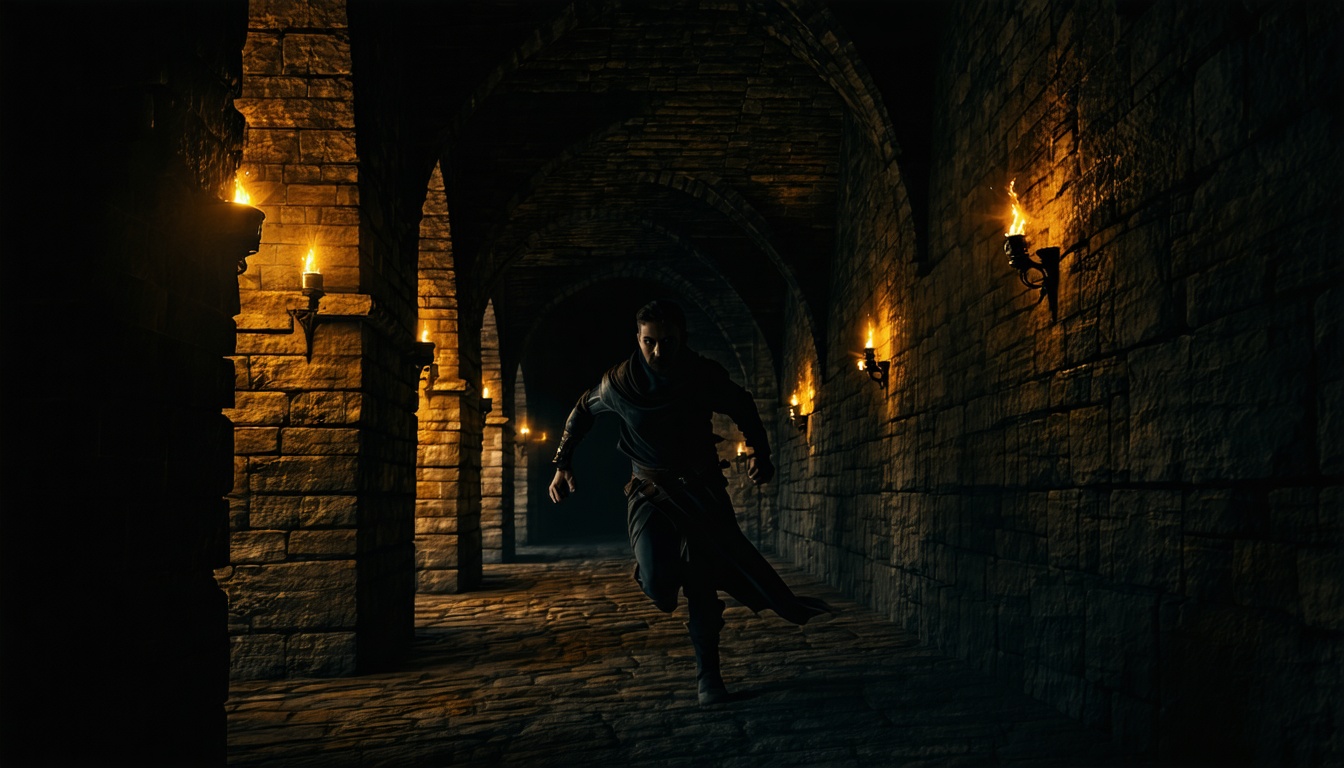
He ducked into the first shop he saw on the next street over and crouched behind a rack of hats. Less than twenty seconds later, the soldiers sprinted past the doorway and down the street, cursing.
Gregory panted, his stomach churning. They were just making sure I don't follow them, he told himself. They might even assume he was part of a bandit group, scoping their defenses before they left.
In any case, the caravan would leave Marisburg soon, and if he laid low and did nothing suspicious, they would forget he existed.
"Can I help you?" a voice asked directly behind Gregory. He flinched and let out a sharp scream, and then laughed.
So much for not looking suspicious.
Gregory turned and saw a middle-aged salesperson standing behind a counter, watching him with an amused expression. His jowls gave him the appearance of a jolly old friend, which no doubt helped his sales technique. Gregory stood up from behind the hat rack and brushed dust off his jacket.
"Yes... I... uh..."
"You were looking for a hat?"
"I... um..."
"What you mean to say, son," the salesperson leaned forward on the counter, "is 'by golly yes, sir, I need a hat to protect my fair skin!' Those were the words you were looking for; else why would you be in a hat store?"
"Uh, what?"
"I mean, if you weren't here to buy a hat, I might assume you were a criminal hiding from those soldiers that just ran past. And that most certainly isn't what you are, is it?"
Gregory laughed. At least he wasn't shouting to the guards.
A hat? Sure, why not? The sun was bright.
"My skin isn't that fair, is it?"
"Quite. From Farrsburrough?"
"Olestin."
"You're practically albino, son. Take it from me kid, this sun will chew you up, spit you out, and then set you on fire. That is, of course, unless you buy one of my fine hats to protect you."
Gregory smiled. "You've convinced me."
He glanced around the racks at various hats.
The merchant hadn't exaggerated, at least on quantity of merchandise. On the quality, Gregory wasn't so sure. Several had floppy brims that would settle over his eyes, no matter how much protection they offered. One rack was elaborate and annoying, coming in every disgusting color combination imaginable.
"People actually wear these?" The salesperson nodded gravely.
"Those are my best sellers."
"How?"
"Rich young gents like yourself purchase them to attract ladies. Shows their wealth. It is called peacocking."
Gregory couldn't tell if the salesperson was serious, then decided that he couldn't possibly be. Peacock hat, he thought, and couldn't suppress a laugh; and just when I don't want to be noticed.
He moved to another aisle and found a selection of safari hats. The brims were smaller, but still enough to protect most of his face. He picked one and slipped it over his head. Smooth and sturdy, a shade of deep brown. It rested comfortably, and he couldn't shake it loose.
His best bet, and he'd probably wasted enough time that the guards had given up on the chase.
"Will that be all, sir?" the merchant asked as Gregory approached the counter.
Of course, he started to say, reaching for a bag of coins tied to his hip.
"Yes," a voice said behind him in the doorway.
His heart skipped a few beats, and he didn't have to turn around to know who it was: the Captain.
Doing his best to act unperturbed, Gregory pulled a few coins out of his pocket. Footsteps on the wooden floor behind him, stopping only feet away.
"I would suggest you hurry and pay the man."
Gregory passed the money over but dropped one coin on the ground. So much for unperturbed. The Captain reached down and grabbed the coin, passing it to the merchant, and took Gregory by the arm. The merchant's look of amusement was gone, and he could only offer a shrug and a frown as the Captain steered Gregory toward the door.
"Move." The Captain shoved him through the doorway and into the street, where two soldiers waited. They seized his arms and marched him down the road, past market stalls and gawking pedestrians. His legs turned to rubber, and it was all he could do to stay calm.
"Where are we going?" he asked.
No response. Not even a glance his direction.
Not a good sign.
The soldiers dragged Gregory down an alley, and he considered making a run for it. He was fast on his feet, and he doubted they could keep up with him once he got going.
But they had iron grips on his arms, and he wasn't sure he could slip free. He was sure, however, that they could draw their weapons and stab him before he got far enough away.
They turned a corner in the alleyway and came upon orphans and vagabonds huddled around empty boxes and crates. Several of the crates were covered with paper and wood to fill in cracks, creating makeshift homes. The children lived here. Most of them were on the verge of starvation, protruding bellies and disproportionate limbs.
"Beat it," the Captain said, drawing his sword.
Gregory winced. The kids sprang to their feet and jolted down the alley, disappearing around a corner. Maybe, Gregory thought, they will run for help and warn people that an innocent man is about to be murdered.
The thought almost made Gregory chuckle.
Almost.
The soldiers held Gregory up and the Captain turned to face him. The alley stank of rotting vegetables and urine, the kind of smell that settled into clothing and stayed for days. A puddle of something Gregory didn't want to identify pooled near a collapsed crate. This was a place where people came to be forgotten—and the Captain had chosen it for exactly that reason.
Then, between one breath and the next, the stench vanished. Not faded—severed. Gregory inhaled and tasted nothing: no rot, no urine, no damp stone. The air in his lungs was as barren as an empty room sealed for a century. Cold prickled the skin of his forearms beneath his sleeves, a chill that had nothing to do with shade or wind. For one dislocated heartbeat, the alley felt less like a place and more like a gap—a space where the city's noise and filth couldn't quite reach, as though something had pressed the world thin here and the membrane hadn't fully healed.
Then the smell crashed back, as rancid and choking as before, and Gregory's stomach lurched with the suddenness of it. The soldiers' grip tightened on his arms. Neither of them seemed to have noticed anything.
The Captain stepped closer. The look on his face was calm, eerily so. "Who are you working for?"
"I don't work for any— "
The fist came fast; Gregory hadn't even registered the movement before his head was rocked sideways. He reeled from pain, and his new hat tumbled free to the ground. He fought through the pain and moved his jaw.
Nothing broken, but he could taste blood. The soldier in front of him clenched and unclenched his fist—his bloody fist, Gregory noted—and a shudder rippled through him.
His merchant's mind, absurdly, began tallying. One hat, paid for and lost. One split lip, freely given. Whatever this interrogation cost, the Captain wasn't the one paying for it.
"Want to run that by me again?" the Captain asked.
"I'm by myself. I don't know anyone."
The next punch was in the stomach, knocking his air out. He struggled for air.
"I came from Olestin looking for passage to Mulrich."
Another punch to the jaw, this time from the opposite side.
"Don't lie."
"I'm not!"
"Who are you working for?"
"No one! I swear. I'm just traveling north, trying to reach the Capital. I didn't want to travel alone."
"Stop lying."
"I'm not."
His mind spun. His vision swam. But beneath the pain, heat flooded his muscles—adrenaline, pure and sharp.
His jaw clenched, fists tightening despite the pain. Who do they think they are? Nothing he had done justified this kind of treatment: you don't go beating people up because they are clever enough to see through your stupid disguises.
"Are you done?" he asked
"I don't like liars," the Captain said.
"Then you must love me," Gregory said. This time a guard kneed him in the crotch. Stars exploded across his vision.
Sure, goad him. He coughed and blood ran down his chin, but his anger only sharpened:
"Is this how you treat all foreigners? No wonder you don't get many tourists."
A dagger appeared in the captain's hand. "You have quite a mouth on you. Trained to resist torture?"
"By my mother," Gregory said, narrowing his eyes. "She made me eat broccoli."
The man stepped forward and stabbed the dagger into Gregory's stomach. The pain was beyond anything he could imagine, and he slipped toward unconsciousness. Time passed, and he drifted. Did the Captain hit him again? He didn't know.
Somewhere in the gray space between waking and oblivion, his father's voice surfaced—patient, methodical, the way he'd sounded teaching Gregory to balance the household ledger. Every transaction has two sides, boy. What's given and what's taken. You find the imbalance and you know the truth. Gregory tried to apply the lesson to the iron taste in his mouth, the fire in his gut. What had been given: his curiosity, his cleverness, his inability to leave well enough alone. What had been taken: blood, dignity, a hat he'd owned for less than an hour. The imbalance was grotesque—a column of violence that dwarfed any debt he might have owed—and his ledger-keeper's mind filed it away with cold precision even as the rest of him was drowning.
"Patch him up," someone said distantly. "We might need him."
And then he passed out.



Join the Discussion