The Everett Exorcism - Chapter 3: Meeting the Bishop
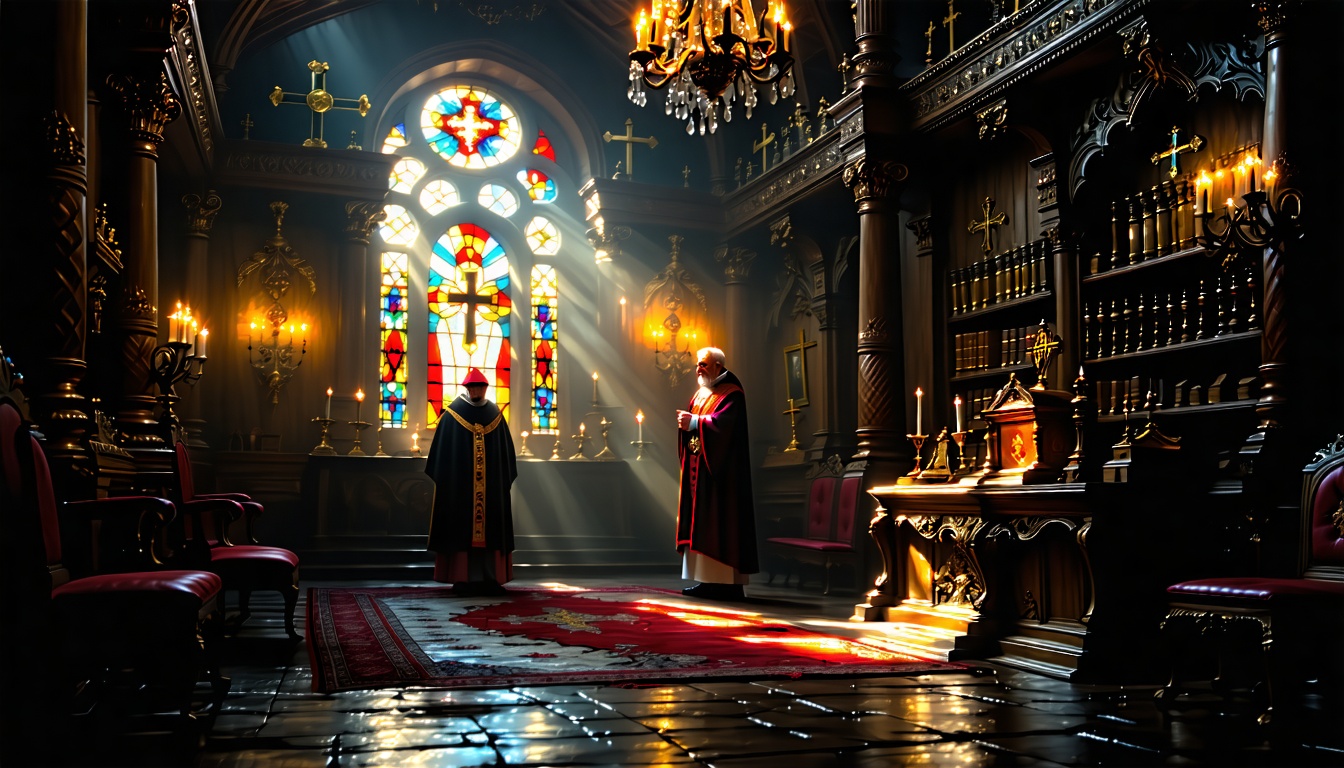
The trip to Leopold Glasser's countryside estate took longer than Niccolo expected. They drove east on Highway 2, past the Snohomish River crossing and the last scattered houses of suburbia, before the road climbed into hills the driver called the Pilchuck foothills. The bishop lived a solid twenty-five minutes outside the city in a thickly wooded area. Ancient cedars and Douglas firs surrounded them, their massive trunks draped in moss that glowed an eerie green in the headlights. The estate backed up against Olympic National Forest, hundreds of thousands of acres of old-growth wilderness.
Father Paladina knew the drive would have was beautiful in the day with the sun out to light their way, but traveling through the forest at night turned eerie and made him uncomfortable. The evergreens pressed close, their branches interlocking overhead like grasping fingers. Unlike the deciduous forests of Europe, these trees kept their needles year-round—dark, watchful, eternal.
Bishop Leopold Glasser's estate outside of Everett sprawled ostentatious and expensive—two floors and many thousands of square feet. The sight of it made him cautious about the bishop. Niccolo disliked such wasteful spending, yet many clergy leadership participated in the activity. Such men spent more effort propping up their station and creating an image than they did on solving problems in their communities.
They did, however, work as servants of their communities. The more distance they put between themselves and the people they served, the more difficult it became to understand what such people needed.
An unfortunate, yet forgivable, offense.
The rain stopped at some point during the drive; something of a relief. The air hit him with the scent of wet cedar bark and decomposing needles—the primordial smell of the Pacific Northwest. He breathed deeply, the dampness coating his lungs, before heading up the steps toward the front entrance.
The door opened as he approached, and a butler met him. A tall and well-dressed man with hard eyes and an emotionless demeanor.
Wordlessly, he led Niccolo through the foyer of the home and upstairs. Leopold met him in an office on the second floor, but the first thing that greeted Niccolo was the smell of cigarette smoke pouring from the room.
The chamber was rich in its decor with soft cream-colored walls and gray carpeting. A fireplace spilled heat into the room, and an overhead fan sucked up a cloud of smoke as it wafted lazily across the ceiling.
Rich and ornate tapestries decorated one wall. They depicted historical events throughout the past millennia that had importance for the Church, including the Last Supper and a rather immodest representation of Joan of Arc that Niccolo disregarded immediately as tasteless.
Finally, Niccolo turned his attention to the bishop. Leopold Glasser was a short man with a trimmed black beard, and he had a bald spot at the top of his head. He held a cigarette between stained fingers, and a crumpled pack rested on the desk beside him. In his late forties, he'd started to turn gray, but not in a dignified way. Time had not been kind to him.
A young man sat in a nearby chair, reading a book. He was maybe fourteen years old with curly black hair and angular features. He glanced up when Niccolo entered but didn't say anything. He frowned at Niccolo and then returned to his book.
Father Niccolo had heard a lot about Washington's Bishop, and very little of it flattering. Much of it, he assumed, came down to pure gossip—a favorite pastime at the Vatican.
In practice, Niccolo disregarded such rumors. He didn't like to cast judgment upon people he'd never met and preferred forming opinions of his own about people; however, he also acknowledged that rumors and prejudice, on occasion, held nuggets of truth. After surveying Leopold for only a few seconds, his first impression indicated that he wouldn't much like the man. He seriously doubted that the bishop could do much to change his opinion.
"Welcome," Leopold said when Niccolo walked into the room. He leaned heavily against his expensive wooden desk with a small smile on his face. "It is a pleasure to meet you in person finally, Father Paladina."
"Likewise," Niccolo said, striding over and shaking the smaller man's hand.
The bishop gestured his hand toward the young man. "This is Jeremy. He's been staying in my home for the past few weeks. Jeremy, please say hello to Father Paladina."
Jeremy didn't look up from his book. "Hello."
"Hello, Jeremy," Niccolo said.
"Run along now, Jeremy. I have much to discuss with Father Paladina, and I believe you have lessons to attend to anyway."
Jeremy flashed Niccolo a look of annoyance, but he did nod. He closed the book and walked out of the room, brushing rudely past Niccolo and into the hall. A few moments later and a door slammed shut.
Bishop Glasser turned his attention back to Niccolo. "I apologize. The child has been through much. He recently lost his family."
"No apology needed."
"I trust you had a pleasant journey?"
"Not exactly pleasant, but acceptable."
"I must confess, your presence here intrigues me more than a bit. On the phone, you told me little about why you planned to make this trip. It seems a long way to come just to have dinner at home; so, might I ask why you came all this way?"
Niccolo couldn't suppress his frown at the man's demeanor. Leopold got right to the point and in a mildly aggressive way, which gave another strike against him. Civility and pleasant conversation provided an important cornerstone of modern civilization. He would have greatly preferred discussing issues like this with a full stomach.
"The silence about the issue was intentional," Niccolo replied. "This is a rather delicate matter that should get attended to in person. Not over the phone."
"Oh? I trust it isn't anything too serious?"
"It pertains to one of the priests whose Parish you oversee. Father Jackson Reynolds."
Something—dislike, maybe—flashed across the bishop's face when Niccolo spoke the young priest's name. It disappeared almost as soon as it had shown, however, and the man's small and demeaning smile returned.
The bishop shifted to the side, dropped the butt of his cigarette into an ashtray on his desk, and then drew another one out of the pack with his teeth. He lit it, took a deep draw, and then, finally, turned his attention back to Father Paladina. He lowered himself into a seat across from Niccolo and pursed his lips.
"Ah, Father Reynolds. He is a dear friend. But the words came too quickly, the smile too practiced. Niccolo had spent years learning to read people, and everything about the bishop screamed that he was hiding something."
"I was told he came to you a few weeks ago about a member of his congregation. An elderly woman, behaving erratically, and who he believed needed help."
The bishop frowned and waved his hand in dismissal. "He spoke of this in our last meeting. He believed the woman had experienced a possession and wanted me to request an exorcist from the Vatican to help her."
"Yet, you did not send his request along?"
"I went through my due diligence and looked into the matter personally. I gave his request all of the attention it deserved and met with the woman myself."
"Did Jackson go with you?"
"No, I went alone. I wanted to meet with Ms. Rose Gallagher without any preconceived notions or biases. After meeting with her, I did not agree with his conjecture."
"You didn't believe she was possessed?"
"Rose lives by herself and suffers from loneliness. She sees her family only rarely, and I admit, she appeared quite troubled when I met with her. Troubled but not possessed. I denied Jackson's request to pass the information to the Vatican and asked him to speak no further of the issue."
Niccolo nodded, pursing his lips. "The issue did not end there."
"I can see that."
"I've come here to present a full report on the situation and determine if Jackson's concerns should get looked into further."
"You're an exorcist?"
Niccolo squirmed a little in his chair. "I am. But, should I determine that the Church will get involved in this situation, they will send someone else to handle the exorcism itself."
"I see. I feared something like this might happen," Bishop Glasser said. "Jackson is a rather … persistent young man."
Niccolo could tell that the word 'persistent' hadn't come to the bishop's mind first. He also couldn't fault the man for his edge of anger—he would have been furious, too, if one of the priests under his charge went over his head and attempted to supersede him on so important an issue.
"My duty is to search for evidence and report back without biased input from either of you," Niccolo said. "However, I thought it only dutiful to notify you that I will speak with Father Reynolds in the morning about these matters on behalf of the Church."
"It's a waste of time."
"Of that, I have no doubt. Nevertheless, I must oblige the young priest and investigate this issue. I intend to report everything I find to the Vatican as accurately as possible. As I am sure you can imagine, this puts me in a rather tricky position."
"One I don't envy." The bishop nodded. "Naturally, Jackson will ask you to speak with the old woman, and you will come to the same conclusion I did. She is a lonely woman who needs help, but not the kind of help that the Church can offer."
"My superiors believe that as well."
Bishop Glasser rose from behind his desk and walked over to a counter. It had various decanters on it filled with amber and brown liquids.
"Would you like a drink?"
"No, thank you." Niccolo stood too. "I don't partake."
The bishop poured himself a glass and took a long sip before turning back to face Niccolo. The expression on his face spoke of poorly disguised frustration, tinged with something darker. He held up the glass to the light, swirling the liquid.
"So, the Church sends an exorcist to dismiss the rumors of a wayward priest?"
"I didn't come here as an exorcist."
"Come now. Your reputation precedes you, Father Paladina. I know those whom you serve."
"I have been trained, but I have not sat in upon a true exorcism."
"Never called upon to serve God in that capacity?"
Niccolo's jaw tightened. The lie tasted bitter. Manila pressed against the edges of his thoughts—Vittorio's face, the crack of bone, the demon's laughter—but he forced it back. "No."
"And why do you think that is?"
A moment passed in silence. Niccolo struggled to ascertain whether the bishop meant to insult him or not. He hoped that the bishop simply spoke out of ignorance. "An occasion has never arisen in which the Church has asked me …"
He trailed off when a mocking smile spread on the bishop's face.
"No. It has nothing to do with occasion or circumstance. It is because demons are not real," the bishop said. "A fact which every priest worth his salt knows but none feel willing to admit. You know it. I know it. The Church knows it. Demons are an invention to scare lay people into giving larger donations to their parish."
Niccolo didn't respond immediately, but his blood seethed at the words. The bishop might be correct in his beliefs—Niccolo remained torn on the issue—but it wasn't Bishop Glasser's place to speak openly about something like this. Certainly not to a practicing exorcist.
However, attempting to refute the ignorant man would prove a waste of time. A growing sect of the Church shared the bishop's opinion. It made for a sensitive topic, and one not often brought up in gatherings. The people who held passionate views one way or another about the existence of demons never got swayed easily.
Niccolo's opinion on the matter came down on the side that demons represented a darker part of humanity, much like the idea of heaven and hell. Demons represented a loss of control. Such a loss, even if only a perceived loss, could become devastating.
To personify them came down to design. Demons were human creations to help build symbolistic connections between the mundane and religious aspects of life. They inspired understanding and faith, and even if purely abstract, they also proved very real.
He didn't believe that actual demons existed in the world, which lived in hell, like many in the Church maintained. Niccolo did allow that demons served as a representation of the inner darkness within humanity itself. He had taken courses at the Vatican on exorcism and demonology and had come to realize that much of the teaching and process was about offering forgiveness to people who believed themselves unworthy of it.
That provided the job of an exorcist—to form an anchor for people lost at sea. He could offer forgiveness to the unforgivable and help people regain control of their lives.
Forgiveness, Father Paladina had learned, proved something difficult to come by. Some people believed they weren't worthy of it, and that they had no right to ask for such. His duty in his capacity as an exorcist was—or would be, considering that the Church had never asked it of him—to offer that unquestionable forgiveness and salvation.
In any case, they hadn't sent Father Paladina here to help lead this bishop out of ignorance. He had more important matters to attend to, and this visit only offered a courtesy.
A wasted one, but a courtesy nonetheless.
"Father Reynolds called upon the Church to ask for help with a sensitive situation, and whether or not you agree with his request, it remains our duty to support him in any capacity we might. I came here so that I can offer him assistance."
"For now," the bishop said, sipping his drink.
Niccolo tilted his head. "I'm sorry?"
"This isn't the first time Father Reynolds has acted outside the best interest of the Church, and I don't believe it will make for his last. At a certain point, his mistakes will surmount the power of his friends, and the Church will have no choice except to take action against our young friend."
"You believe he will end up excommunicated?"
"It seems a distinct possibility. The Church follows a certain set of rules and expectations. Continually stepping around those systems can result in negative repercussions."
Niccolo had assumed a small possibility that the bishop might take his visit personally, but now his concern became fully validated. If the bishop was willing to go through the arduous process of having Father Reynolds removed from the Church simply because the priest had spoken up, then he must dislike the man seriously.
That, however, was none of his concern. It presented an issue—and a fight—for another day. He took a steadying breath and asked about dinner. From the expression on the bishop's face, it became clear that he had overstayed his welcome. Dinner was now a distant prospect.
Niccolo's annoyance didn't last long, though. In speaking with the bishop, he found that he'd lost his appetite.
"Thank you very much for your time," he said, shaking the bishop's hand once more.
"No, thank you," Bishop Glasser said. "I truly appreciate your honesty in this matter."
"I merely wanted to ensure that we would have no hard feelings regarding the tenuous situation we both face."
"Of course," the bishop said, "and I would like to assure you that there are absolutely none."
His expression, however, made it clear that there would be hard feelings. Niccolo didn't much care. He hadn't come here to make friends, and he wouldn't shirk his duty to make Bishop Glasser happy. His task at hand ordained that he analyze the situation and make a determination for the Church about whether an actual exorcism would prove necessary.
If, in his dealings, he reported back that it would, then no doubt they would send someone else to deal with it. Someone more appropriate to handle a situation like this. That suited him perfectly fine.
In either case, his only goal tonight had been to warn the bishop about the investigation before it began so that the man didn't get blind-sided by his showing up in the city. Niccolo considered it a courtesy both necessary and polite, and now that he had taken care of it, he could move on to the rest of his concern.
"Then, if our business is concluded, I would like to get back to my hotel to rest for the night. I have grown exhausted from the trip."
"You won't stay for dinner?"
"I would rather not infringe upon your hospitality, and I am afraid I would not make for good company. I am simply too tired."
"I understand. My driver will, of course, drive you back to the city."
After saying this, Bishop Glasser rose from his chair and leafed through miscellaneous papers on his desk. The dismissal was clear, and Father Paladina wasted no time in heading out of the room and back down the staircase to the front entrance.
The butler led him outside and gestured his hand toward a waiting car. The cool night air washed over the priest, chilling him, and he wanted nothing more than to get away from the bishop's estate and back to his hotel.
***
By the time Niccolo made it back to his room at the Everett Inn, bone-weary and could barely stay on his feet. He'd been tired earlier, but this was something else altogether. The jetlag had gotten to him, and as though he could sleep for a few days, if not weeks.
However, when he laid on the lumpy mattress and shut his eyes, he found that sleep wouldn't come. His mind spun, replaying the conversation with the bishop and pondering the circumstances that had brought him to this city.
The meeting hadn't gone at all how he'd expected. He didn't like the bishop, nor did he respect the man. The man's demeanor held something unsettling. An unpleasantness that permeated the entire estate, and the more Father Paladina ruminated on it, the more pervasive that unease became.
But that reflected his personal assessment of the man, not a professional one. He simply didn't like the bishop; however, that didn't make Leopold any less capable of performing his duties for the Church. Father Paladina couldn't let his personal opinions influence his investigation.
In either case, the time had come to meet with the man who had summoned him to Everett, Washington. He would meet with Father Jackson Reynolds in the morning at Saint Joseph's Cathedral, his church on Colby Avenue downtown. Then he could get the younger priest's perspective on the issue and start making some headway.
This initial meeting would give him the chance to discuss the matter at hand and introduce himself, and he hoped it would go better than his dinner engagement tonight had. His stomach growled, reminding him he'd barely eaten.
It would be important, he reminded himself, to stay neutral in the matter and examine the facts. He couldn't allow his dislike of the bishop to sway these dealings in any way.
Mostly because the bishop probably had it right. To be honest, he agreed with the bishop that, likely, there would be nothing here in Everett to find; certainly not a demonic possession. Father Reynolds, young and ambitious, had risked a lot to get him here, but the likelihood that any need existed for an exorcist in this town remained incredibly slim.
Maybe Niccolo would manage to convince Jackson to help Rose Gallagher seek more mundane assistance, perhaps through a therapist or other healthcare professional. That would provide the best outcome for everyone involved, including the woman. Then Niccolo's duty would shift from determining the need for an exorcism to smoothing over the rift between the bishop and the young priest.
That, however, wouldn't be an easy job either.
Satisfied that he would find an equitable resolution to the situation and get on a flight back to his home in Rome in only a few days, Father Niccolo Paladina finally found sleep.
But his dreams that night were not peaceful. In them, the bishop's smile never reached his eyes, and somewhere in the darkness of a house he didn't recognize, something ancient and hungry had begun to stir.
Join the Discussion