The Long Dark - Chapter 2: Journey North
The commercial flight from Missoula to Yellowknife took most of a day with connections. Montana disappeared beneath clouds, replaced by endless Canadian wilderness. Lakes like scattered mirrors. Forests so dense they looked like carpet. The farther north they flew, the more the landscape emptied.
By the time they descended into Yellowknife, civilization felt like a distant memory.
The airport was small, practical, built for function over form. The overhead lights hummed with that particular frequency that set teeth on edge—forty-year-old fixtures cycling at fifty-nine point eight hertz instead of sixty. Wilson collected his duffel bag—he'd packed light, was told Aurora provided cold-weather gear—and followed the instructions in his welcome packet. Meet at the charter terminal. Look for the ARI shuttle.
The terminal's heating system groaned as he passed a wall vent. The sound was wrong—metal on metal, bearing failing somewhere in the ductwork. The warm air came in uneven pulses. On. Off. On again. Like mechanical breathing.
He found it easily: a white van with "Arctic Research Initiative" stenciled on the side. A driver leaned against it, smoking a cigarette despite the no-smoking signs. He was maybe sixty, weathered face, gray stubble, wearing a parka despite the relatively mild temperature.
"Wilson Hayes?" the driver asked.
"That's me."
The driver flicked his cigarette away and extended a hand. "Bill Mackenzie. Call me Mac. I'll get you to the depot."
His handshake was firm, calloused. Wilson threw his bag in the back and climbed into the passenger seat. The van smelled like coffee and diesel.
Mac drove without much conversation, navigating Yellowknife's streets with the confidence of someone who'd done this route a thousand times. The city was small, functional, built on mining and resource extraction. Not pretty, but honest. They passed industrial sites, modest houses, a surprising number of Tim Hortons.
"First time up north?" Mac asked eventually.
"First time this far north," Wilson said. "Did some field work in Greenland a few years back."
"Greenland's different. More accessible. Aurora's about as remote as it gets without leaving the continent." Mac glanced at him. "You read the briefing materials?"
"Every word."
"And you still said yes?"
Wilson laughed despite himself. "Is that so hard to believe?"
"Most people see 'six months isolated in the Arctic' and run the other direction. Scientists especially—you're usually smart enough to know better." Mac's tone was dry, but not unkind.
"The research opportunity is worth it."
"If you say so." Mac merged onto a highway heading northeast. "I've been shuttling researchers to Aurora for six years. Seen all types. Excited ones like you, desperate ones running from something, ambitious ones chasing grants. By the time they rotate out, they all look the same: tired."
"You make it sound terrible."
"Not terrible. Just..." Mac searched for words. "Different. Changes people. Some handle it fine. Others don't. Had a guy two years ago, lasted three months before he locked himself in his room and refused to come out. Had to wait until the convoy window opened to extract him."
Wilson shifted uncomfortably. "That's rare though, right? Most people complete their contracts?"
"Most do. Doesn't mean they come back the same." Mac lit another cigarette—apparently he didn't care about the smoking ban inside his own vehicle. "You got family? People who'll worry?"
"Sister. She thinks I'm crazy."
"She's not wrong."
They drove in silence. The highway was well-maintained but empty. They passed maybe three other vehicles in an hour. The landscape gradually transitioned from boreal forest to tundra—trees became sparse, stunted, eventually disappearing entirely. The ground was rock and moss and permafrost.
It was beautiful in an austere way. Alien.
After several hours, Mac pulled off the highway onto a gravel road. No signage. Wilson wouldn't have known it was there.
"Depot's about forty minutes," Mac said. "This is where the real isolation starts."
The gravel road was rough. Mac slowed to navigate potholes and washboard sections. The van rattled. Wilson gripped the door handle as they bounced through a particularly bad section.
"Road gets worse every year," Mac said. "Permafrost thaw. Another decade, this route might not be passable at all."
"What happens then?"
"Aurora shuts down, I guess. Or they bring everything by helicopter. Either way, I'll be retired." Mac grinned. "Not my problem."
The depot appeared suddenly: a cluster of prefabricated buildings surrounded by chain-link fence. Solar panels on the roofs. Massive fuel tanks. A garage large enough to house semi-trucks. Several all-terrain vehicles parked in rows. It looked like a military outpost.
Mac drove through the open gate and parked near the garage. "End of the line for me. Your ride's inside."
Wilson climbed out. The air was shockingly cold despite it being summer. Wind cut through his jacket. He grabbed his bag and followed Mac into the garage.
Inside, he found the convoy: three enormous all-terrain trucks with tank-like treads, enclosed cargo trailers, reinforced cabins. They looked like something designed for Mars. Workers loaded supplies into the trailers—crates of food, equipment, fuel drums. The operation was well-organized, efficient.
A woman in a heavy-duty parka approached. "Dr. Hayes?"
"Yes."
"Sergeant Lara Chen. I'm convoy lead." She was maybe forty, compact and muscular, with the bearing of someone military or ex-military. "You're in truck two with the other researchers. We depart in thirty minutes. There's coffee in the break room if you want it. Bathroom too. Won't have another chance for eight hours."
"Eight hours?"
"It's 120 kilometers to Aurora, but the terrain is rough. We average fifteen kilometers per hour." She caught his expression and smiled. "Welcome to the Arctic. Speed limits are irrelevant when you're driving on permafrost and ice. We go slow and careful, or we don't go at all."
Wilson used the bathroom, grabbed coffee that tasted like it had been sitting for hours, and returned to find the convoy nearly loaded. Mac was talking to one of the drivers, laughing about something. He spotted Wilson and waved.
"Good luck up there, kid. Keep your head down and your sanity up."
"Thanks, Mac."
Wilson boarded truck two. The cabin was utilitarian: bench seating, storage compartments, heating vents blasting warm air. Three other people were already inside.
An older man with a salt-and-pepper beard and wire-rimmed glasses nodded at him. "New blood?"
"Wilson Hayes. Glaciologist."
"Dr. Yuri Petrov. Atmospheric chemist. This is my fourth rotation." He gestured to the others. "This is Dr. Sarah Kim, botanist. Second rotation. And Marcus Webb, maintenance engineer."
Sarah was petite, late thirties, with bright eyes and nervous energy. She waved. Marcus was broad-shouldered, maybe fifty, with a thick mustache and a skeptical expression. He grunted acknowledgment.
"Four rotations?" Wilson asked Yuri. "You keep coming back?"
"The work is good. The isolation suits me." Yuri shrugged. "And where else can I study pristine Arctic atmospheric samples for six months without interruption?"
"Don't listen to him," Sarah said. "Yuri loves it here. The rest of us are just masochists."
Marcus snorted. "Speak for yourself. I'm here because the pay is triple what I make anywhere else, and my ex-wife can't find me for six months."
The truck's engine rumbled to life—a deep, powerful sound. Sergeant Chen's voice crackled over an intercom: "Convoy rolling in two minutes. Buckle up. It's going to be a long ride."
Wilson secured his seatbelt. Through the cabin window, the depot receded as they rolled forward. The convoy moved in single file: truck one, two, three. Slow and steady.
They passed through the gate and onto unmarked tundra.
For the first hour, there was conversation. Yuri described his previous rotations—the research, the people, the peculiarities of living in a sealed environment. Sarah talked about her project studying permafrost microbial communities. Marcus mostly listened, occasionally adding sardonic commentary.
But eventually, conversation dried up. The landscape outside was unchanging: rocky terrain, patches of snow despite the summer season, distant mountains. No trees. No animals. No signs of human presence.
The isolation settled over him like a weight.
Around hour four, the convoy stopped for a mechanical check. They were allowed to disembark for ten minutes. Sergeant Chen walked the perimeter, checking tire pressures with a digital gauge. Her voice muttered into her radio: "Truck two, port rear showing ninety-two PSI. Should be one-ten. Temperature compensation? Copy."
Wilson stepped out and was nearly knocked over by the wind. The cold bit through his jacket—minus fifteen according to the dashboard thermometer, but wind chill made it feel like minus thirty. His breath crystallized instantly. The sky was vast and empty. In every direction: nothing.
He'd never felt so small.
Sarah stood beside him, staring at the horizon. "Crazy, right? We're not even to the mountains yet. Aurora is way deeper in."
"How much deeper?"
"You'll see."
They reboarded. The convoy continued.
Hour six brought the mountains into view: jagged peaks covered in snow and ice, even in summer. The convoy navigated increasingly treacherous terrain—loose rock, narrow passages between cliff faces, frozen streams. The trucks handled it easily, but Wilson's knuckles were white from gripping the seat.
"First time is always nerve-wracking," Yuri said. "You get used to it."
"What if we break down out here?" Wilson asked.
"Satellite beacon," Marcus said. "They'd send a helicopter from Yellowknife. Assuming weather allows. Assuming they can land. Assuming they get here before we freeze to death." He grinned. "Don't worry. Only happened once."
"Once?"
"Relax," Sarah said, shooting Marcus a look. "He's messing with you. The trucks are maintained obsessively. Chen wouldn't roll out if there was any risk."
Wilson wasn't reassured.
Hour seven, the terrain leveled out into a high valley surrounded by peaks. The convoy slowed further, navigating a path marked by reflective stakes driven into the ground—the only indication there was a road there.
Then, rounding a curve between two cliffs, there it was.
Aurora Station.
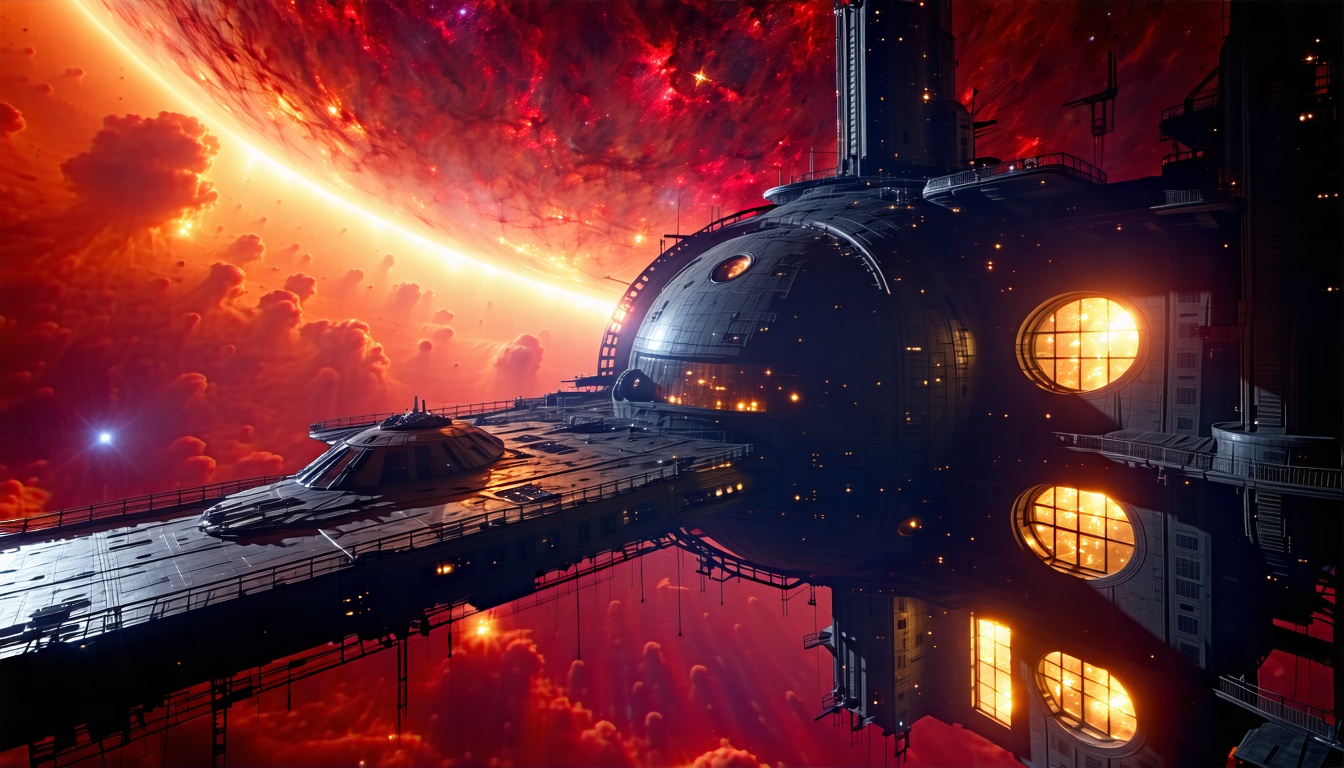
Three towers rising from the valley floor like fingers pointing at the sky. They were massive—each must have been twenty stories tall—angular and industrial, built from reinforced concrete and steel. The buildings were partially buried in the mountainside, integrated into the rock itself. Enclosed bridges connected them at multiple levels, spanning the spaces between. Solar panels covered every south-facing surface. Wind turbines spun on the peaks above.
It looked like something from a science fiction film. A colony on an alien world.
"Impressive, да?" Yuri said.
Wilson could only nod.
The convoy approached the base of the valley. The entrance: a massive tunnel mouth carved into the mountain, large enough to accommodate the trucks. Heavy doors stood open, recessed into the rock. Lights glowed inside.
"The access tunnel," Sarah said. "Only way in or out. Come winter, it's impassable. Ice, avalanche risks, whiteout conditions. That's when we're locked in."
The convoy entered the tunnel. The temperature dropped immediately—they were inside the mountain now, protected from wind but surrounded by ice and stone. Lights embedded in the tunnel ceiling illuminated the path. The tunnel curved, descending gradually.
After ten minutes, they emerged into a massive underground garage. The space was enormous: high ceilings, bright LED lighting, marked parking areas, maintenance bays. The three trucks parked in designated spots. Engines shut down.
Sergeant Chen's voice: "Welcome to Aurora Station. Disembark and report to orientation in the main atrium. Your luggage will be delivered to your quarters."
Wilson stepped out of the truck onto smooth concrete. The air was cool but not freezing—climate controlled. The garage was bustling with workers unloading supplies, operating forklifts, checking equipment. It was shockingly normal after the desolate journey.
"This way," Yuri said, leading them toward an elevator bank.
They rode to the surface level. The elevator doors opened onto a wide atrium: three stories tall, windows overlooking the valley, sleek modern design. People moved through the space—researchers in casual clothes, support staff in uniforms, everyone purposeful.
It looked like a corporate office building. Or a high-end hotel.
"Not what you expected?" Sarah asked, reading his expression.
"I don't know what I expected. But not this."
Marcus grunted. "Wait until you've been here three months. Then it feels like a prison. A comfortable prison, but still."
A man approached them: mid-forties, Asian, wearing a button-down shirt and slacks. Professional but approachable.
"New arrivals? I'm Richard Chen, facility administrator. Welcome to Aurora. If you'll follow me, I'll get you oriented and settled."
Wilson followed, trying to take in everything at once. The facility was impressive—state-of-the-art, well-maintained, almost luxurious. He passed a cafeteria, a gym, what looked like a common room with couches and a large TV.
It didn't feel isolated at all.
But as they walked, Wilson noticed something. A window overlooking the valley. Outside, the mountains loomed. The sky was vast. The distance to anything resembling civilization was incomprehensible.
They were buried in the middle of nowhere, surrounded by stone and ice and endless wilderness.
And come winter, there would be no way out.
Wilson shivered despite the comfortable temperature.
Richard Chen glanced back, smiling. "Don't worry, Dr. Hayes. You'll get used to it. Everyone does."
Wilson nodded. But Mac's words echoed in his mind: "By the time they rotate out, they all look the same: tired."
He wondered what he'd look like in six months.
If he made it that long.
Join the Discussion