The Long Dark - Chapter 3: Arrival
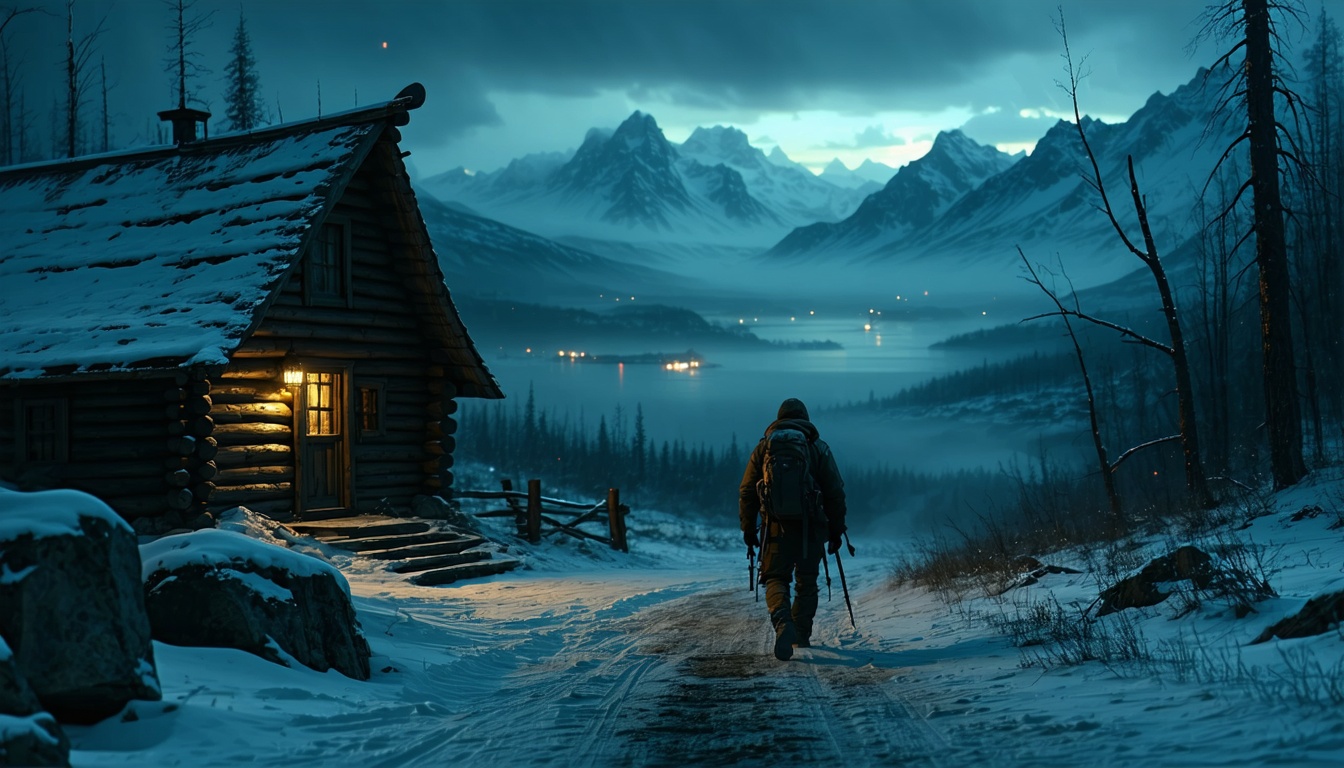
"Welcome to Aurora Station," Richard Chen said, standing at the front of the conference room.
Wilson sat in an office chair with seven other new arrivals—Sarah Kim and six others from the convoy. The room was on Beta Building's third floor, windows overlooking the valley. Mostly rock face and distant peaks. Better than his windowless basement office in Montana.
The air smelled of recycled atmosphere—filtered, sterile, with a metallic undertone from the ventilation system. Nothing like outside.
Chen held a tablet. Some arrivals looked excited. Others apprehensive. Up close, Wilson noticed the facility administrator looked exhausted—dark circles under his eyes, a tremor in his hands when he gestured, the kind of weariness that went deeper than missed sleep. Three years in this place, Chen had said. Maybe that was enough to hollow anyone out.
Chen continued without waiting for responses. "I'm the facility administrator, which means I handle logistics, personnel issues, and general operations. If something's broken, if you have a conflict with another resident, if you need anything—you come to me. I've been here for three years across five rotations, so I know this place inside out."
He tapped his tablet and a holographic projection appeared above the conference table—a 3D model of Aurora Station. Wilson leaned forward, fascinated.
"Three buildings," Chen said, gesturing. "Alpha, Beta, Gamma."
The model rotated slowly. Wilson could see the three towers arranged in a triangle, connected by enclosed bridges at multiple levels. Each tower massive—must have been twenty-two stories.
"Each is ten stories above ground, twelve below," Chen continued. "Solar panels, windows, communications arrays topside. The underground sections are buried in bedrock. Insulation and stability."
He swiped his tablet.
"Alpha Building houses our research laboratories and equipment. That's where most of you will work."
The model highlighted Alpha in blue.
"Beta Building, where we are now, contains living quarters, common areas, cafeteria, gym. Gamma handles administration, storage, the vehicle garage you saw earlier."
Chen swiped his tablet. The model zoomed in on the space between buildings.
"The buildings are connected by enclosed tunnel bridges at levels two, five, eight, and ten. You can move between buildings without going outside—essential during winter when external conditions are lethal. Each tunnel has its own climate control and emergency seals in case of fire or structural issues."
As Chen spoke, Wilson noticed the heating vent nearest him. The airflow cycled irregularly. Ten seconds on. Six seconds off. Ten on. Four off. Not the smooth, consistent warmth he'd expect from a modern HVAC system. He glanced up at the vent grille—the fins were slightly bent, and frost had formed along the edges despite the room being climate-controlled. Thermal bridging, probably. Cold bleeding through from outside.
Sarah raised her hand. "How many people live here?"
"Currently forty-two residents, including you new arrivals. We cap at fifty for safety and resource management. Population includes researchers, support staff, maintenance crew, medical personnel, and myself. Everyone has a job. Everyone contributes. We're a closed system for six months, so we all depend on each other."
"What if there's a medical emergency?" asked one of the other new arrivals, a nervous-looking young man.
"We have a medical bay on Beta's fifth floor," Chen said. "Two trained paramedics on staff, full pharmacy, surgical suite, diagnostic equipment. We can handle most emergencies. Anything catastrophic..." He paused, and Wilson caught something in his expression—not just concern, but something darker. Fear, maybe. Or resignation. "We do our best. Helicopter evacuation is possible during summer, but once winter hits, we're on our own. That's why we screen so carefully during hiring."
The room went quiet.
Chen continued. "Let's talk logistics. Your living quarters are on Beta levels seven through nine. You'll each have a private apartment: bedroom, bathroom, small kitchenette. We provide linens, basic furniture, internet access—though bandwidth is limited and we have usage quotas. Meals are served in the cafeteria on Beta two, three times daily. Chef Antoine runs the kitchen. He's a miracle worker with shelf-stable ingredients."
Someone laughed nervously.
"Laundry facilities are on each residential floor. We have a gym on Beta four, a theater on Beta three, a library on Beta six. We show movies twice a week—selection is limited to what we have on the servers, but there's variety. We also have game nights, trivia competitions, whatever people organize. Social activities are important. Isolation does strange things to people if they don't stay engaged."
Chen's expression turned serious. "Rules. First, respect the schedule. We operate on a 24-hour cycle even when the sun doesn't. Lights dim at 2200 hours in common areas, full brightness at 0600. This maintains circadian rhythms. Second, respect the resources. Water is recycled but not infinite. Electricity is abundant via solar and generators, but we still conserve. Third, respect each other. You're living in close quarters with the same people for months. Conflicts happen. Work them out like adults or bring them to me. We can't afford drama in a sealed environment."
He tapped his tablet again. The hologram shifted to show the access tunnel.
"Finally, the tunnel. It's our lifeline and our prison. During summer, convoys can navigate it. Come late October, ice and avalanche risks make it impassable. It stays that way until April. That's when we're locked in. No resupply. No rotation. No evacuation. You knew this when you signed the contract, but I want it clear: once the convoy leaves next week, you're here until spring. No exceptions. No early departures."
The weight of that settled over the room.
"Questions?" Chen asked.
Sarah raised her hand again. "What's the most common problem people face here?"
Chen considered. "Isolation. It's insidious. First month, people are fine—excited about the work, bonding with colleagues, enjoying the novelty. Second month, the reality sets in. You can't leave. You've seen everyone's face a hundred times. Conversations start to loop. Third month is usually the breaking point. Some people pull through. Others crack. We had a researcher last rotation who locked himself in his room and refused to come out. Had to wait until the convoy window to extract him."
Wilson glanced at Sarah. She looked pale.
"But most people do fine," Chen added quickly. "Especially if you stay busy, maintain connections with people outside via email, and take advantage of the social activities. You'll be okay."
Wilson wasn't sure he believed him. And from the way Chen's eyes kept drifting to the window—watching for something in the fading light—Wilson wondered if Chen believed it himself.
The orientation continued for another hour: safety protocols, emergency procedures, introduction to the staff. Chen showed them how to use their facility ID badges to access different areas. He explained the communications system: limited satellite access, scheduled windows for calls and emails, strict bandwidth quotas.
By the time it ended, Wilson's head was spinning with information.
Chen dismissed them with a final instruction: "Your luggage is in your assigned apartments. Get settled. Dinner is at 1800 in the cafeteria. Tomorrow, you'll meet with your department supervisors and start work. Welcome to Aurora."
As Wilson stood to leave, he noticed Chen's phone buzz. The administrator glanced at it, and his face went pale. He turned away quickly, walking toward a private office with quick, nervous steps.
Wilson followed the others into the hallway. A staff member handed him a key card and a slip of paper with his apartment number: Beta-7-12.
He took the elevator to level seven. The hallway was wide, well-lit, carpeted. Doors lined both sides, each marked with numbers. It looked like a hotel.
He found 12 and swiped his key card. The door unlocked with a soft beep.
The apartment was small but comfortable. A bed with clean linens. A desk and chair. A kitchenette with a mini-fridge, microwave, and coffee maker. A window overlooking the valley—the view was mostly rock, but there was a sliver of sky visible. A door led to a compact bathroom with a shower, sink, and toilet.
His duffel bag sat on the bed.
Wilson unpacked slowly. He didn't have much: clothes, toiletries, a few books, his laptop. He put his framed photo of Claire on the desk. She was smiling in it, taken at a family gathering three years ago. He hadn't seen her in person since he left.
Six months felt like an eternity.
He sat on the bed and looked around. The apartment was nice—nicer than his place in Missoula. But it was still a box. A comfortable box in a massive tower in the middle of nowhere.
His phone buzzed. A text from Claire: "You there yet? Still alive?"
He smiled and typed back: "Alive. Facility is impressive. I have my own apartment. Pretty nice, actually."
Claire: "Send pics. I want to see your ice prison."
Wilson took a few photos and sent them.
Claire: "Okay, it's nicer than I thought. Still crazy. Stay safe. Email me when you can."
Wilson: "Will do. Love you."
Claire: "Love you too, Ice Man."
He set his phone down. The isolation was already palpable. Outside this tower, there was nothing for hundreds of miles. No restaurants. No coffee shops. No strangers to bump into. Just forty-two people in three buildings.
His stomach growled. He checked the time: 1745. Almost dinner.
Wilson left his apartment and headed for the elevator. On the way down, he shared the elevator with an older woman wearing a lab coat.
"New arrival?" she asked.
"Yeah. Wilson Hayes. Glaciologist."
"Dr. Patricia Soto. Marine biologist. Second rotation." She smiled, but there was something manic in her eyes—too bright, too eager. "You'll get used to it faster than you think. First week is disorienting. By week two, it feels normal. By month three, you forget anywhere else exists." She laughed, a little too loudly. "That's when it gets interesting."
"I hope so."
They reached level two and Wilson followed the signs to the cafeteria.
It was larger than he expected: seating for at least seventy, industrial kitchen visible through a service window, buffet-style setup. The walls were painted warm colors—reds and oranges, probably to combat the cold aesthetic of the facility. People were already gathering, chatting in clusters.
Wilson grabbed a tray and joined the line.
The food was better than he'd anticipated. Chef Antoine—a stocky man with a thick French accent, scarred forearms from decades of kitchen burns, and an apron that had seen better days—served roasted chicken, mashed potatoes, steamed vegetables. "Welcome, welcome," he said, ladling generous portions onto Wilson's plate. "You are new, yes? Eat well. You will need your strength. This is not restaurant food, but I make it taste like home. Everyone deserves to taste home, especially when home is far away." His eyes crinkled with genuine warmth. "You have dietary restrictions? Allergies? Tell me. Antoine remembers everything. Ask anyone—they say I am annoying, but I remember."
Wilson thanked him and looked for a place to sit.
Sarah Kim waved him over to a table. She was sitting with Yuri and Marcus from the convoy, plus a few others. Wilson joined them.
"How's your apartment?" Sarah asked.
"Good. Small, but comfortable."
"Better than grad student housing," she said, grinning. "I had a window. An actual window. I nearly cried."
"First rotation always gets the good rooms," Marcus muttered. He was a big man, broad-shouldered, with hands calloused from maintenance work. Everything about him suggested practical competence—the way he sat, the way he watched the room, cataloguing exits and equipment out of habit. "Wait until you're here a few cycles. They stick you in the sublevels."
Yuri laughed. "Marcus is bitter because he requested a sublevel. He likes the quiet."
"I like not seeing the mountains," Marcus said. "They're oppressive. And the sublevels are warmer—better insulation. Less thermal variance. The surface levels lose three degrees every time the wind shifts. I've measured it." He caught Wilson's expression. "Sorry. I notice things. Occupational hazard."
Wilson glanced out the cafeteria windows. The peaks were indeed imposing, towering over the valley, shadowed in the perpetual twilight of Arctic summer.
He could see how they might feel oppressive after a while.
Dinner conversation was light: introductions, backgrounds, what brought people to Aurora. Sarah was studying permafrost microbiology. One of the others, a woman named Dr. Linda Chen (no relation to Richard), was an atmospheric physicist. A quiet man named David Chen (also no relation, though he joked they should form a club) worked in maintenance with Marcus.
Everyone was friendly. Everyone seemed normal.
But Wilson noticed little things. The way Yuri's smile didn't quite reach his eyes. The way Linda Chen kept glancing at the windows like she was expecting something. The way David picked at his food without eating much, pushing vegetables around his plate in precise geometric patterns.
Maybe they were just tired from the journey.
Or maybe this place did change people.
After dinner, Wilson returned to his apartment. He tried to work on his laptop—reviewing literature on isotope analysis—but his mind wandered. He looked out the window at the darkening valley. The sun was still visible, but it dipped closer to the horizon than it should. Soon it would barely set. Then it wouldn't set at all. Then it would start setting earlier and earlier until it didn't rise.
The Long Dark, that blogger had called it.
Wilson shivered.
He climbed into bed around 2200. The lights in the hallway dimmed automatically, simulating night. But the sun was still visible through his window, a pale disc above the mountains.
Sleep didn't come easily.
He lay awake, listening to the sounds of the facility: distant footsteps in the hallway, the hum of ventilation, the creak of the building settling. Somewhere, a door closed. Somewhere, someone laughed.
The generator's rhythm was wrong. Wilson could hear it through the walls—a deep thrumming that should have been steady but wasn't. Chug-chug-chug-pause-chug-chug-chug. Like it was struggling. Like something in the fuel system was starving it intermittently. He counted the intervals. Every eighth cycle, there was that pause. Consistent. Measurable. Wrong.
Forty-two people in three towers, surrounded by wilderness so vast and hostile it might as well have been another planet.
Wilson closed his eyes and tried not to think about how far he was from home.
He didn't know yet that he was already too far to escape.
That the journey north had been one-way.
That this place would change him, hollow him out, remake him into something he didn't recognize.
He didn't know that in six months, he'd stand outside in subzero temperatures, bleeding and terrified, fighting for his life against things that shouldn't exist.
He didn't know that most of the people he'd just met at dinner would be dead.
All he knew was that he was there for the science. For the ice cores. For the career he'd always wanted.
And tonight, that was enough.
Join the Discussion