He woke gasping for air.
The breath caught in his throat, sharp and painful. His lungs burned. For a moment he couldn't remember anything—not his name, not where he was, not how he'd gotten here.
Only darkness. Only fear.
*ABC, Thomas. Airway, breathing, circulation.* Training kicked in before conscious thought. Airways clear—no obstruction, no gurgling. Breathing rapid but steady—twenty-two, maybe twenty-four respirations per minute. Pulse thready but present. No obvious hemorrhaging. The protocol ran through his mind like muscle memory, grounding him even as panic threatened to take hold.
*Great. Patient assessment complete. Unfortunately, the patient is you, and you have no idea where the hell you are.*
Forcing his pulse to slow—*come on, aim for sixty, you've talked down worse*—he drew in another breath, fighting the terror that clawed at his chest. The air tasted stale, thick with dust and something else—the musty dampness of the Northeast, familiar from too many calls in old Catskill farmhouses. *Forty miles from the station. Maybe fifty. If you're even still in New York.* The smell hit him next: decomposition, early-stage. Maybe forty-eight hours post-mortem, based on the sweetness underneath the must. *Jesus Christ, what is this place?*
Fragmented images scratched at the back of his mind—jumbled memories that refused to form into anything coherent. Like trying to read an EKG with half the leads disconnected.
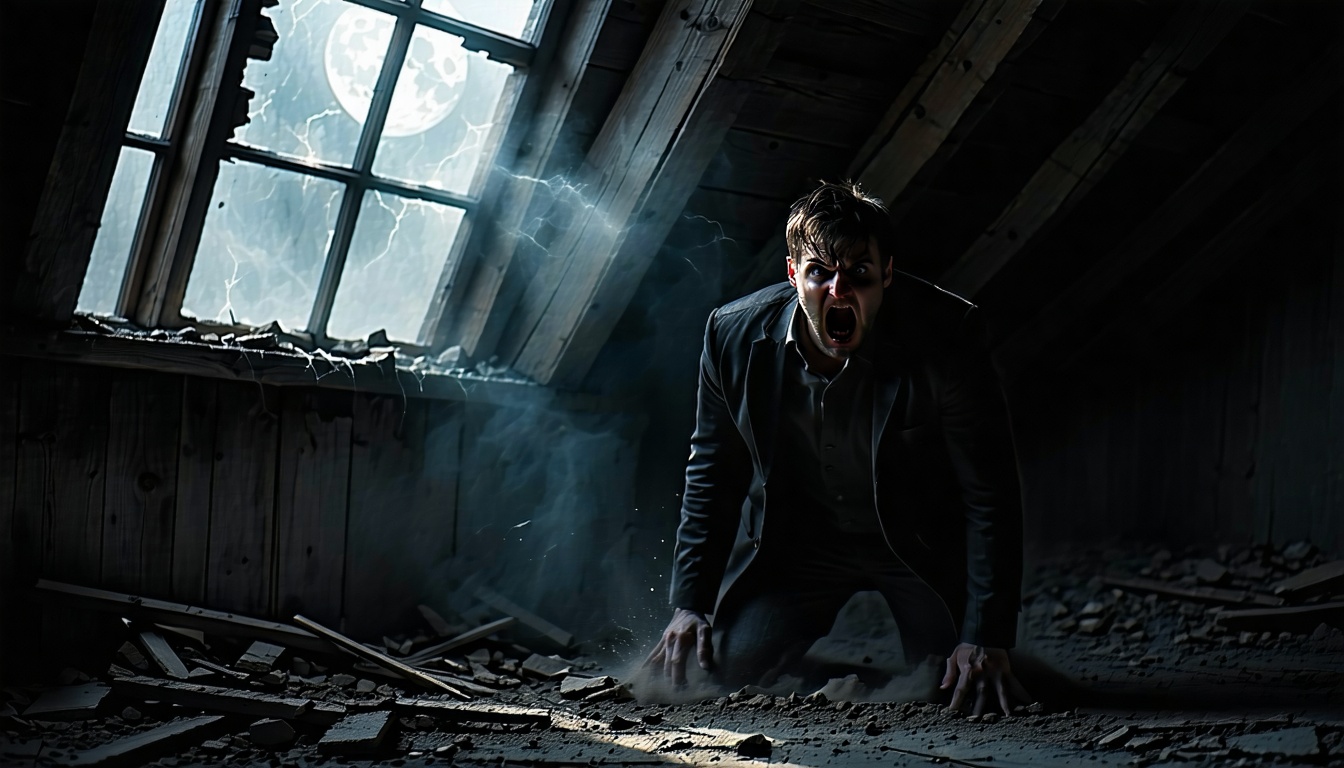
Moonlight filtered through cracks in the walls above him. Thin beams cutting through the darkness, revealing dust motes suspended in the air like tiny ghosts.
He was lying on something soft. A mattress. Old and lumpy, springs digging into his back. *Institutional grade. Hospital surplus, maybe. Or morgue overflow.* The thought came unbidden, the kind of dark joke that got EMTs through their shifts. *Gallows humor,* Sarah used to call it. She'd lean against the rig after a bad call, peeling off her nitrile gloves one finger at a time—always one finger at a time, like a ritual that kept the world from falling apart—and shake her head at him. *"You know what your problem is, Crane? You joke when you should cry. And you cry when you should be angry."*
Sarah.
The name stabbed through him. Sharp and immediate.
A memory surfaced through the fog—not fragmented this time, but whole. Their second anniversary. She'd cooked. Badly. Blackened chicken that she called "Cajun style" with that defiant grin she wore when she knew she'd lost but refused to admit it. Dollar-store candles, already half-melted from some previous life. Wine from a box because they'd spent their money on a weekend in the Catskills that got rained out. She'd sat across their tiny kitchen table in his old FDNY shirt, sleeves rolled past her elbows, tomato sauce on her collarbone, and said, *"Crane, this is the worst meal I've ever made and the best night I've ever had."* And she'd meant it. That was Sarah—she could make burnt food and cheap wine feel like the only thing in the world worth having. Could make a cramped apartment feel like a cathedral just by being in it.
Then the images splintered. Blood on asphalt. Red and blue lights strobing. Her voice cutting through static: *"Thomas, I need you to stay with me—"* The smell of gasoline and copper. Mr. Buttons—that ridiculous teddy bear she kept on the dash of the rig—hanging from the shattered windshield by one arm. Her hand in his, grip weakening. Her eyes losing focus. The last breath she took sounding like every last breath he'd ever heard on a call, and he'd heard enough to know exactly what it meant.
Then nothing. Just silence where her voice should have been.
The image dissolved. His partner. His wife. Three years gone, and the grief still sat in his chest like a stone. The accident haunted him—the call he'd missed, the shift he should have covered—and the weight of it pressed down even though the details wouldn't come clear.
His hands were shaking.
Sitting up slowly, his head pounded. *Concussion protocol: headache, confusion, memory loss. Check, check, and check. Congratulations, Thomas, you've got the trifecta.*
The mattress beneath him was stained dark. In the dim light, he couldn't tell what the stains were, but his stomach churned anyway. The smell was worse up close—rot and mildew and something else. Copper.
Blood.
*Arterial spray pattern on the fabric. Someone exsanguinated here.* The clinical observation came automatically, years of crime scenes and accident sites making him read the evidence before his emotions could catch up. The mattress was soaked with old blood. Dried and crusted in some places, still tacky in others.
He touched the fabric. The wet sections were cold. Too cold. *Blood coagulates in four to eight minutes at room temperature. Dries completely in about an hour. This should be brown and flaking, not—*
This blood was fresh.
But how? He'd been lying here unconscious. For how long? Minutes? Hours? The blood should have dried, should have congealed, should have stopped being slick and wet against his fingers.
Unless it wasn't old blood at all.
Unless someone—something—had put it there recently. While he slept. While he lay unconscious and vulnerable in the dark.
*Well, that's not terrifying at all.*
His hand came away sticky. The smell intensified, copper thick in his nostrils. He wiped his palm on his pants, but the sensation lingered. The wetness. The cold.
*Not mine,* he thought desperately, running his hands over his body. No pain. No wounds. No entry or exit trauma. The blood wasn't his.
That didn't make him feel better.
Standing on shaking legs, he fought a wave of dizziness. *Orthostatic hypotension. Dehydration, probably. When did you last drink anything?* The room spun, then settled. An attic. Low ceiling, exposed beams overhead—hand-hewn oak, ornate and heavy. Second Empire Victorian, maybe 1880s. The mansard roof geometry was unmistakable, the kind of extravagant construction that Hudson Valley railroad money had commissioned to outlast dynasties. *Someone built this place to stand for centuries. Ironic, given the state of it.* Cardboard boxes stacked against one wall. Spider webs thick in the corners, hanging like curtains.
Wind whistled through the cracks in the walls. Cold air that raised goosebumps on his arms. *October cold. Late fall in the Hudson Valley, maybe. Hypothermia risk. Core temp's probably dropping. File that under "problems for later."*
On the floor beside the mattress: a pistol and a sword.
He stared at them, not understanding. Why would someone leave him weapons? Who would do that?
The sword lay on a square of folded cloth—deliberate placement, angled so the hilt faced his hand. Not tossed beside him. Not dropped. Arranged with the kind of care that contradicted everything else about this room. The blood-soaked mattress said *victim.* The weapons said *chance.*
*Maybe whoever left you on the murder mattress has a twisted sense of fair play.*
A piece of paper lay between them, folded once.
His hands trembled as he picked it up. Unfolded it.
Neat handwriting. Clinical. The precise lettering of someone accustomed to medical charts and research logs.
*Welcome, Thomas. Subject 152. Vital signs at induction: promising. Median survival of previous subjects at this juncture: 4.7 hours. I expect better from you. The weapons are a courtesy—the last 12 subjects were unarmed. Consider it a controlled variable.*
*Find me when you're ready.*
*—H*
The paper slipped from his fingers.
But something nagged at the back of his mind. The note was clinical—"vital signs," "median survival," "controlled variable"—the language of a researcher documenting an experiment. Detached. Methodical. But the weapons told a different story. Arming a test subject wasn't a controlled variable. It was an advantage. A gift disguised as data.
*Two intentions in the same handwriting. The scientist running an experiment. And someone else—hiding behind the same pen—trying to give you a fighting chance.*
Someone knew his name. Someone had brought him here deliberately—categorized him, numbered him, expected him to perform. One hundred and fifty-one people before him. Most of them dead inside five hours.
*Subject 152. And whoever H is, they're running this like a clinical trial. You're not a prisoner. You're a test subject.*
His hand came away sticky. The wetness. The cold. The note.
The pistol came first. Weight familiar in his hand, though he couldn't remember why. Muscle memory guided his fingers as he checked the magazine. Loaded. Safety on. He went to rack the slide—and his hand stuttered. Fingers closing on empty air where the metal should have been, motor cortex reaching for a pathway that had been scrambled along with everything else. The second attempt found the slide, pulled it back, let it snap forward.
*Not just memory gaps. Coordination gaps. Whatever wiped your history is leaking into your motor skills. The EMT protocols came back first—thousands of repetitions burned into the nervous system. But the tactical stuff? That's degraded. Patchy. Like running software on a corrupted drive.*
The sword came next. Simple blade, well-balanced. Sharp enough to cut.
Someone had armed him. Someone had left him here with weapons and a blood-stained mattress and a note that treated his survival like a research hypothesis.
This wasn't a rescue. This was an experiment.
Turning slowly, he took in the attic around him. The boxes. The webs. The shadows that moved in the corners of his vision.
And then he saw them.
Five figures stood in a circle ahead, just visible in the darkness. Motionless. Silent.
His breath caught.
People?
*Vitals check—no respiratory movement. No heat signature visible. Stationary posture suggests—*
No. Not people.
Stepping closer, pistol raised, his heart hammered against his ribs.
Mannequins.
Five mannequins arranged in a perfect circle, facing inward. Their features were smooth and featureless in the dim light. Their mouths—
He stopped. Stared.
Their mouths were sewn shut. Crude stitches through plastic lips, the thread dark and thick.
*Okay. That's new. Never saw that in the DSM-5.*
A low humming filled the air. Barely audible, but there. Coming from the mannequins.
*They're humming.*
The thought was insane. Mannequins didn't hum. They didn't move or breathe or do anything but stand still and model clothes.
But the sound was real. He could hear it. A low, droning note that made his teeth ache.
In the center of their circle: a chalk drawing. A pentagon with symbols he didn't recognize scrawled around the edges. And in the very center, an unlit candle.
He backed away slowly.
The humming grew louder.
One of the mannequins turned its head.
The movement was wrong—too smooth, too fluid. Not the jerky motion of something mechanical. The head swiveled on its neck until it faced him directly.
*Impossible. That's anatomically impossible. There's no musculature, no—*
Then the others turned.
Five blank faces staring at him. Five sewn mouths still humming that terrible sound.
He ran.
*Screw assessment. Screw triage. RUN.*
Across the attic, away from the circle, away from the things that shouldn't be able to move. His foot caught on something—a box, a board—and he stumbled but kept going.
There. A trapdoor in the floor. Closed but visible.
He yanked it open, not caring what was below. Anywhere was better than here. Anywhere was better than those things with their sewn mouths and their terrible humming and their too-smooth movements.
He dropped through the opening, hit wooden floor below with a jarring impact. Rolled. Came up in a crouch, pistol still in hand.
*Impact assessment: left shoulder took the brunt. Rotator cuff's going to hate you tomorrow. If there is a tomorrow.*
A hallway. Dark and empty. Creaky wooden floors stretching away in both directions.
Above him, the humming stopped.
The silence was worse.
He stood slowly, breathing hard. Listened.
Nothing. No footsteps. No movement.
A voice flashed through his head—gravel-rough, not Sarah's. *"Crane, you keep running toward fire, eventually the fire wins."* A face tried to form behind the words: salt-and-pepper mustache, dress uniform at something formal. The image scattered before he could hold it. *Someone important. Someone who worried about you. Can't remember who.*
The air down here was different. Thicker somehow. Like something was wrong with the oxygen itself. Each breath sat heavy in his lungs, refusing to satisfy. *Possible hypoxic environment. Or you're having a panic attack. Probably both.*
The walls pressed inward—not physically, but in some way that made his skin crawl. The hallway stretched too long in both directions, the perspective slightly off. Wrong angles that his eyes couldn't quite focus on.
*Spatial distortion. Concussion symptom? Or is this place actually wrong?*
The wood itself looked diseased. Dark veins spread through the exposed beams like infection, pulsing faintly in rhythm with that distant grinding sound. Not decay—a corruption that made the structure feel alive in all the wrong ways. *Like watching necrosis spread in real-time. Like watching a body reject itself.*
The floorboards beneath his feet yielded slightly when he shifted his weight. As if the house was rotting from within, its bones turning to pulp.
A door to his left hung at an impossible angle, the frame warped beyond any natural settling. Through the gap, he glimpsed movement. Just a shadow. Just a flicker. Gone before his eyes could track it. The doorknob was covered in something that looked like rust but smelled like copper. Fresh copper. Like blood that had oxidized too quickly, the metal underneath corrupted by whatever substance had seeped into it.
The temperature dropped. Not gradually. All at once.
His breath misted in front of his face. *Rapid environmental temperature change. Core body temp already compromised. Time's running out.*
A sound drifted from somewhere distant. Mechanical grinding, rhythmic and slow. Like gears turning deep in the walls. Then it stopped. Started again. Stopped.
The pattern was deliberate. Purposeful.
Something in this house was breathing.
A scent threaded through the stale air—sharp, clinical. Ozone. The metallic tang of high-voltage equipment, utterly foreign to the Victorian must and rot surrounding him. It carried something institutional, something sterile and watchful, as though the air itself had been sterilized in preparation.
A speaker crackled—old, embedded in the crown molding, the kind of intercom system you'd find in a mid-century institution. Static first, then a voice. Calm. Educated. The measured cadence of a man dictating clinical notes.
*"Subject 152 has cleared the observation chamber. Locomotion unimpaired. Stress response within acceptable parameters. Cognitive function appears baseline despite induction trauma. Initiating secondary assessment protocol."*
A pause. The faintest sound of a pen scratching paper.
*"Note: subject retained both weapons. Promising. The last three discarded the sword within ninety seconds."*
The speaker died. Silence pressed back in.
Thomas's grip tightened on the pistol. Someone wasn't just watching him. Someone was *studying* him. Documenting his reactions like a lab rat navigating a maze.
*H. The note said H. And this voice sounds like the same person—clinical, detached, running this whole nightmare like a goddamn experiment.*
The wallpaper peeled in long strips, revealing dark wood beneath. In the dim light from cracks above, he could make out patterns in the exposed wood. Scratches. Deep gouges. Letters carved frantically into the surface.
HELP.
GET OUT.
IT KNOWS.
The messages covered every visible section of wall, hundreds of them, overlapping. *How many people had been here before him? How many had tried to warn whoever came next?*
*One hundred and fifty-one,* the note had said. The answer was right there in that precise clinical handwriting.
How many had failed to escape?
*Focus, Thomas. Can't help them. Can only help yourself. Triage: the living take priority over the dead.*
The trapdoor hung open above him like a wound in the ceiling.
He stared up at it, waiting. Waiting for something to emerge. For those terrible sewn faces to appear in the opening.
Nothing came.
After a long moment, he reached up and pulled the trapdoor closed. It fell into place with a soft thud that seemed too loud in the silence.
The hallway stretched ahead of him. Doors on either side, all closed. A staircase visible at the far end, leading down.
He had no idea where he was. No idea how he'd gotten here. No memory of anything before waking on that blood-stained mattress.
But he had weapons. And he had a choice.
Stay here and wait for whatever came next.
Or move.
*Never wait for the reaper to come to you.* Sarah's voice, from their first shift together. *You hesitate, people die. Including you.* She'd been right. She'd always been right. And the one time he'd hesitated—
He shut down the thought before it could finish.
He chose movement.
The floorboards creaked under his feet as he started down the hallway, sword in one hand, pistol in the other. Every shadow hid something. Every closed door a potential threat.
Behind him, from the attic above, came a sound.
A crash. Sharp and sudden.
Then silence again.
He didn't look back.
Whatever was in this house—whoever was running this experiment—they weren't going to let him leave easily.
But he was going to try anyway.
He had to.
Because the alternative—staying here, waiting in the dark for those things to come for him—was worse than any danger ahead.
*One foot in front of the other, Thomas. Just like a call. Assess, treat, transport. Only this time, you're the patient.*
The hallway stretched forever. Each step an eternity. Each creak of the floorboards a scream in the silence.
But he kept moving.
Toward the stairs. Toward the lower floors. Toward whatever came next.
Toward escape.
Or toward whatever Subject 152's file said would happen next.

Join the Discussion