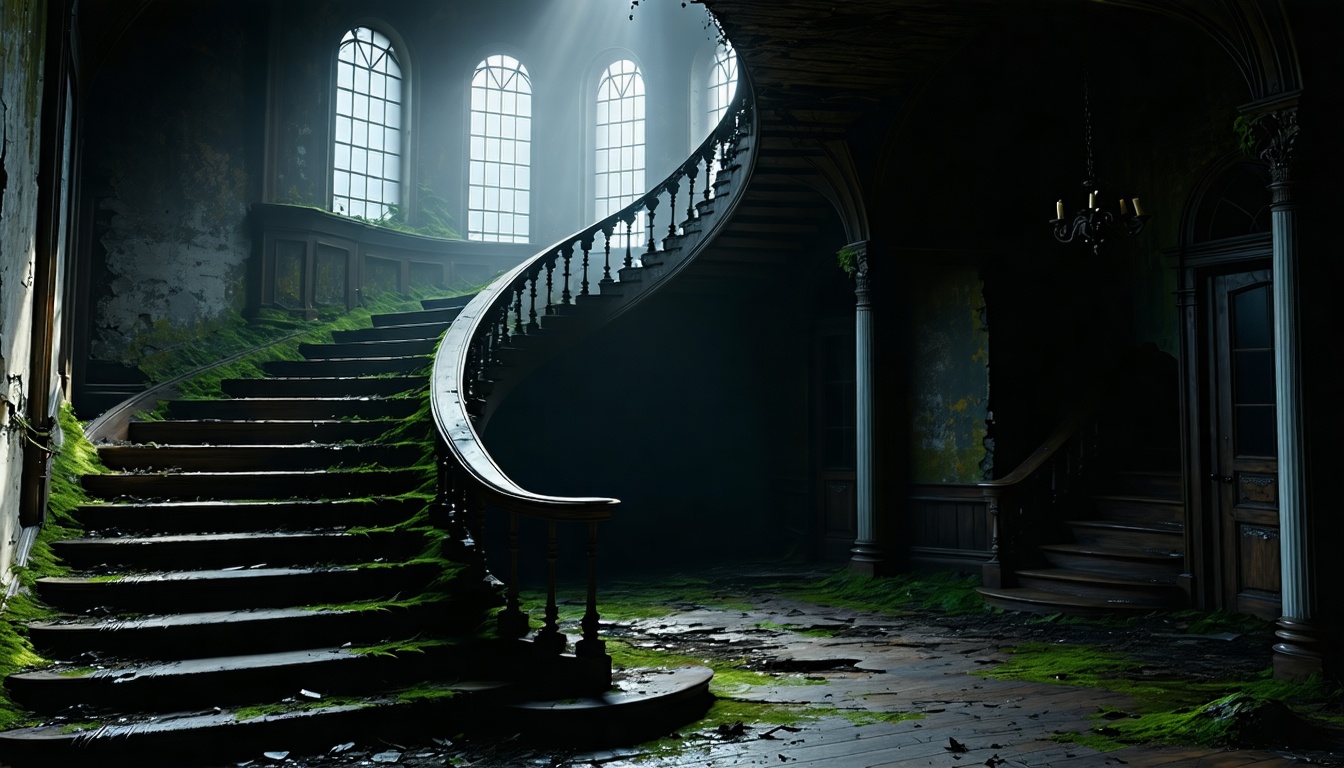
The first floor was darker than above.
No moonlight reached down here. No windows that he could see. Just shadows thick enough to feel solid and a smell that made his stomach turn.
Rot. Mildew. Something sweet and sickly underneath it all. *Decomposition.* He'd smelled enough dead bodies to recognize it. Not fresh—this was old death, months at least. Maybe years.
His eyes adjusted slowly. Shapes emerged from the darkness. A grand foyer with a staircase curving up to where he'd just come from. Doors leading off in multiple directions. Wallpaper peeling in long strips.
And dust. Dust over everything, thick as snow.
No footprints in it but his own.
How long since anyone walked these halls?
He tried the front door first. Massive thing, solid wood with iron fittings. The kind of door that belonged in a castle.
It didn't budge.
Again, throwing his weight against it. The door didn't even rattle. Sealed shut, swollen wood jammed tight in the frame.
No way out there.
Other doors beckoned. He chose one at random, turned the handle.
A dining room. Long table, chairs mostly broken. And on the table—
A sandwich.
The sight stopped him. Fresh bread. Peanut butter and jelly, cut diagonally. Like someone had made it five minutes ago and just walked away.
Everything else in the house was decayed. Rotten. Ancient.
But the sandwich looked fresh.
Left alone. Don't trust anything in this place.
Next door. A storage closet. Empty shelves. And on the floor, a dark stain. Tar-like substance, still wet and gleaming.
Kneeling beside it, careful not to touch, he examined the stain. *Scene preservation,* some distant part of his mind noted. Old habits from too many accident scenes. Sarah's voice echoed: *Don't contaminate the evidence, Crane. The dead deserve better than sloppy work.* The smell was stronger here. Sweet and wrong. Like coagulated blood left too long in the sun, but darker. Thicker.
Movement caught his eye.
The tar rippled.
Instinct threw him backward, but something grabbed his ankle. Cold and wet and impossibly strong.
The world tilted. Twisted. Reality bent like hot glass.
And then he was somewhere else.
***
Water dripped somewhere in the darkness.
Cold tile beneath him. Head pounding. For a moment he thought he was back in the attic, waking from the same nightmare.
But the floor was wrong. Too smooth. Too cold.
Porcelain.
A bathtub. Old and stained, in what looked like a bathroom. But not one he'd seen before.
Harsh fluorescent lights flickered overhead, buzzing like dying insects. The sound set his teeth on edge.
The pattern of the flickering wasn't random. Three short bursts. Pause. Three long bursts. Pause. Three short bursts again. Over and over. SOS in Morse code.
The lights were calling for help.
The fluorescent tubes flickered in their desperate pattern, mechanical and relentless. How many people had died in this room? How many had watched these lights flash their distress signal while they bled out or transformed or whatever horror happened here?
The walls were concrete. Bare. But scratches covered every surface within arm's reach of the tub. Deep gouges in the cement, fingernails worn down to nothing trying to claw through solid stone. Some scratches formed words. Most were just frantic lines. Evidence of panic. Of people who'd woken in this tub and tried to dig their way to freedom.
None of the scratches made it more than an inch deep.
This wasn't the manor's first floor. Wasn't anywhere he recognized.
Out of the tub. Dripping—no, his clothes were dry. The dripping sound came from somewhere else.
A faucet, maybe. Or something worse.
The bathroom was small. A sink with a smashed mirror. Glass in the basin, reflecting the flickering lights in a thousand fragments. A toilet with the seat cracked. And the door.
Closed but not locked.
Weapons check. Pistol. Sword. Both still there. Good.
What the hell had that tar stuff done to him? Teleported him? How was that possible?
How was any of this possible?
The mannequins. The ghost child. The tar that moved and grabbed.
Nothing made sense.
The door opened onto a hallway. Long and straight, fluorescent lights flickering at intervals. More doors on either side.
The smell hit him immediately.
Blood. Fresh blood.
And beneath it, chemicals. Antiseptic. The smell of a hospital.
His grip tightened on the pistol.
This was different from the manor. Newer. The walls were cement, not wallpapered. The floor was tile, not wood. Industrial. Institutional.
Where the hell was he?
A dragging sound echoed from somewhere down the hall. Metal on tile. Rhythmic and slow.
The sound drew him forward, every instinct screaming at him to run the other way.
The hallway forked. Right, the dragging sound continued. Left, silence.
Right it was.
The sound grew louder. Closer. Whatever was making it was just around the corner ahead.
Back against the wall, pistol raised. Waiting.
The thing that came around the corner wasn't human.
Green skin, lumpy and malformed. Arms too long. Legs too short. It dragged a body bag behind it, the bag leaving a streak of something dark and wet on the white tile.
The creature's face was wrong. Eyes too far apart. Mouth too wide. When it saw him, that mouth opened wider, showing teeth like broken glass.
It charged.
Three shots, center mass.
The creature stumbled but didn't fall. Green blood splattered the walls. It kept coming.
Again. Headshot this time.
The creature went down, sliding forward on the bloody tiles until it lay at his feet. Twitching. Dying.
Breathing hard, Thomas stood over the corpse. His hands shook as he lowered the pistol. Standard post-engagement protocol—check for additional threats, assess injuries, secure the perimeter, then—the next step wouldn't come. The procedure was right there, trained into him somewhere he couldn't reach, but the specific sequence had holes in it. Like reading a manual with torn-out pages.
*The amnesia isn't just taking your history. It's taking your edge. The deep grooves hold—trigger pull, recoil management, center mass. But the framework around them is Swiss cheese.*
What was that thing?
More sounds from deeper in the facility. Shuffling footsteps. Moaning. Things that might have been human once but weren't anymore.
Out. Now.
But the hallway stretched ahead, and he had no idea which direction led to an exit.
Behind him, the bathroom. Ahead, the facility and its monsters.
Ahead. Always ahead. Always moving.
Because stopping meant dying. And he wasn't ready to die.
Not yet.
Not until he understood what was happening. Why he kept waking in these nightmare places. Who had done this to him.
Doors flew past. Rooms filled with medical equipment. Gurneys with restraints. Walls covered in photographs—polaroids showing empty rooms and dark windows and faces he didn't recognize.
Through one open doorway, he glimpsed an operating theater. Surgical lights hung at odd angles, their bulbs shattered. The table beneath bore restraints—thick leather straps with metal buckles, worn from use. Dark stains radiated from the table's center like a blooming flower. On the floor, discarded medical instruments lay scattered. Scalpels. Bone saws. Syringes filled with something that glowed faintly green in the flickering light.
A clipboard hung on the wall. Without thinking, he grabbed it.
The top page showed a diagram. Human body, front and back views, with sections marked and labeled. "Subject 47 — Transformation Protocol, Phase III." Areas highlighted in red indicated where modifications had been made. Where things had been added or removed or altered. The notes in the margins were clinical, detached—the same precise handwriting as the note from the attic. *H's handwriting.* "Subject expired at 73% completion. Cellular rejection accelerated beyond projected timeline. Recommend increased sedation for future trials."
At the bottom, a signature line: *Dr. J. Harrow, Principal Investigator.*
Seventy-three percent completion of what? What had Harrow been trying to create?
The ozone found him first—that sharp, electrical tang he was learning to associate with being observed. With the intelligence behind the speakers. It seeped through the facility air, stronger here than in the manor above, as though the clinical source were closer.
A speaker crackled overhead. Static hissed through it, then cleared into something worse—a voice. Measured. Calm. The kind of calm that came from absolute certainty.
"Subject One-Five-Two." A pause, precise as a metronome. "Heart rate elevated. Adrenal response consistent with projections. You're performing within expected parameters, Thomas."
The voice came from everywhere. Speakers set into the ceiling at regular intervals, the wiring exposed like veins along the concrete.
Spinning, pistol raised—at nothing. At the empty hallway. At the dead fluorescent lights buzzing their SOS.
"Who's there?" His own voice sounded small. Fragile. A living thing trapped in a dead man's laboratory.
"You already know." The speaker popped with interference. "You read the name. You've been reading it since you woke. On clipboards and walls and the insides of your own eyelids. I'm the constant in your equation, Thomas. The variable you can't solve for."
Harrow. The voice belonged to Harrow.
Not a ghost. Not a recording. The cadence was too responsive, too aware of what Thomas was doing right now.
"The clipboard you're holding," Harrow continued. "Subject Forty-Seven. Gerald Marsh, retired schoolteacher. He lasted nineteen days. You've lasted—" Another pause. "—four hours and eleven minutes. Already better. I chose well."
The next page revealed a table of subjects, numbered sequentially. Names, dates of acquisition, transformation percentages at time of death. Subject 1 through Subject 47, spanning 1952 to 1964. Every single one marked DECEASED in red ink.
And at the bottom of the list, added later in shakier handwriting: *Subject 48: J. Harrow. Self-administered. Transformation: complete. Status:* The word that followed had been scratched out and rewritten three times. The final version read: *Ongoing.*
Self-experimentation. The mad scientist's final gambit.
"You found my confession." The voice shifted—something almost like amusement threading through the clinical tone. "I was Subject Forty-Eight. The first success. The only success, for a very long time. But success is a relative term when the process never stops."
One photo made him stop.
His own living room. Photographed from outside, through the window. He could see his couch. His TV. His bookshelf.
Someone had been watching him.
Before this. Before the manor. Before the attic.
Stalking him.
A sticky note was attached to the corner of the photo, the same clinical handwriting: *Candidate 152. Thomas Crane. EMT/Paramedic, 8 years. Critical loss event: spouse (Sarah Crane, deceased). Grief index: 9.2/10. Projected integration compatibility: 94.7%. Acquisition timeline: 6-8 weeks post-identification. Priority: HIGH.*
His hands shook. Not just rage anymore. Horror. Harrow had profiled him. Selected him specifically—because of Sarah. Because his grief made him *compatible* with whatever transformation waited in this facility.
*You're not random. You're not unlucky. You were chosen. Handpicked by a dead scientist who thought your broken heart made you the perfect lab rat.*
"Sarah's death was the catalyst," Harrow said, and the name in that clinical voice was obscene. A scalpel pressed against something sacred. "Grief destabilizes the cellular membrane. Makes it porous. Receptive. You were already transforming before I brought you here, Thomas. I simply accelerated what loss had already begun."
"Shut up." The clipboard cracked against the wall. The sound echoed like a gunshot. "You don't get to say her name."
The speakers hummed. Then, quieter: "Rage. Good. The process feeds on strong emotion. Keep going."
Another sound. Closer now. Running footsteps.
Thomas turned.
More of them. Three creatures, different from the first but equally wrong. Malformed bodies, too many limbs or too few. Skin the wrong color. Eyes that didn't belong in human faces.
Experiments. Harrow's experiments. Failed subjects who hadn't died—who'd been transformed into something that could still move, still hunt, still serve their creator's purposes.
The speakers crackled once more. "My children are curious about you. They can smell the compatibility. Don't worry—they won't kill you. I've waited too long for a Subject One-Five-Two to let them end you prematurely."
Thomas ran.
Down the hallway, through a door, into another corridor. The creatures followed, their shrieks echoing off the cement walls. But they kept their distance now—herding, not hunting. Driving him forward like dogs working a flock.
The running felt like coming home. A flash hit him mid-stride: sprinting into a building everyone else was evacuating. Smoke so thick he tasted it for days. The captain screaming over the radio to fall back. He'd ignored the order. Had been ignoring orders for months. *"You've got a death wish, Crane. And I can't watch you use my firehouse to commit it."* The memory fragmented, leaving only the adrenaline—the sick, familiar comfort of risking everything because losing everything had already happened.
Harrow's dogs.
A ladder. Ahead, set into the wall. Leading up to a hatch.
Cold rungs bit into his palms as he climbed. The metal was too cold. Frost formed on his fingers, spreading across his skin like crystalline infection. Each rung felt colder than the last. By the top, his hands were numb, skin gray and lifeless.
The hatch resisted. Sealed from disuse or deliberately locked.
The creatures reached the bottom of the ladder. Their claws scraped metal. They were climbing.
Shoulder braced against the hatch, he pushed. The metal groaned. Didn't move.
Harder. His shoulder screamed. The hatch gave slightly, rust breaking free.
The creatures were halfway up.
One final push. The hatch flew open, hinges shrieking. Cold air hit him. Fresh air.
Outside.
Night sky above. Trees around him. And in the distance, the silhouette of the manor.
Underground, then. The facility sat beneath the property. Part of the same nightmare. Harrow's subterranean laboratory, connected to the manor by tar and madness and decades of obsessive research.
The hatch slammed shut. Thomas scrambled away from it, breathing hard.
Safe.
For now.
But for how long?
The manor loomed ahead, dark windows like watching eyes. And somewhere inside—no, somewhere woven *through* it all—Harrow watched. Not as a ghost haunting dusty rooms. As something alive and aware, threaded through every speaker and camera and drop of black tar. An intelligence that had been refining its methods for seventy years and had finally found what it was looking for.
Subject One-Five-Two. Thomas Crane. The one whose grief made him perfect.
Answers. That's what Thomas needed.
And he was going to get them.
Even if it killed him.
Especially if Harrow wanted him alive.
Join the Discussion