The Temple - Chapter 1: Awakening
His skull cracked against wood before his eyes were open.
The impact drove consciousness in like a nail—one moment nothing, the next everything at once. Darkness. Absolute. And heat, dry heat that had weight, that settled on his skin like a wool blanket left in the sun. Each inhale burned the back of his throat with the taste of baked clay. Each exhale came back insufficient, the darkness drinking his breath before his lungs could claim it.
His hand disappeared in front of his face. Nothing visible. Just blackness pressing in from all sides like something solid.
And the smell—ancient. Musty. The unmistakable scent of old wood and older death, of oils and resins meant to preserve the dead, of three thousand years compressed into a space barely big enough for a body.
Where was he? Wood above. Inches from his face. Solid. Unyielding.
Panic flared—instinctive and primal, the kind that bypassed thought entirely and went straight to the animal brain, the part that knew enclosed spaces meant burial meant suffocation meant death.
He was in a box.
No. Not a box. His hands explored the space around him, fingertips mapping the geometry of his prison with desperate precision. Smooth painted wood on all sides. Curved. Following the contours of his body as though it had been built around him while he slept.
A coffin.
He was in a coffin.
The panic intensified. Heart racing. Breathing faster, each gasp using up oxygen that might already be limited. The smell grew stronger with each desperate breath—cedar and myrrh and something underneath that might have been natron, the mineral salt Egyptians used to dry their dead. The smell coated his tongue until he could taste the centuries, taste the preservation chemicals that had been poured over wrapped corpses in this very chamber.
Buried alive. Sealed in darkness. Left to suffocate.
No. Focus. Think.
He forced himself to slow his breathing, counting each inhale to four, each exhale to six, the way he'd coached panicking patients in the back of ambulances when their world was collapsing. Control the fear. Assess the situation rationally.
Except his hands were already doing it. Already pressing flat against the painted wood, fingertips walking a grid pattern—left to right, top to bottom, systematic, efficient. He hadn't decided to do that. Hadn't chosen a search methodology or consciously begun assessing the structural integrity of his prison. His hands had simply started, moving with the practiced certainty of someone who'd mapped confined spaces a thousand times before. The disconnect was nauseating—his mind still fumbling for his own name while his body operated with the calm efficiency of a thing that had done this so many times the fear was merely procedural. For three lurching seconds he felt like a passenger in his own skin, watching himself work with expertise that belonged to a version of Thomas he'd never met.
His fingers traced the wood above his face. The surface was smooth. Painted. But not modern paint—something older, something that had a granular texture like dried riverbed clay mixed with pigment. Raised designs met his fingertips. Carved grooves following patterns too deliberate to be decorative. Hieroglyphs maybe.
Egyptian.
The realization cut through the panic like cold water. This wasn't a modern coffin. This was a sarcophagus. Ancient. Authentic. The kind of artifact that belonged behind glass in a museum, not wrapped around a living man's body like a second skin.
And he was sealed inside.
How had he gotten here?
Nothing before waking. Just darkness and heat and the crushing awareness of confinement, as though his existence had begun the moment his eyes opened in this sealed wooden tomb.
Wait. His name. What was it?
Thomas. Yes. Thomas Gray. No—Crane? Both resonated somehow, like two tuning forks vibrating at frequencies close enough to blur together but not quite identical. Memory fragmenting across iterations. Identity splintering into versions of himself that each felt real and each felt borrowed.
EMT. Emergency Medical Technician. Mercy General Hospital. Fifteen years. Those memories real? Or implanted? He could feel the weight of a stretcher in his hands, could hear the specific pitch of a cardiac monitor's flatline alarm, could smell the chemical tang of the ambulance's disinfectant—details too granular for fabrication, too specific to be anything but lived experience.
Violet. The name surfaced like a drowning man gasping air. Wife who died. Daughter he never held. Patient in ambulance. All three. None true. All true.
Memory fragments like shattered glass. Each piece real. But which timeline? Which iteration? Which version of Thomas was truth and which was reflection?
He forced the thoughts down. Deal with identity later. Survive now.
Like before. The manor. The shoreline. The castle. The recognition settled into his body like muscle memory—a bone-deep familiarity with waking in impossible places, with the specific quality of fear that came from knowing the nightmare was engineered.
This was another iteration. Another location in the endless cycle. And his body already recognized the pattern—muscles tensing before his mind caught up, hands already probing for structural weaknesses the way a locksmith's fingers found tumblers. Four thousand iterations had taught his bones what his memory couldn't retain.
He pressed against the lid. Testing. The wood didn't budge. Solid. Heavy. Probably weighted down with stone or secured with straps that had petrified over centuries into something harder than the wood they held.
But old. Ancient. Three thousand years old if this was authentic.
Wood degraded. Became brittle. Even in dry climates. Even in sealed tombs. He'd broken through barriers like this before—not in memory, but in the way his palms knew exactly where to push, the way his shoulders found the leverage point without conscious thought, the way his breathing steadied into the controlled rhythm of someone who had done impossible things so many times that impossibility had become routine.
He braced his feet against the bottom of the sarcophagus. Pressed his shoulders against the lid. Pushed.
The wood creaked. Slightly. But it moved.
He pushed harder, straining until his vision filled with white sparks and the tendons in his neck stood out like bridge cables. Muscles burning with effort that felt like it was tearing fibers loose from bone.
A crack. Loud in the enclosed space. Like a gunshot that echoed and re-echoed off the painted interior until the whole sarcophagus rang with it.
Light. Thin golden sliver where the lid had split. Not much. But after absolute darkness—blinding. His eyes watered and stung, pupils contracting so violently he could feel the ache behind them.
He pushed again. The crack widened. More light. His hands emerged pale. Dirty. Covered in dust that might have been there for centuries.
One more push. Everything he had. All his strength focused on the single point where ancient wood met ancient seal.
The lid shattered.
Wood fragments flew. Ancient painted pieces scattering across stone like startled birds. He burst upward, gasping, drawing in air that was barely cooler than inside the sarcophagus but at least different—carrying the scent of stone and dust and the faint copper tang of old blood from somewhere deeper in the temple.
He was free.
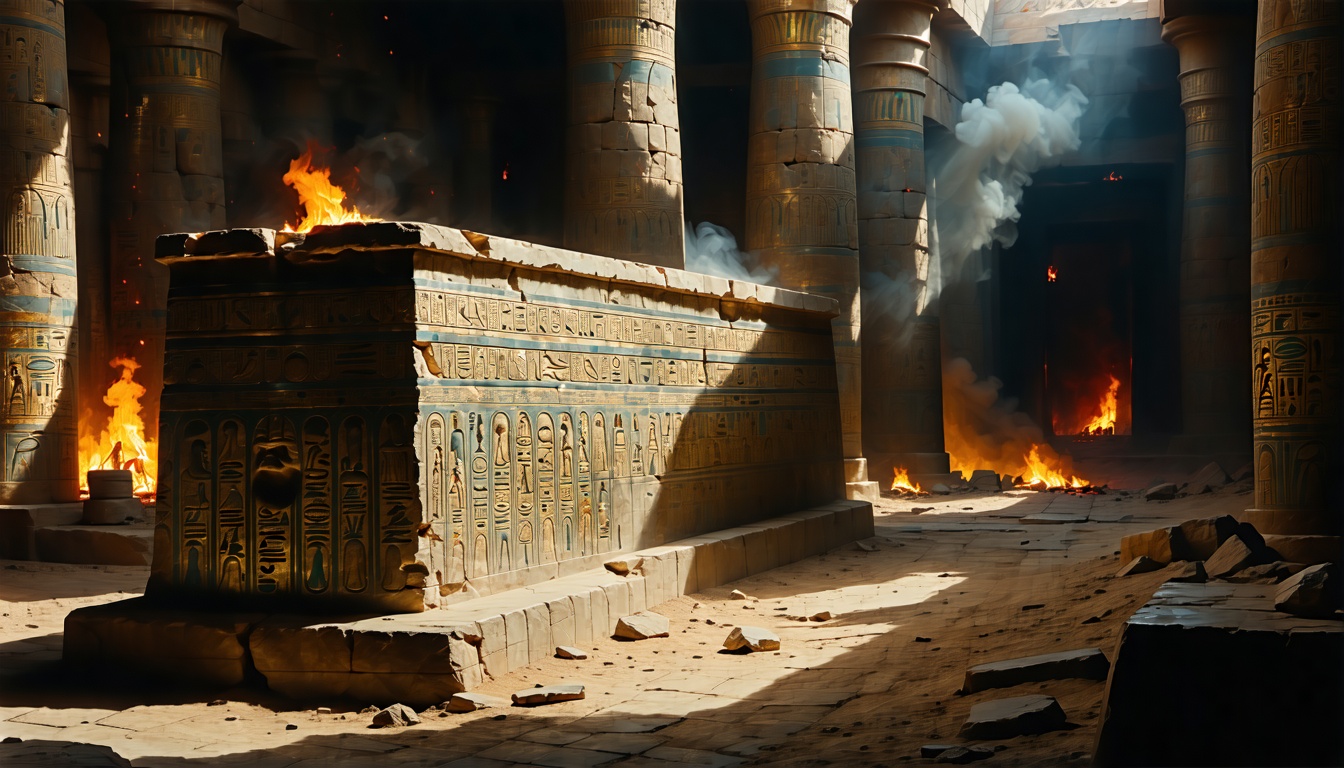
The sarcophagus stood upright in a small chamber. Stone walls on all sides, close enough that he could touch opposite walls if he stretched his arms wide. Hieroglyphs carved deep into every surface—stories and prayers and warnings covering floor to ceiling in dense columns of images and symbols that seemed to writhe in the flickering light.
The light came from a torch. Single torch mounted in a wall bracket, its flame burning with a steadiness that no natural fire should possess, especially in a sealed chamber with no ventilation to feed it.
Impossible. But burning anyway.
Like the castle's torches. Like the manor's electricity. Things that shouldn't work but did because this place existed outside normal reality, operating on rules that bent physics into shapes that served the nightmare's purpose.
He climbed out of the sarcophagus. His legs nearly buckled—weak and trembling, the muscles stiff with the particular atrophy that came from lying motionless for a span of time his body understood even if his mind couldn't measure it. How long had he been lying down? Hours? Days? Longer?
The chamber was small. Maybe ten feet square. The sarcophagus took up most of the space. But there was room to move. Room to examine his prison.
He looked back into the shattered sarcophagus. Linen wrappings lined the interior—ancient bandages yellowed to the color of old bone, stiff with dried preservation oils that had turned them into something closer to papyrus than cloth. Meant for a mummy. Not for him.
Wait. Something tangled in the linen. Small. Metal. Glinting in torchlight.
He reached in. Pulled it free. Chain. Gold chain, the links so fine they felt like liquid between his fingers. And attached—a locket.
His breath caught. Throat closed. Hands shaking before his mind registered why, before conscious thought could catch up with whatever recognition his body had already made.
He knew this locket. Bunny rabbit engraved on front. Tarnished. Old. But familiar. Impossibly familiar.
This. This was real. Violet's locket. How did it survive iterations? How did it cross from timeline to timeline, persisting through resets that erased everything else? How did it remain physical when everything else dissolved between cycles?
He opened it. Photograph inside. Faded. Damaged by heat and time. But visible. Woman's face. Beautiful. Sad. Gone.
Violet.
The memory ambushed him—not as thought but as full sensory immersion, so vivid that for one disorienting moment the tomb dissolved and he was standing in their tiny apartment kitchen. Her laugh. That specific laugh, head thrown back, hand pressed against her sternum as though the joy might crack her ribs, the sound filling the room while he burned pancakes on a Sunday morning. She'd laughed until tears tracked mascara down her cheeks, then kissed the black smoke from his lips and said, "Thomas Crane, you can restart a heart but you can't flip a pancake." The smell of char and coffee and her jasmine shampoo. The weight of her hand on his chest when they slept—her fingers always finding the space between his third and fourth ribs, as though she was checking his heartbeat even in dreams. The way she hummed off-key in the shower, some melody she invented new each time, melodies that existed once and were gone forever because he'd never thought to record them.
All gone. Eighteen months gone. Drunk driver. Red light. Phone call at 2 AM from a colleague whose voice cracked because he knew what the words meant before he said them.
He closed the locket. Pressed it against his forehead. Metal warm against skin. Physical anchor. Proof. Truth.
If the locket was real, maybe she was real. Maybe ALL of it was real. Maybe Thomas Crane was truth and Gray was lie. Maybe the EMT memories were foundation and everything else was nightmare built on top.
Whatever came next—he had this. Had evidence. Had reality in his hand.
The hieroglyphs weren't random decoration. They told a story, and though his knowledge of ancient Egyptian was limited—non-existent really—some symbols carried meaning that transcended language, that communicated through shape and repetition the way a skull on a bottle communicated poison without requiring literacy.
Ankh. Life.
Was. Power.
Scarab. Rebirth.
And others. Darker symbols. Warning symbols that appeared with increasing frequency toward the chamber's only exit, as though the original artists had grown more desperate the closer they worked to whatever lay beyond.
A cartouche. Royal name enclosed in oval. But the name inside had been deliberately defaced—chiseled away with such violence that the surrounding stone had cracked—rage rather than duty in every chisel mark, pure fury given tool and time.
Damnatio memoriae. The Romans called it. But Egyptians practiced it too. Ultimate punishment. Erasing someone's name erased their soul. Prevented them from reaching the afterlife. Condemned them to wander the space between existence and oblivion for eternity.
Whoever was buried here had been condemned. Not just killed. Destroyed. Their identity wiped from history with a thoroughness that spoke of profound fear—you didn't erase a name out of spite, you erased it because you believed the person behind it was dangerous enough to reach back from death if you left them even a syllable to cling to.
He looked at the sarcophagus. The painted surface showed a figure. Human form. Royal regalia. But the face had been scratched away with the same desperate violence as the cartouche.
Condemned. Forgotten. Erased.
But not dead. Because the torch still burned. Because this place still existed. Because the nightmare continued, fed by whatever ancient power had been sealed into these walls alongside the condemned king's ka.
The chamber had one exit. Doorway carved into the stone. No door. An opening leading into darkness thicker and heavier than the darkness he'd woken in—centuries more settled into the stone, compressed into something almost solid.
He had no choice but to go forward.
He took the torch from its bracket. The flame didn't flicker. Burned steady despite the movement. Unnatural.
Beyond the doorway—a corridor. Stone blocks fitted together with precision that modern engineers would struggle to replicate.
The passage ran level for a short distance before beginning a gradual descent—the hill's rock pressing in on all sides as it carried him below the burial chamber, deeper into the body of the hill, toward levels that had never been intended for the living. No mortar. Just perfect cuts, perfect angles, perfect weight distribution—each block seated against its neighbors so tightly that a knife blade couldn't find the seam. The work of master builders who understood mathematics and astronomy and architecture with an intuition that modern civilization had traded for technology.
But old. So old that the dust had its own archaeology, layers of it marking centuries the way tree rings marked years. The air tasted of age and sand and secrets that had been buried long enough to ferment into something toxic—incense burned centuries ago leaving a ghost that still lingered in the stone's pores, decay that had been arrested rather than completed, the distinctive mineral bite of natron wafting from chambers he hadn't reached yet.
The hieroglyphs continued along the walls. More stories. More warnings.
One panel showed a figure drinking from a bowl. But the liquid was wrong. Green. Glowing with a luminescence the ancient artist had captured by mixing the pigment with something metallic that still caught the torchlight after three millennia. Poison maybe. Or something worse—something that changed rather than killed, that transformed rather than destroyed.
Below it—text. He couldn't read it. But the image told enough. Someone had drunk something they shouldn't have. Done something forbidden. And the consequences had outlasted the civilization that recorded them.
Another panel. The same figure surrounded by priests. Kneeling before them. But holding a staff—symbol of power, not submission. A pharaoh who knelt in body but not in spirit, whose compliance was theater and whose defiance was permanent.
A pharaoh. Refusing to kneel even when condemned.
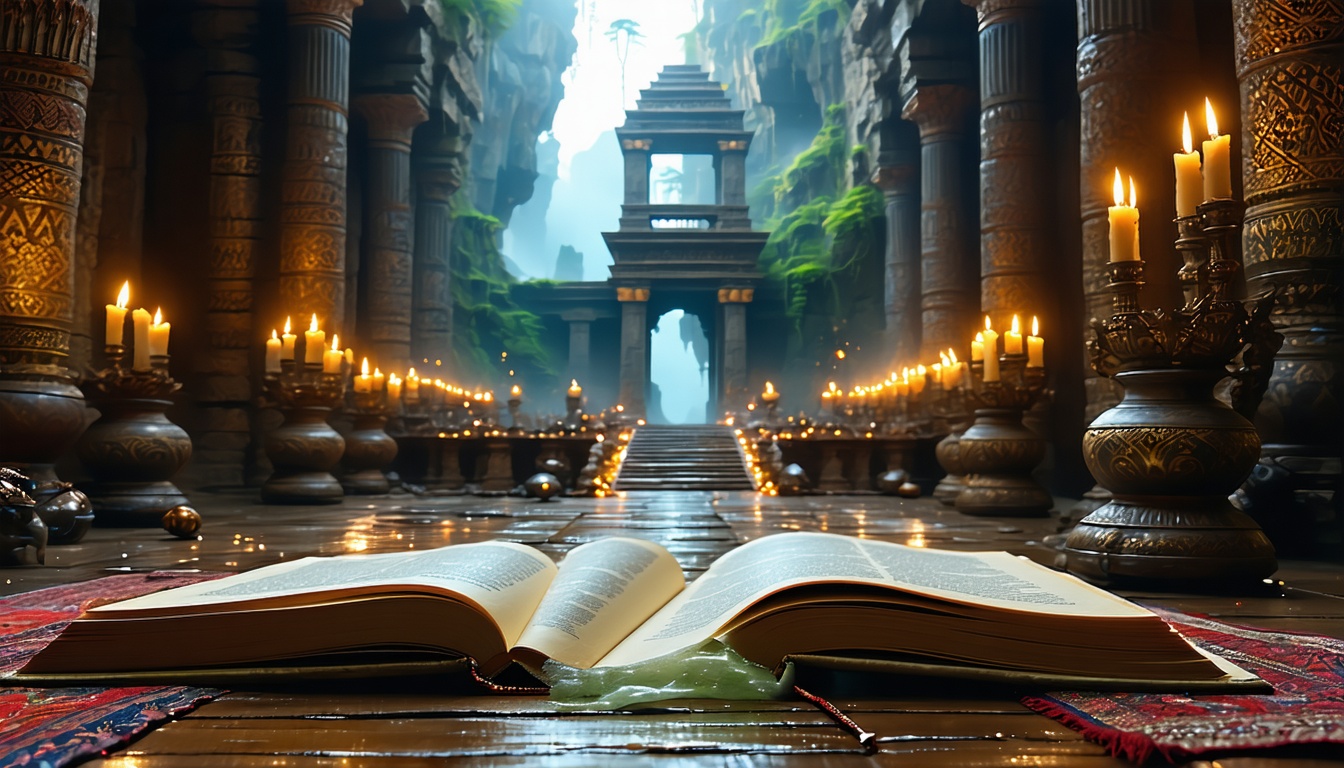
The corridor ended at a larger chamber. The burial chamber proper, and the scale of it hit him before his eyes adjusted—the echo of his footsteps multiplying and returning from walls too far away to see, the ceiling vanishing into darkness overhead like the inside of a cathedral designed by someone who equated proximity to the divine with proximity to madness.
The smell changed as he entered. Stronger. More complex, each component distinct enough to catalog individually: preservation oils that had gone rancid over centuries and then somehow stabilized into something almost sweet, dried flesh that smelled less like death than like leather left in an attic for generations, lotus blossoms or some flower placed with the dead that had mummified alongside its host. And underneath it all, the copper tang of old blood—old sacrifices staining the stone in patterns that the torchlight caught and made shimmer, as though the blood remembered being liquid.
In the center—a massive stone sarcophagus. Not wood like his. Solid granite. Carved from a single piece that must have taken decades of labor to shape and transport. Weighing tons.
The lid was covered in hieroglyphs. Condemnation spells. Binding magic. Layer upon layer of curses designed to imprison the soul for eternity—each line of text a lock, each symbol a chain, the whole surface a cage made of language.
And the name cartouche. Also defaced. But less thoroughly than the one in the smaller chamber. He could make out part of it.
Kha-em-Waset.
Pharaoh Kha-em-Waset. The condemned king. The blasphemer.
This was his tomb.
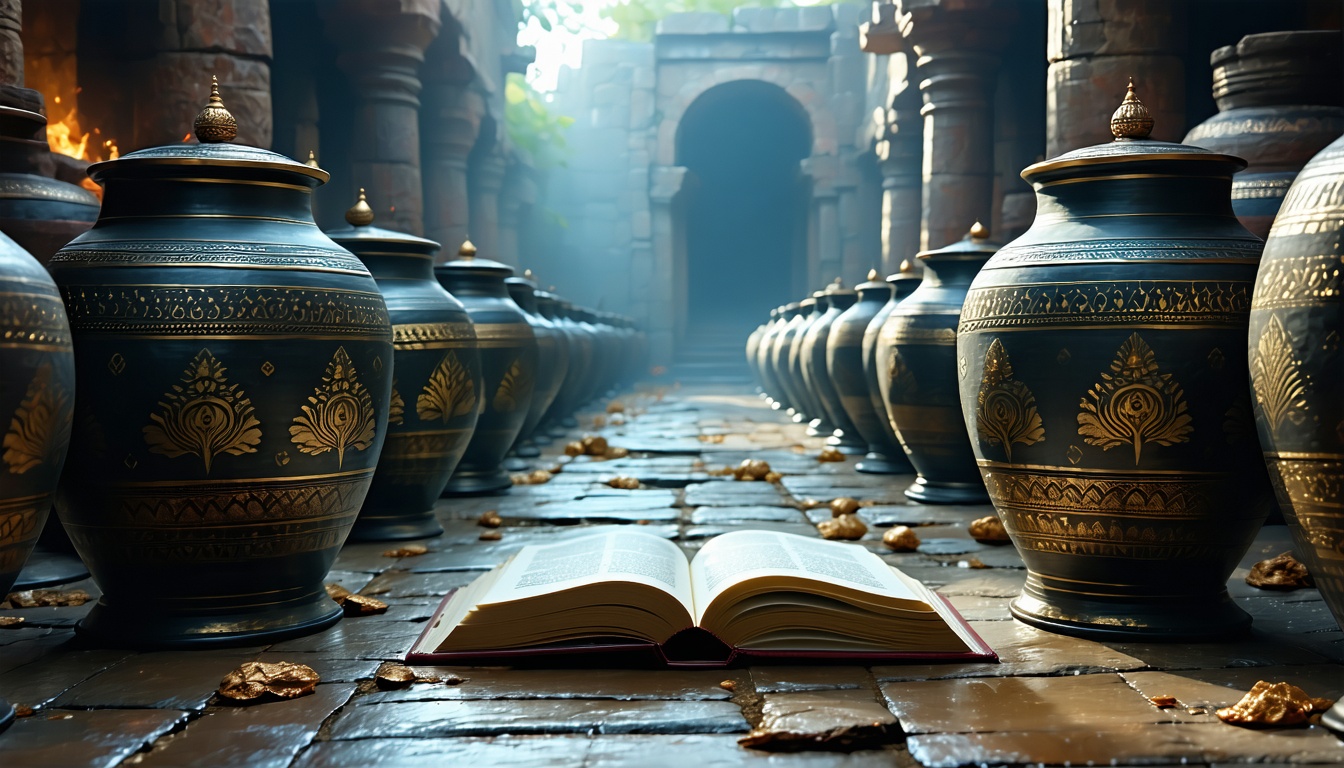
Canopic jars lined the walls. Four large jars with lids carved into the heads of gods—falcon, jackal, baboon, human—their painted eyes watching him with the serene patience of beings who measured time in dynasties. Plus dozens of smaller ones. Hundreds maybe. All containing organs of the dead. All sealed with wax and spells. All meant to preserve the body for resurrection.
But resurrection required the name. Required identity. Required remembrance.
And Kha-em-Waset had been erased. Condemned to exist without existence. To linger between life and death for eternity.
Just like Harrow. Just like the lighthouse doctor. Just like King Aldric.
Different names. Different eras. But the same pattern. The same curse. The same entity wearing different faces across history, the way a disease wore different symptoms but maintained the same pathology underneath. The recognition came faster now—some deep part of him mapping connections his conscious mind hadn't reached yet, cataloguing similarities with the efficiency of someone who'd done this thousands of times.
The precision of that internal cataloguing unsettled him. Not the pattern recognition itself—he'd learned to trust instincts forged across iterations—but how complete the indexing felt. Too organized. Too systematic. As if something had been filing his observations before he consciously made them, sorting his memories into categories that served a purpose he couldn't name. The sensation was faint. Easily dismissed as disorientation from waking in a sarcophagus. But it lingered the way a wrong note lingered after the music stopped.
He approached the granite sarcophagus. The surface was cold despite the heat—unnaturally cold, like touching a block of ice that refused to melt. The smell of preserved death was strongest here, myrrh and frankincense and something underneath that was purely decay held in stasis, arrested mid-process like a photograph of rot.
The lid was sealed. Impossible to move without heavy equipment. But there was writing on the side. More hieroglyphs. More warnings.
And one symbol he recognized from museums and documentaries.
The Eye of Horus. Protection against evil.
But this one was inverted. Upside down. Reversed.
Protection against good. Sealing evil inside.
A sound echoed through the chamber. Distant. Deep. Like stone grinding on stone somewhere in the temple's guts, some mechanism older than memory engaging after millennia of stillness.
He turned. The entrance he'd come through was gone. Solid wall where the doorway had been—stone indistinguishable from the walls that had stood for millennia, as though the opening he'd walked through had never existed.
The curse. The binding spells that imprisoned the pharaoh's ka also gave him limited dominion over the temple's structure—he could seal passages, shift stone blocks, reshape his domain. Not true reality manipulation. Masonry responding to will, ancient mechanisms triggered by ancient power, the architecture itself serving as an extension of the condemned king's rage.
Sealed in. Trapped. With the condemned pharaoh's sarcophagus.
Another sound. Closer. Not stone this time. Voice. Chanting. Ancient Egyptian words that rose and fell in rhythmic cadence, the syllables carrying a weight that pressed against his eardrums like changes in atmospheric pressure.
The canopic jars began to rattle. All of them. Hundreds of jars shaking simultaneously, lids vibrating against wax seals that had held for millennia and were now failing, one by one, with soft pops that sounded obscenely like knuckles cracking.
The torch flame changed color. From yellow-orange to sickly green—the same green as the liquid in the hieroglyph, the same green as the between.
The sarcophagus lid moved. Slightly. Scraping. Grinding. Rising with the inevitable patience of something that had been waiting for this moment since before his civilization existed.
Something inside was waking up.
He backed toward the wall, searching for any exit—a crack, a seam, anything. Tombs had false doors. Secret passages. Escape routes for tomb builders who knew better than to trust the dead to stay dead.
But the walls were solid. Hieroglyphs mocking him with their incomprehensible warnings.
The lid rose higher. Six inches. A foot. Darkness visible in the gap. And something else.
Light. Green light. Glowing from inside the sarcophagus with an intensity that cast shadows in directions that didn't correspond to any geometry the chamber should have allowed.
And eyes. Two points of emerald fire. Looking at him.
Seeing him.
Judging him.
The voice grew louder, words forming in the chant that were still ancient Egyptian yet somehow understandable—the meaning bypassing language entirely and arriving in his mind fully formed, like thoughts that had always been there waiting to be noticed.
"*Defiler. Thief. Violator of the sacred.*"
"I didn't—" he started.
"*You woke me. You entered my tomb. You breathed my air. You stand in my presence without permission.*"
"I was already here. In the small sarcophagus. Someone put me there."
"*Then you are a sacrifice. An offering. Payment for disturbance.*"
The lid flew open. Crashed against the wall with a sound like thunder trapped underground. The impact sent cracks racing through the stone and shook dust from the ceiling in sheets.
The sarcophagus was empty.
No. Not empty. There was something. Bandages. Linen wrappings. Thousands of them coiled in the space where a mummy should be, arranged in loops and spirals that suggested a body's shape without containing one—an outline drawn in cloth, a negative space where a king had once been.
But no body. Just wrappings.
And the eyes. The green fire. Hovering in the space above the bandages. Watching.
A ka. A soul separated from its body. Existing without form. Imprisoned in the tomb for eternity.
Pharaoh Kha-em-Waset. The Living God. The Blasphemer. The Condemned.
The green eyes moved. Circling him. Examining. Searching for weakness with the methodical patience of a predator that had never needed to hurry because its prey had nowhere to run.
"*You are not Egyptian. Not of this land. Not of this time. What are you?*"
"A prisoner. Like you."
The eyes stopped. Focused on him with an intensity that pressed against his temples and behind his eyes—a migraine forming in real-time, the pharaoh's attention carrying actual weight.
"*I am not imprisoned. I am entombed with honor. This is my palace. My domain. Mine for eternity.*"
Delusion. Or insanity. Or both—the mind's final defense against a truth too devastating to integrate, the same desperate fiction a father told himself to survive what he'd become. The pharaoh couldn't accept his condemnation. Couldn't acknowledge the curse. Thomas had stood before this exact madness three times already—different names, different centuries, same refusal to see the prison for what it was.
"Your name was erased," he said. Careful. Respectful. Speaking the way he'd once spoken to patients in psychotic breaks—with honesty that honored their humanity even while contradicting their reality. "Your cartouche defaced. You were condemned by the priesthood."
"*LIES!*" The voice thundered. The chamber shook. Dust fell from the ceiling in curtains. Cracks appeared in the walls, racing outward from the sarcophagus like fractures in ice.
"*I am Kha-em-Waset! Son of Ra! Living God! Eternal King! My name shall never be forgotten!*"
But it had been. For three and a half thousand years. Erased from history. Removed from king lists. Reduced to myth and rumor and the kind of silence that was louder than any record.
The green eyes blazed brighter. The temperature in the chamber plummeted—heat to cold in seconds, so fast that his breath misted in the air and the moisture on his skin crystallized into frost that burned like fire in reverse.
Ice formed on the walls. On the canopic jars. On the sarcophagus. The preservation oils froze into amber-colored glass.
Beneath the pharaoh's supernatural cold, something else registered. Faint. Almost subliminal. A different quality to the chill—not the rage-driven freezing of an ancient king but something precise, something sterile. The way a laboratory maintained exact temperatures for a sensitive experiment. It was there for one breath and gone the next, swallowed by the pharaoh's theatrical fury before Thomas could examine it. He filed the sensation away. Didn't understand it. But his body—trained by four thousand iterations to notice things his mind hadn't learned to name—marked it as significant.
"*You will serve me. As all must serve. As the priests served. As my family served. As my—*"
The voice fractured. For an instant. The green fire in those hovering eyes dimmed to something softer—not rage but bewilderment, the look of a man waking from a dream he couldn't remember entering. The cold in the chamber shifted, losing its edge, and in that single heartbeat Thomas could have sworn the ka's outline flickered into something smaller. Someone standing with arms held out, reaching for something at waist height. The posture of a father lifting a child.
Then the green blazed back. Hotter. Harder. As though the slip had never happened.
"*As Egypt served.*"
"No."
The word came out before he could stop it. Instinctive. Defiant. The same refusal his body made automatically now—worn smooth by four thousand repetitions, emerging from somewhere deeper than thought, from the bedrock of identity that persisted even when memory didn't.
The eyes narrowed. The cold intensified until his joints ached and his fingers went numb.
"*You dare refuse a god?*"
"You're not a god. You're a prisoner. Same as me. Same as all the others."
"*I AM KHA-EM-WASET! I DRANK THE SACRED OILS! I PERFORMED THE RITUALS! I ACHIEVED DIVINITY WHILE LIVING! I CANNOT DIE! I WILL NOT DIE!*"
The bandages erupted from the sarcophagus. Thousands of linen strips flying through the air with directed malice, each one reaching for him with the blind certainty of roots seeking water.
He ran. Torch held high. Searching for the exit that had vanished.
The bandages wrapped around his legs—dry and rough against his skin, tightening with strength that no cloth should possess. They pulled. Dragged him across the stone floor toward the sarcophagus. Toward the green eyes. Toward the imprisoned ka that wanted company in its eternal sentence.
He slashed with the torch. The fire caught. Linen burned—ancient dried fabric going up like kindling, three thousand years of desiccation turning each strip into a fuse. The smell of burning cloth filled the chamber, acrid and choking, mixing with the preservation oils to create smoke that stung his eyes and coated his throat.
The pharaoh screamed. Not pain. Rage. The bandages released him, retreating, coiling defensively around the sarcophagus like a wounded animal protecting its belly.
A doorway appeared where solid wall had been seconds before—the pharaoh's rage breaking his concentration, his control over the temple's geometry fluctuating with his emotions. The same power that sealed passages could open them when focus slipped.
The only escape.
He ran for it. The pharaoh's voice followed, reverberating through the stone until it seemed to come from everywhere and nowhere.
"*You cannot escape! This is my tomb! My domain! All who enter serve me for eternity!*"
He plunged down the stairs. Into the darkness. Away from the green eyes and the condemned pharaoh and the sealed chamber that smelled of frozen death and burning linen.
Behind him—the doorway sealed. Stone grinding on stone. Trapping the pharaoh in his eternal tomb.
For now.
But this was the beginning. The first chamber. The first encounter with a mind that had spent three millennia fermenting in isolation, and whose madness was only beginning to reveal its architecture.
The temple was vast—designed to hold thousands, built to last for eternity, and filled with the accumulated fury of a king who had been promised godhood and received a prison instead.
And somewhere in the depths, buried beneath layers of sand and stone and curse and time, the truth waited. The heart of the pharaoh's madness. The source of the curse. The same pattern he'd found in the manor, in the shoreline, in the castle—grief and loss and desperation twisted into something monstrous by the inability to accept that death was permanent and love was not enough to prevent it.
He descended deeper into the temple.
The stairs seemed to go on forever. Down and down into the earth. Into the darkness beneath the desert. Into the tomb that shouldn't exist but did, maintained by the same impossible persistence that kept torches burning in sealed chambers and dead kings raging in emptied sarcophagi.
And somewhere in the stone around him—a vibration. Not the pharaoh's awareness, which pressed against his thoughts like approaching weather. This was different. Subtler. A pulse at intervals too regular for anything geological, too precise for anything supernatural—a rhythm that belonged to machines, not magic. It registered against his fingertips where they brushed the wall, hummed once through his bones, then ceased, as if whatever produced it had become aware of his attention and chosen to withdraw.
He kept descending. The vibration didn't return.
The smell of incense and death faded as he went deeper, replaced by something older—stone and dust and the particular emptiness of spaces that had never been meant for the living, that had been carved not as rooms but as containers for something that required darkness and depth and the crushing weight of earth above to keep it sealed.
And above—the sarcophagus. The green eyes. The pharaoh.
Waiting. Watching. Planning with the patient malice of a mind that had nothing but time and rage and the memory of a name that no longer existed.

Join the Discussion