The Temple - Chapter 2: Break Free
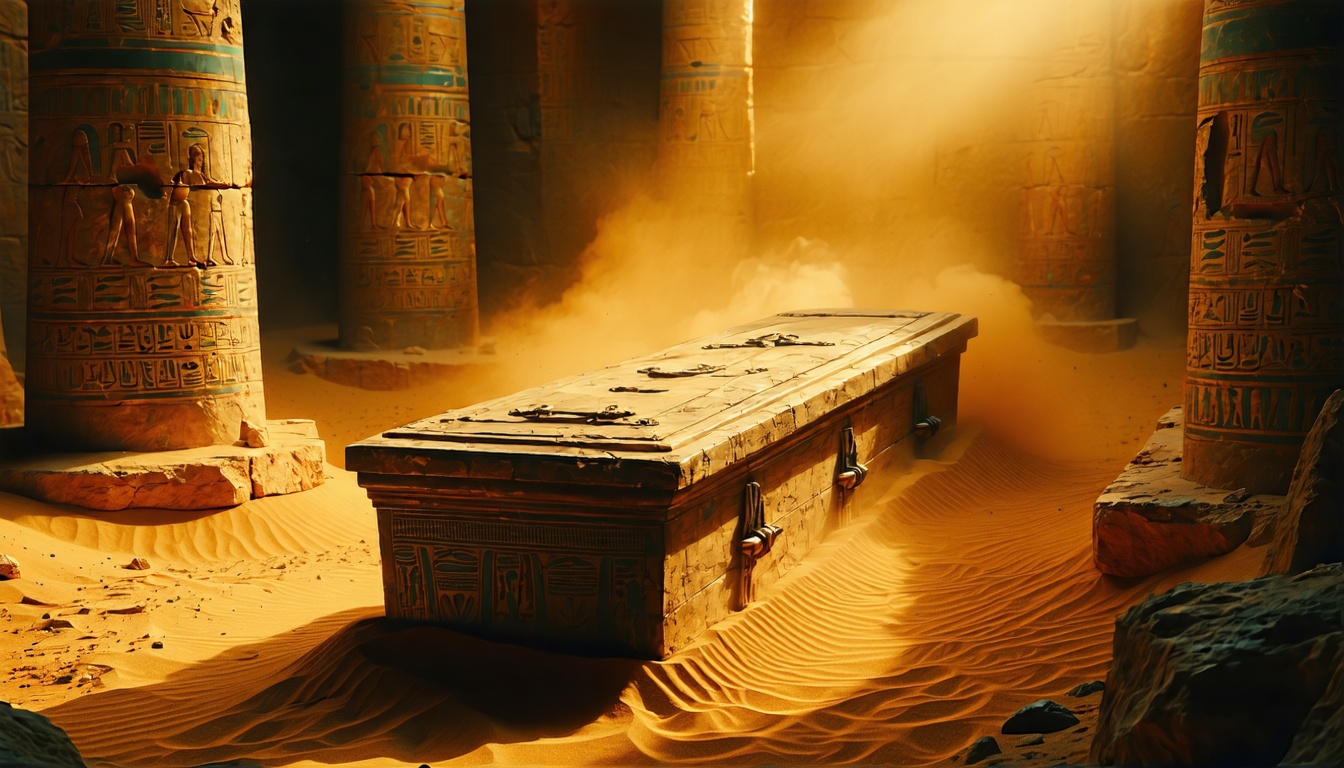
The stairs ended in sand.
Not a room. Not a chamber. Just sand—compacted by millennia into something half-stone, half-desert, the grains fused together by pressure and time until they formed a surface that crumbled under his weight like old plaster. At the junction between stairway and sand, hairline cracks spider-webbed through ancient mortar, and through those cracks came the faint whisper of moving air carrying moisture that had no business existing this deep underground. Water vapor. The sand here remained almost liquid, fed by an underground aquifer that had slowly infiltrated the sealed tomb over centuries, turning what should have been an impenetrable barrier into something treacherous and alive.
He stumbled as the stairs gave way beneath him. Fell forward. His hands sank into wet sand up to his elbows, the grains closing around his forearms with a sucking intimacy that made his skin crawl. Cold. The sand was cold where the water touched it—a shock after the tomb's dry heat, like plunging his arms into a winter creek. The torch fell from his grip, its flame sputtering against the damp surface, and for three heartbeats he was in darkness again, that absolute darkness from the sarcophagus, and the panic surged before the flame caught and held.
He grabbed the torch. Held it high with fingers that trembled from more than cold.
The light revealed a burial chamber of staggering scale. Cathedral-sized. The ceiling vanished into shadows overhead, and the pillars that supported it rose from the sand like the trunks of petrified trees, their surfaces carved with hieroglyphs that the moisture had blurred into ghosts of meaning. Water stains climbed the stone in tide lines that marked centuries the way growth rings marked years—each line a record of the aquifer's slow invasion, its patient dissolution of the barriers the ancient priests had built to keep this place sealed.
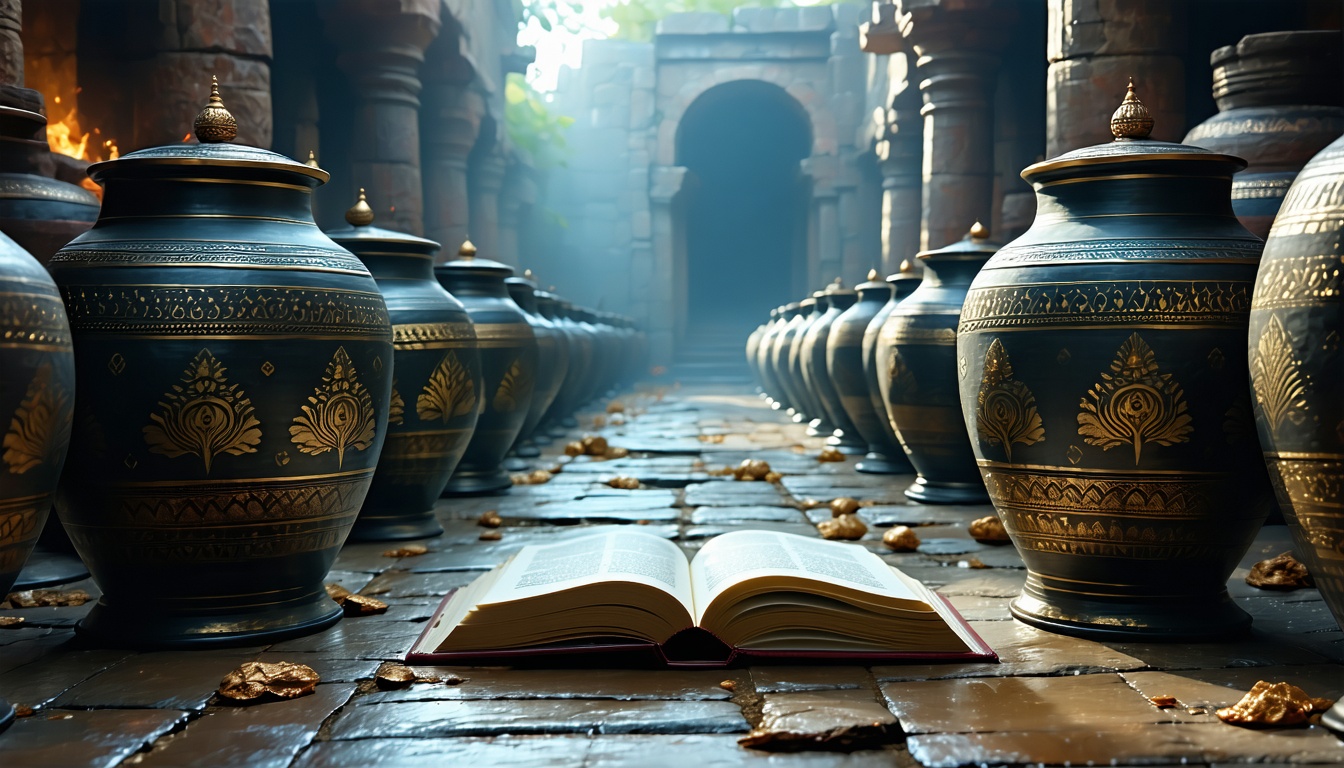
And everywhere—sand. Drifts of it piled against walls in dunes that mimicked the desert above, as though the Sahara had sent an emissary underground to reclaim what had been stolen from it. Half-buried sarcophagi jutted from the drifts at angles that suggested they'd been shifted by the sand's movement, their painted surfaces worn smooth on the windward side. Canopic jars lay scattered where drifts had toppled them—some cracked, spilling their preserved contents into the wet sand where organs that had been maintained for three thousand years were finally, quietly, completing their decay. The smell was extraordinary: part preservation chemicals, part standing water, part the rich organic funk of things that had been dead so long they'd forgotten what decay was supposed to smell like and were improvising.
The temple was deliberately buried. He could see it in the architecture—blocked doorways packed tight with rubble and sand, sealed passages where the mortar had been applied in frantic layers, the intentional burial of a condemned space. The priesthood had done this after erasing Kha-em-Waset's name. They'd filled the chambers, sealed the entrances, and let the desert reclaim what should never have existed, trusting the weight of a continent's worth of sand to keep the condemned king contained.
But the aquifer had found its way in. Over endless centuries, water had seeped through bedrock fissures, dissolving the mortar between stone blocks, liquefying the sand barriers, turning the priests' careful seals into permeable membranes. The barrier between desert-above and tomb-below was failing—slowly, inexorably, with the patience that only geological processes possessed.
He waded through the sand. Each step required deliberate effort, his feet sinking to the ankles where moisture had created suction that gripped his boots and released them with soft, obscene sounds. The sand shifted around him as he moved, redistributing his weight in ways that felt intentional, as though the chamber was adjusting to his presence the way a sleeping animal adjusted to a fly landing on its flank.
The torch light caught something ahead. Wood. Dark wood sticking up from the sand at an angle. Too regular to be natural. Too new.
He approached, each step a negotiation with the sand that wanted to hold him. Pulled away wet grains with his free hand, the sand packing under his nails and staining his skin the color of weak tea.
A coffin. Modern. Twentieth century—machine-milled wood, factory-stamped brass hardware, the kind of mass-produced burial container that funeral homes sold by the thousands. Nailed shut with finishing nails that had already begun to rust in the tomb's moisture. With a name plate, tarnished but legible.
*Ahmed Hassan. Beloved son and brother. 1985-2023.*
Recent. Someone had been buried here within the last three years, in the condemned pharaoh's temple, miles beneath the desert in a chamber that should have been inaccessible. The coffin's wood still smelled of varnish beneath the sand, still held the faint chemical sweetness of embalming fluid—modern death sealed inside ancient death, the present folded into the past like a letter slipped between the pages of an old book.
He dug deeper. More coffins emerged from the sand as he swept his arm across the surface of the drift. Dozens of them, arranged in rough rows that suggested someone—or something—had placed them with deliberate care. All modern. All recent. All brought here by something that called to them, that drew the dead to this place the way gravity drew water downhill.
Just like the manor. Just like the shoreline. Just like the castle. Victims pulled into the network.
He knelt beside one coffin long enough to read the name: *Sarah Chen. 1991-2022. Taken too soon.* The words hit him sideways—not recognition, he'd never known a Sarah Chen. But the shape of the grief on the nameplate, the careful font selection of someone trying to dignify a loss that defied dignity, triggered something beneath conscious thought. His vision stuttered. For one lurching instant he was kneeling beside a different coffin in a different nightmare—pine instead of mahogany, rain instead of sand, a name he couldn't read because his eyes were full of tears that belonged to an iteration he didn't remember living. Two heartbeats. Then gone—leaving only the tremor in his hands and the metallic taste of someone else's tears on the back of his tongue. He steadied himself against the coffin's edge and read the next name through the aftershock: *Marcus Williams. 1978-2023. Rest in peace, brother.* Each name a life, each life ended and somehow deposited here in this impossible place, their remains adding to the pharaoh's collection of the dead. How many more lay beneath the sand, buried too deep for his torchlight to reach? How many years of victims filled this cathedral-sized chamber?
He stood. Kept moving. The chamber had to have another exit.
The sand shifted beneath his feet. Suddenly. Violently. The surface that had been merely treacherous became actively hostile—a circular section twenty feet wide liquefying all at once as the aquifer surged from below, turning compacted sand into something with the consistency of wet concrete. He fell. The torch flew from his hand, spinning end over end, its flame painting wild arcs on the ceiling before it landed upright in a drift ten feet away, still burning, impossibly still burning.
The sand was moving. Swirling. Creating a vortex that pulled everything toward its center with a current he could feel in his bones. The aquifer water had saturated this section completely, and some shift in the underground water table—natural or engineered, he couldn't tell—had liquefied it into a trap that swallowed everything it touched. The modern coffins nearest the vortex tilted, slid, disappeared beneath the surface with sounds like wooden bones breaking.
He tried to swim. But the saturated sand was too heavy, too dense—his arms plunged through the surface but couldn't generate enough force to propel him forward, the grains clinging to his skin and clothes with the desperate grip of drowning hands. The vortex pulled him toward the center, where the sand was darkest, where the water was deepest, where Ahmed Hassan and Sarah Chen and Marcus Williams and all the other modern dead were being swallowed for a second time.
His hand hit metal. He grabbed it with both hands, felt the shape—an archaeologist's survey marker, iron post driven into the chamber floor, corroded but solid, anchored in stone beneath the sand. He held on while the vortex tried to strip him from his handhold, the current pulling at his legs with the impersonal strength of something that didn't care whether he lived or died, that operated on principles older than intention.
He hauled himself out, hand over hand along the marker post, emerging from the liquefied sand in stages—torso, then hips, then legs, each section of his body surrendering reluctantly, the sand making sounds like suction cups releasing. He collapsed on firmer ground, gasping, his clothes sodden with water that smelled of minerals and preservation chemicals and the particular rot of things that had been dead long enough to become a new kind of soil.
The sand stopped moving. Settled. And revealed a hole in its center—a dark shaft descending to deeper levels, exposed by the vortex like a bone exposed by erosion.
Beside it lay a skeleton. Modern clothing rotted to rags but recognizable: khaki cargo pants, cotton field shirt, the kind of practical expedition wear sold at outdoor supply stores in every college town in the world. Tool belt still buckled around what had been a waist. Flashlight clipped to the belt. Notebook in a breast pocket, protected by the pocket flap from the worst of the moisture.
A tomb raider who'd triggered the same trap. Died here, within sight of the shaft that might have saved him, close enough to touch the escape he never reached.
The notebook was still readable—the pages warped and stained but the ink legible, the handwriting deteriorating from careful academic script to desperate scrawl as the entries progressed.
He opened to the last entry.
*"Day 7. Ahmed is hearing voices. He says the pharaoh speaks to him in dreams—promises him a place in the court, a title, eternity. He believes it. God help us, he actually believes it. We should have listened to the warnings. Every local guide refused to bring us past the outer chambers."*
*"The exits are sealed. We tried explosives on the northern passage—debris cleared, sand flowed back within an hour. The aquifer section acts like quicksand when disturbed. Dr. Rashid went under yesterday, screaming. We saw her hands above the surface for almost a minute before the sand pulled them down. We couldn't reach her."*
*"I can hear it now too. The voice. Ancient. Patient. Offering a choice with the certainty of someone who already knows the answer. Serve willingly and live—as whatever 'live' means in a place where the dead walk and the walls rearrange themselves. Or resist and die in the sand, slowly, aware the entire time, your consciousness preserved even as your body dissolves."*
The entry ended there. The archaeologist had died before writing again, had joined the skeletons and the modern coffins and the ancient dead in the pharaoh's ever-growing collection.
He took the flashlight from the dead man's belt. Clicked it on. The beam was weak—battery nearly depleted—but it cut deeper into the darkness than the torch, revealing details the firelight had only suggested: the walls pocked with erosion, the ceiling webbed with cracks that wept mineral-stained water, the far end of the chamber where the sand drifts were deepest and the coffins most densely packed.
The hole led down. Deeper into the temple. Into whatever existed beneath the burial chamber, beneath the aquifer, beneath the layers of sand and stone and curse that separated the pharaoh's domain from whatever had existed before him.
He slid into the shaft. The damp sand cascaded around him like a cold, gritty waterfall, filling his ears and the creases of his clothes and the spaces between his fingers. He descended in controlled stages, bracing his back against one wall and his feet against the other, chimneying down through darkness that smelled of wet earth and something metallic—iron deposits in the groundwater, maybe, or something older and less geological.
His feet hit stone. The shaft had deposited him on a floor made of something different—not the limestone of the upper chambers but a dark, dense rock that absorbed the flashlight beam rather than reflecting it. Basalt, maybe. Volcanic stone that had no business existing in the sedimentary geology of the Egyptian desert.
Older architecture here. Pre-dynastic. This part of the temple predated Kha-em-Waset by millennia—predated Egypt itself, predated the civilization that had carved the hieroglyphs above, predated the concept of pharaohs and priests and condemnation. Whatever had built this section had done so when the desert was still savanna and the Nile valley was a different world entirely.
The flashlight caught hieroglyphs of a sort, though "hieroglyphs" was the wrong word for images this crude. Pictographs. Primitive marks carved with stone tools into walls that had been smoothed by hands rather than instruments. Images of figures that weren't quite human—elongated limbs, oversized craniums, fingers that had too many joints. They were performing surgery, the images showed it clearly: opening skulls with instruments that looked like curved thorns, replacing organs with something the artist had represented as a glowing mass inside the body cavity. Something green.
The between. The substance. Ancient beyond Egypt itself, ancient beyond any civilization that had left records, reaching back into a period of human history—or pre-human history—that had been deliberately erased, the way Kha-em-Waset's name had been erased, the way all inconvenient truths were erased: thoroughly, violently, and never quite completely enough.
The corridor ended at a circular chamber with a domed ceiling that curved overhead like the inside of a skull. And in the center—an altar of polished black stone, the same basalt as the floor, carved from a single piece and polished to a mirror finish that reflected the dying flashlight beam back at him as a distorted green glow.
On the altar—a bowl containing liquid. Still liquid after thousands of years, still viscous and alive-looking, still moving with slow internal currents that had nothing to do with the air in the chamber because there was no air movement, no draft, nothing to explain the gentle, rhythmic pulse of the liquid's surface.
Green liquid. Glowing faintly. Casting shadows that moved independently of the flashlight beam, shadows that seemed to lean toward him the way plants leaned toward light.
He could feel the pull. The temptation. The promise whispered directly into his mind, bypassing ears and language entirely, arriving as pure desire—the want to drink as immediate and involuntary as the want to breathe.
*"Drink. Achieve immortality. Transcend death. Everything you've lost can be recovered. Everything that was taken can be returned. The separation is temporary. The grief is optional. Drink, and time becomes a tool rather than a thief."*
The voice wasn't external. It was thought. Desire twisted and amplified until it felt like his own longing, as though the suggestion to drink had always been there, waiting in the part of his mind where he kept the memory of Violet's laugh and the weight of the daughter he never held.
*"Others have drunk. Others have transformed. You could join them. You could see her again."*
"No."
He spoke aloud, and his voice sounded thin and human in that ancient space, a candle flame asserting itself against the dark. "I've seen what you do. You don't grant immortality. You grant eternal imprisonment. Eternal consciousness without freedom."
*"You cannot refuse endlessly. Given enough iterations, you will break. The question is not whether. Only when."*
"Maybe. But not today."
He turned from the altar.
The chamber shook. Dust fell from the domed ceiling in streams. Cracks appeared in the basalt floor, radiating outward from the altar like the spokes of a wheel.
He ran. Back toward the shaft. The sand was pouring down again—the aquifer section liquefying above, burying the ancient chamber in a cascade of wet sand that poured through the shaft opening like an hourglass counting down to something he didn't want to be present for.
He climbed, fighting the cascade that tried to push him back down, his fingers finding cracks in the stone, his arms burning with the effort of pulling his body weight plus the weight of the sodden sand that coated him. Sand filled his mouth, his nostrils, ground between his teeth with a sound like static. He pulled himself up inch by inch, driven by the kind of determination that existed below thought, below choice—the body's refusal to stop moving even when the mind had run out of reasons to continue.
He burst into the upper chamber. But it had changed. The modern coffins were gone—Ahmed Hassan, Sarah Chen, Marcus Williams, all vanished as though they'd never existed. Only ancient stone sarcophagi remained, sealed with spells, holding the original dead.
And they were opening. Lids grinding aside with the slow deliberation of things that had all the time in the world.
Mummies. Dozens of them. Wrapped in linen but moving—sitting up in their sarcophagi with the stiff, mechanical precision of marionettes pulled by invisible strings. The pharaoh's bound servants, their kas enslaved to his will, their bodies preserved as vessels for his commands. Not conscious. Not alive. Just extensions of Kha-em-Waset's trapped power, animated by the same curse that imprisoned him, doing the only thing their limited existence allowed: obeying.
They sat up. Wrapped heads turning. Eyeless faces somehow oriented toward him with an accuracy that suggested they sensed him through something other than sight—heat, maybe, or heartbeat, or the particular electromagnetic signature of a living consciousness in a place designed to house only the dead.
He ran. Through the sand, his feet finding purchase on the firmer ground near the chamber walls, his torch recovered and held high. Toward the stairs.
The mummies followed. Slow but tireless. Their feet dragged through the sand with a dry rasping sound, like pages turning in a very old book. They had eternity. He had minutes.
He found a doorway. Different from the stairs—wider, with a lintel carved in the shape of two rearing cobras whose stone hoods met at the apex in a gesture that might have been protection or might have been warning. Leading into corridors he hadn't explored.
He plunged through. Into darkness that smelled of stone and age and the particular sterile emptiness of spaces that had been sealed since before the concept of "sealed" existed.
Behind him—the mummies. Their footsteps, that dry paper-shuffle sound. The whisper of ancient linen dragging across stone. The faint, impossibly faint sound of joints that had been still for centuries bending in ways that cartilage and tendon had never been designed to accommodate.
The hunt had begun.
The temple was vast—designed to trap, to confuse, to ensure that no one who entered uninvited would ever find their way out. Every corridor looked like every other corridor. Every chamber opened onto three more. The architecture had been built not for habitation but for imprisonment, and it performed its function with the same inhuman efficiency that everything in this place possessed.
But he wasn't a thief. He wasn't a tomb raider who'd come seeking gold and artifacts and the kind of glory that academics built careers on. He was a prisoner—same as the pharaoh himself, same as the mummies that pursued him, same as Dr. Rashid frozen somewhere above and the archaeologist dead beside his survey marker.
And prisoners learned to escape.
Or died trying.
He ran deeper into the temple, the flashlight's dying beam showing him just enough of the path ahead to keep moving, just enough darkness beyond to keep him afraid. Behind him the mummies followed, patient and inexorable, their ancient feet marking a rhythm on the stone that sounded, if he listened long enough, almost like a heartbeat.

Join the Discussion