The Temple - Chapter 3: The Antechamber
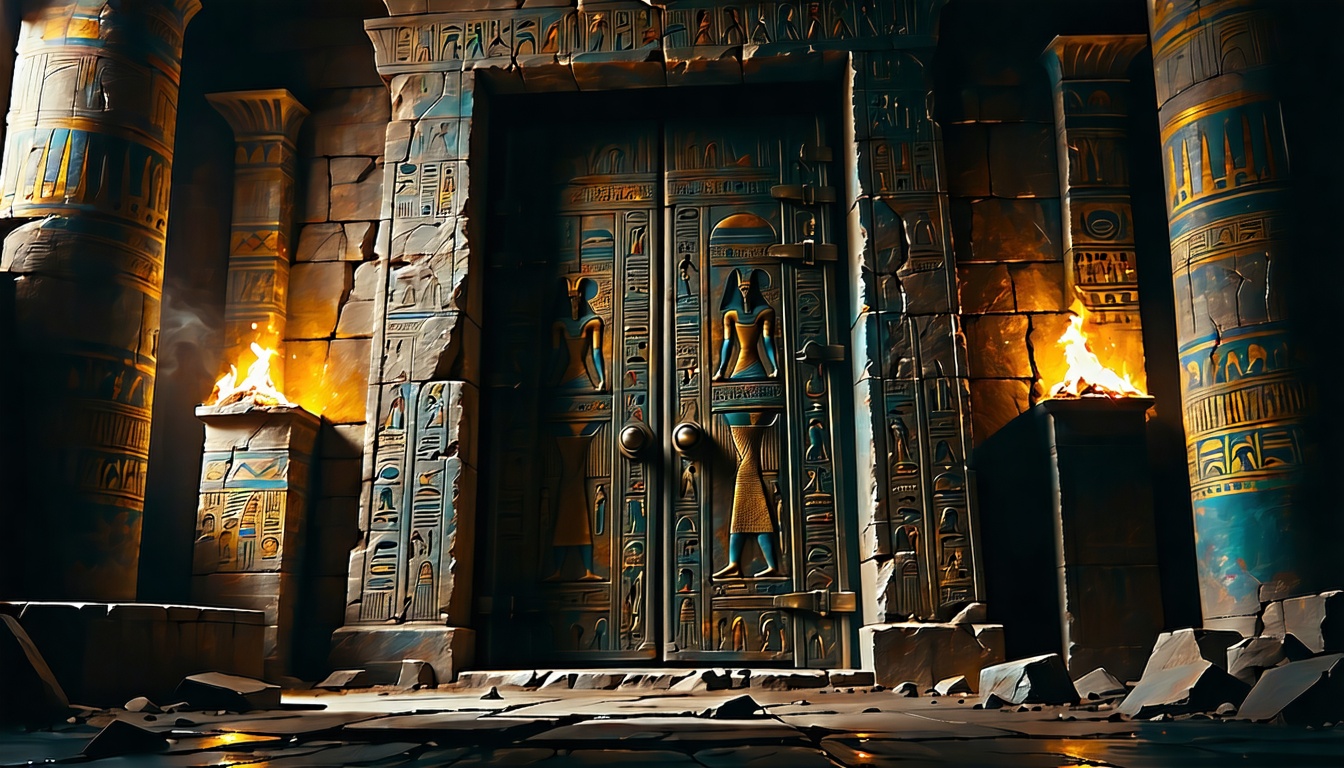
The corridor ended at a massive door.
Not wood this time. Stone. Solid granite. Eight feet tall, and the hieroglyphs covering its surface weren't carved—they were burned into the rock, each symbol blackened at its edges, whatever tool had created them generating heat the stone still remembered. Warning after warning after warning.
He couldn't read ancient Egyptian. But the images told the story clearly enough.
A figure entering. A figure turning back—too late, the doorway already sealed behind it. A figure consumed by green fire that poured from the walls like liquid. A figure screaming, its mouth stretched wider than any human jaw could open. A figure transformed into something that still wore a human shape but had stopped being human in every way that mattered, its eyes replaced with the same green fire, its hands elongated into instruments of a purpose the artist either couldn't or wouldn't depict.
The message was clear: *Turn back. Defiler. Only death waits beyond.*
But behind him—the mummies. Dozens of them filling the corridor with their dry shuffle and the papyrus whisper of ancient linen moving against stone. They'd been herding him since the burial chamber, cutting off side passages with their bodies, appearing in doorways he'd considered entering, channeling him forward with the coordinated precision of wolves driving prey toward a kill zone. He had no choice.
Forward or face an army of the undead that never tired and never hurried because they had already waited three thousand years and could wait three thousand more.
He pushed against the door. Expected resistance. Expected locked. Expected impossible.
It swung open easily. Smooth. Well-balanced despite its massive weight—ancient engineering that still functioned after ages untold, the pivot mechanism hidden inside the stone's thickness, lubricated by something that wasn't oil and hadn't dried out over millennia.
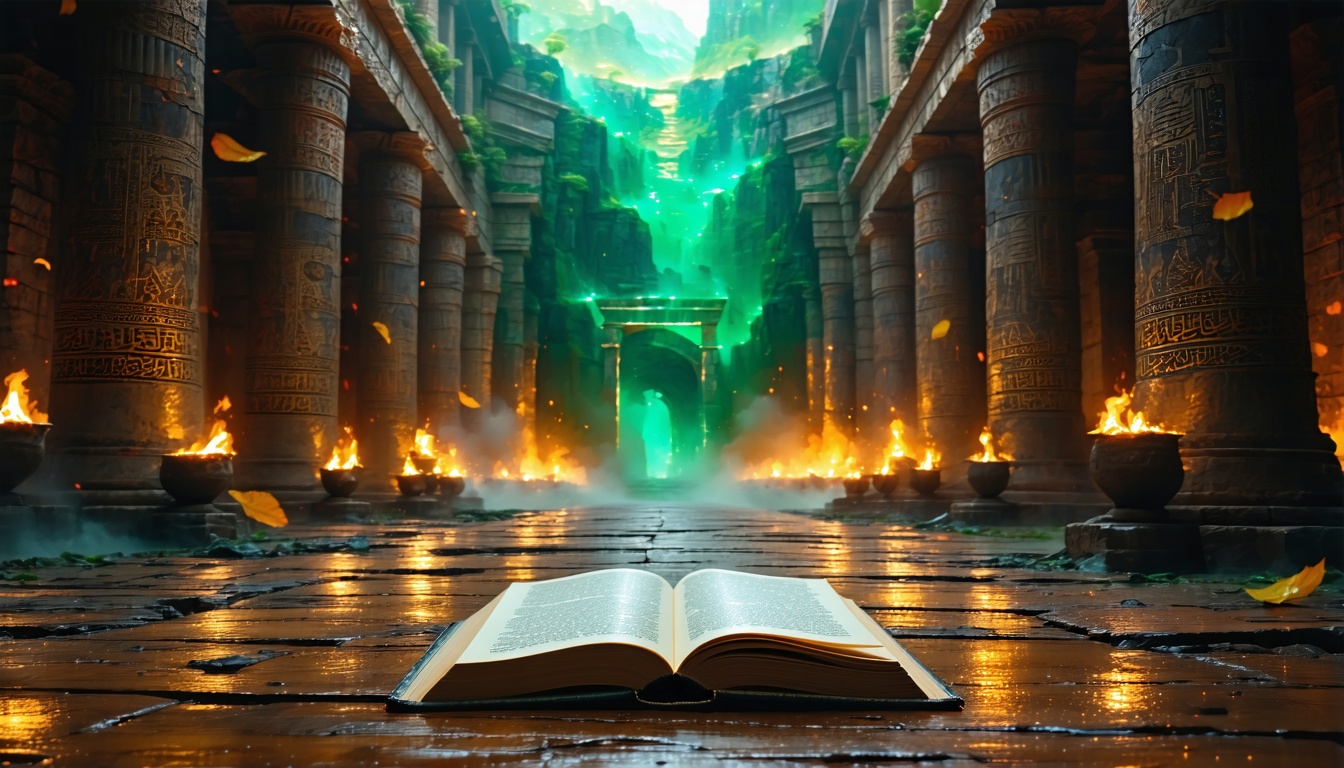
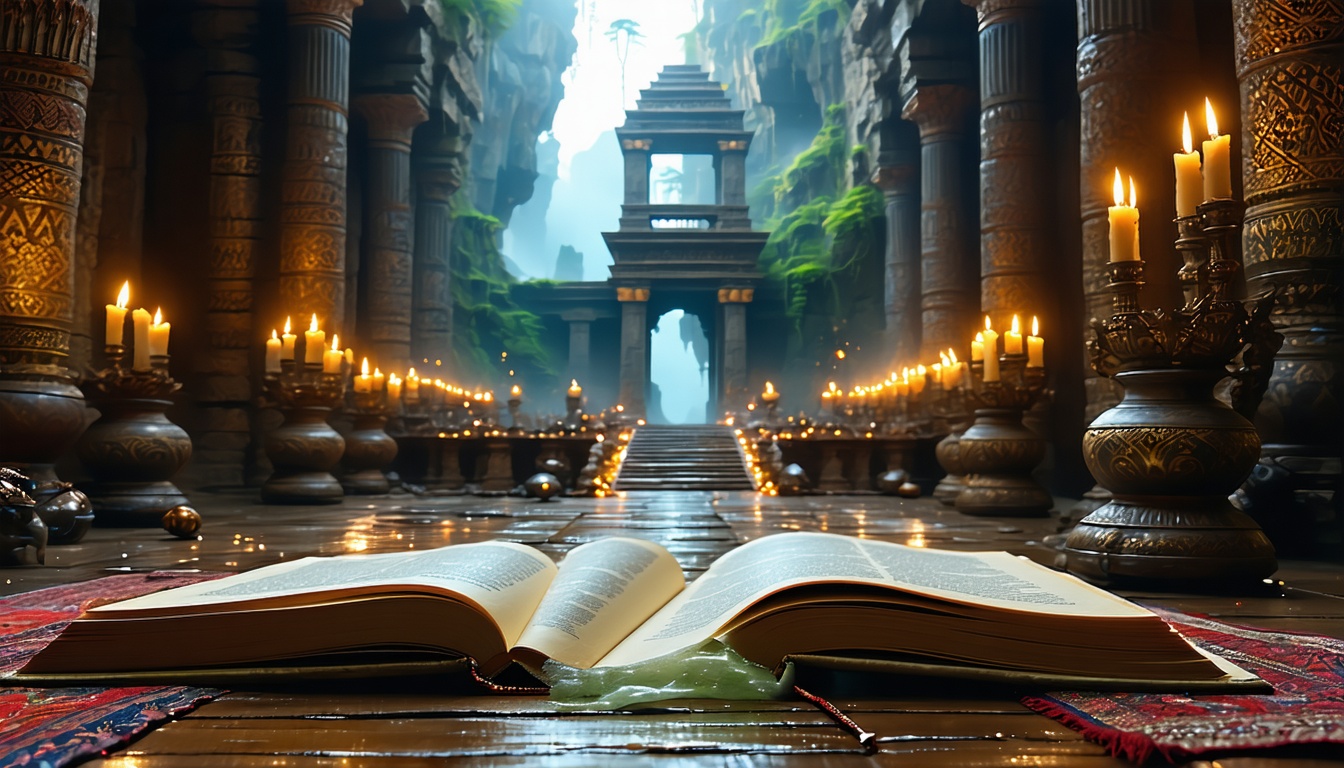
Beyond—a chamber. Large. Antechamber to something greater, though what that greater thing might be the chamber itself seemed reluctant to reveal, its walls retreating into shadows that the torch couldn't fully penetrate, as though the room was larger than the light was willing to admit. Walls covered in more hieroglyphs. Ceiling painted with stars and gods and scenes of the afterlife—Osiris weighing hearts against feathers, Anubis guiding souls through the underworld, Ra sailing his solar barque through twelve hours of darkness, each scene rendered with a detail and artistry that suggested the painters had been documenting events they'd witnessed rather than myths they'd inherited.
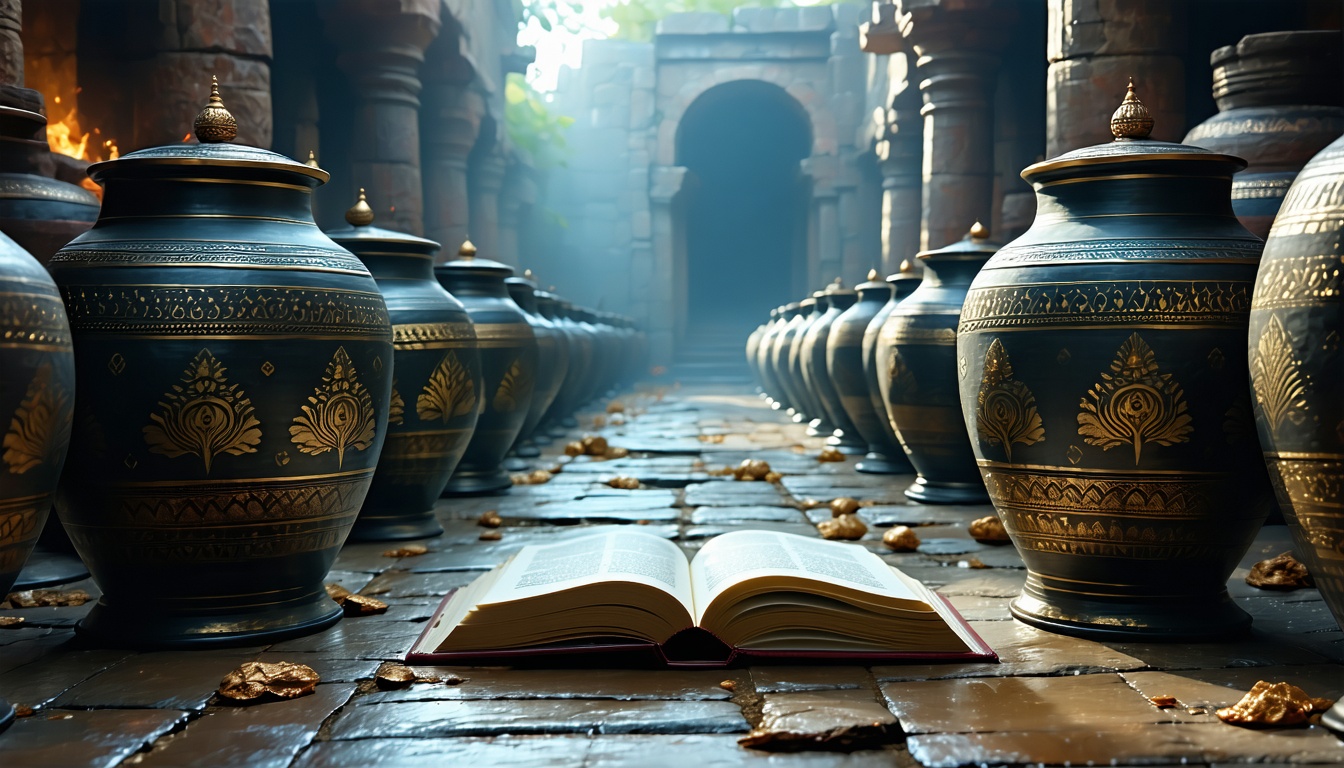
And everywhere—treasure. Gold that caught the torchlight and threw it back multiplied, the metal generating light rather than reflecting it. Jewelry spilled from overturned chests—lapis lazuli and carnelian and turquoise set in gold, necklaces and pectorals and finger rings designed for hands that had been dust for thirty centuries. Furniture built to furnish eternity: gilded chairs, painted chests, beds with legs carved into the shapes of lions and hippos and creatures from the Egyptian underworld. Canopic jars with lids shaped like gods' heads. Ushabti figurines by the hundreds, each one a servant intended to work on the pharaoh's behalf in the afterlife, their blue faience surfaces still gleaming beneath a film of dust.
All cursed. All trap. All bait designed to make tomb raiders greedy, to make them stay long enough for the curse to sink its roots into their consciousness, to make them forget that they'd come to take and remember only that they wanted to stay.
In the center of the chamber—an altar. Not the black stone altar from the lower chamber. This was Egyptian. Proper. Limestone carved with offering scenes showing priests presenting food and incense and the blood of sacred bulls to a figure whose face had been defaced with the same violent thoroughness as every other image of Kha-em-Waset. Bowl for sacrifices, its interior stained dark with something that might have been blood or wine or the residue of substances that predated both. Channels carved into the altar's surface for drainage, leading to a hole in its base that descended into the floor and the darkness below.
But nothing in the bowl. No recent offerings. No blood. Just dust. Millennia of dust, layered so thickly it had formed a crust with the texture of dried mud.
And standing behind the altar—a figure.
Human. Alive. Modern.
A woman. Middle-aged. Wearing khaki expedition gear that had been expensive once—breathable fabric, reinforced knees, the kind of field clothing designed by people who'd never done fieldwork for people who had. Tool belt. Flashlight hanging from her waist. Archaeologist.
Dr. Rashid. Had to be. The one the notebook mentioned. The one the sand had taken. The one who'd disappeared while the team was trapped.
She was standing perfectly still. Facing the altar. Hands at her sides. Not moving. Not breathing. Not blinking. Her hair hung motionless around her face despite the faint draft that stirred the torch flame. A bead of sweat had frozen on her temple, caught mid-descent, glistening in the torchlight like a tiny jewel.
"Dr. Rashid?" he called. Voice echoing in the chamber, bouncing off gold and stone and the painted ceiling where gods looked down with expressions that might have been pity.
No response. The figure didn't move. Didn't react. Just stood there, motionless, a three-dimensional photograph of a woman who'd been caught mid-thought and held there by something stronger than physics.
He approached. Careful. Torch held high. This was wrong—too convenient, too positioned, as though she'd been placed here specifically for him to find, a display arranged in a museum of horrors.
As he got closer, he saw the truth.
Dr. Rashid wasn't frozen by choice. Wasn't standing by willpower. Her feet had merged with the floor—the boundary between boot leather and limestone had dissolved, the materials flowing into each other the way hot wax flowed into the cracks of a mold. Stone crept up her legs in a gradient that was almost beautiful in its horror: skin transitioning to something between skin and mineral, the texture of her cargo pants calcifying, the individual threads visible where the transformation was most recent, still identifiable as fabric even as they hardened into something that would last forever.
The petrification had reached her waist. Below that line—stone. Above it—still flesh, still warm, still alive and aware. The transformation was ongoing, advancing so slowly it might take years to complete, each molecule being individually convinced to become mineral rather than organic.
But her eyes were still human. Still aware. Still conscious.
Still screaming silently behind stone lips that couldn't move, couldn't open, couldn't release the sound that her living brain was producing and her calcified throat was trapping.
Temporal stasis. Like the village in the shoreline. Like Dr. Harrow's temporal experiments. Freezing people between moments—trapping them aware but unable to move, unable to speak, unable to do anything but experience eternity as a conscious statue, watching the world through eyes that could still see but couldn't close.
How long had Dr. Rashid been here? The notebook said days. But that was from the perspective of the rest of the team. For Rashid, trapped in frozen time, each second stretching into hours, it could have been years. Decades. Centuries of subjective experience compressed into a week of real time—awareness without agency, consciousness without mercy, the ultimate refinement of the imprisonment that the pharaoh's tomb embodied.
All experienced in a single eternal moment. Aware. Screaming. Unable to escape.
"I'm sorry," he whispered. The words were insufficient, obscene even—an apology offered to someone drowning by a person standing on dry land. "I can't help you. I don't know how to break temporal stasis. Don't know how to reverse petrification. Don't know how to free you."
Dr. Rashid's eyes moved. Just slightly—the only part of her not completely stone, the last outpost of humanity in a body that was being colonized by mineral. They tracked his movement. Pleading. Begging. Desperate with the particular desperation of someone who had been screaming for help so long that hope had calcified too but who couldn't stop screaming because stopping would mean accepting that this was permanent.
But there was nothing to be done. The curse was too advanced. The transformation too complete. Breaking the stone would kill her—shattering the mineral matrix that had replaced her bones and organs, collapsing the structure that was, however horrifically, keeping her alive. Leaving her would doom her to eternal awareness.
Either way—suffering. Either way—horror. Either way—no good choice, only the selection of which horror was least monstrous.
He turned away. Couldn't watch those eyes anymore. Couldn't handle the silent pleading that was louder than any scream because screams eventually ended and her silence never would.
The chamber had three exits besides the one he'd entered. North. East. West. All marked with hieroglyphs. All showing different paths.
North: *The Hall of Gods. Where the divine judge the wicked.*
East: *The Pharaoh's Rest. Where the condemned lies in glory.*
West: *The Servants' Path. Where the loyal sleep in shadow.*
Three options. Three directions. Three different horrors waiting.
Something stirred in his iteration memory—not a clear recollection but the ghost of orientation, the phantom familiarity that had guided his hands on the trapdoor's handholds without his conscious direction. He had stood in this antechamber before. Many times. The architecture had accumulated in him, layered by repetition into something that functioned like knowledge even without specific memory attached.
The antechamber occupied the temple's center. To the north: the Hall of Gods, the vast ritual space where the pharaoh had performed divinity for audiences of priests and supplicants. To the east: the pharaoh's own domain—burial chambers, inner sanctum, the condemned king's private territory. To the west: the servants' infrastructure, the corridors and kitchens and preparation chambers that extended through the deeper complex, including the work rooms where death was made permanent. And below—accessible only through the trapdoor at the antechamber's center: the original cavern, the pre-dynastic space that predated Egypt itself.
The knowledge had no sharp edges, no origin he could point to. But it fit the architecture around him the way a key fit a lock—not thought, just recognition.
The mummies hadn't followed through the door. They stood outside, blocking retreat—a wall of wrapped bodies filling the corridor from floor to ceiling, their eyeless faces oriented toward him with that unsettling accuracy, ensuring he could only go deeper, only move forward, only commit to the temple's maze.
Which path?
The Hall of Gods sounded like revelation—like answers, like confrontation with whatever powered the curse. But it also sounded like certain death, like walking into judgment unprepared, like standing before beings who measured worth on scales that no living human had ever passed.
The Pharaoh's Rest was the obvious choice. Find Kha-em-Waset. Confront his ka. End the curse at its source. But also the most obvious trap. The pharaoh knew he was here. Would be waiting. Would be prepared with three thousand years' worth of rage and the home-field advantage of a domain that bent to his will.
The Servants' Path sounded safest. Lesser threats. Maybe allies. Maybe someone like Eleanor at the castle—a ghost who'd help, who'd guide, who'd offer information at the cost of a pain that was cheaper to share than to carry alone.
But safe was relative in a nightmare temple. And obvious choices were often wrong.
He thought of the pattern. The manor. The shoreline. The castle. All had shown the same truth. The direct path wasn't the right path. The confrontation with the main antagonist wasn't the goal. The goal was understanding the curse—finding its source, its weakness, the anchor that held it in place the way a tent stake held a structure that looked permanent but was actually fragile, actually dependent on a single point of connection to the earth.
Eleanor had mentioned the Black Altar beneath the castle. The real source of Aldric's curse. Older than the king. Predating the ritual.
There had to be something similar here. Something older than Kha-em-Waset. Some source he'd tapped into, some ancient power he'd perverted for his attempt at godhood. The pre-dynastic altar in the lower chamber. The green liquid. The substance of the between.
But accessing it meant going down. Deeper. Below the temple proper. Into the foundations. Into whatever existed before the pharaoh. Before Egypt. Before history.
None of these three paths led down. They all led laterally—to different sections of the same level, to different horrors but not deeper truth.
Unless—
He examined the floor. The stone was ancient. Original construction, the blocks fitted with the same impossible precision as the upper chambers. But there were cracks. Seams. Places where the blocks didn't fit perfectly, where the builders had accommodated something that already existed below, working around a feature of the bedrock that they either couldn't remove or didn't dare to.
And in the center of the chamber, right in front of the altar—a different stone. Slightly darker than its neighbors. Slightly smoother, polished by something other than time. A trapdoor maybe. Or a hidden entrance, visible only to those who knew enough to look past the gold and the treasure and the petrified archaeologist and the three paths that all led to different varieties of the same trap.
He approached. Dr. Rashid's frozen eyes tracked him with desperate intensity, the irises moving with a precision that the rest of her petrified body couldn't match—her consciousness pouring everything it had into this last functioning organ, trying to communicate a warning or a plea or a desperate last message through the only channel still open.
He knelt. Examined the stone. Found handholds carved into the sides—shallow depressions that could have been decorative patterns to anyone not searching for them, but that fit his fingers with a specificity that suggested they'd been carved for human hands by something that understood human anatomy better than humans did.
He pulled. The stone didn't budge at first. Then—movement. Grinding. The sound of ancient mechanisms activating beneath the floor, gears and counterweights made of stone rather than metal, engineering that predated the concept of engineering by millennia.
The stone lifted. Revealing stairs. Descending into darkness that was different from the darkness above—warmer, heavier, and carrying a smell that didn't belong in any tomb, a smell of ozone and heated metal and something organic that was neither alive nor dead but existed in a state between both that had no name in any human language.
Behind him—Dr. Rashid's eyes went wide. Not relief. Not gratitude. Horror. Pure, complete horror that contracted her pupils to pinpoints and would have driven her backward if her body could still move, would have made her scream if her throat could still produce sound. She was trying to warn him with everything she had, trying to communicate through frozen eyes what her voice and hands and body language could no longer say.
Going down was wrong. Was deadly. Was exactly what he shouldn't do.
But the pattern was also clear. The truth was always deeper. Always hidden. Always in the place everyone warned against.
Harrow's underground facility. The lighthouse's lower levels. The castle's catacombs. Always down. Always deeper. Always toward the source, toward the thing that everyone feared because fear was the most honest signpost.
He had to trust the pattern. Had to believe the truth was below. Had to risk whatever made Dr. Rashid's frozen eyes scream in terror.
He started down the stairs. The flashlight beam barely pushed back the darkness, the batteries dying in real time, the circle of illumination shrinking with each step like a pupil contracting in bright light. The stairs were steep, carved into solid bedrock with tools that had left marks unlike any he'd seen—not the chisel marks of Egyptian stonework, not the drill marks of modern quarrying, but smooth grooves that suggested the rock had been shaped by something that could soften stone the way heat softened wax.
Behind him—the trapdoor remained open. Light from the antechamber creating a shrinking rectangle above, a frame of gold and shadow that contained Dr. Rashid's frozen figure like a painting in a gallery dedicated to suffering.
Then—the door closed. Stone grinding shut. Cutting off the light. Sealing him in darkness with the sound of his own breathing and the dying flashlight and whatever waited below.
He was alone. Descending into the unknown.
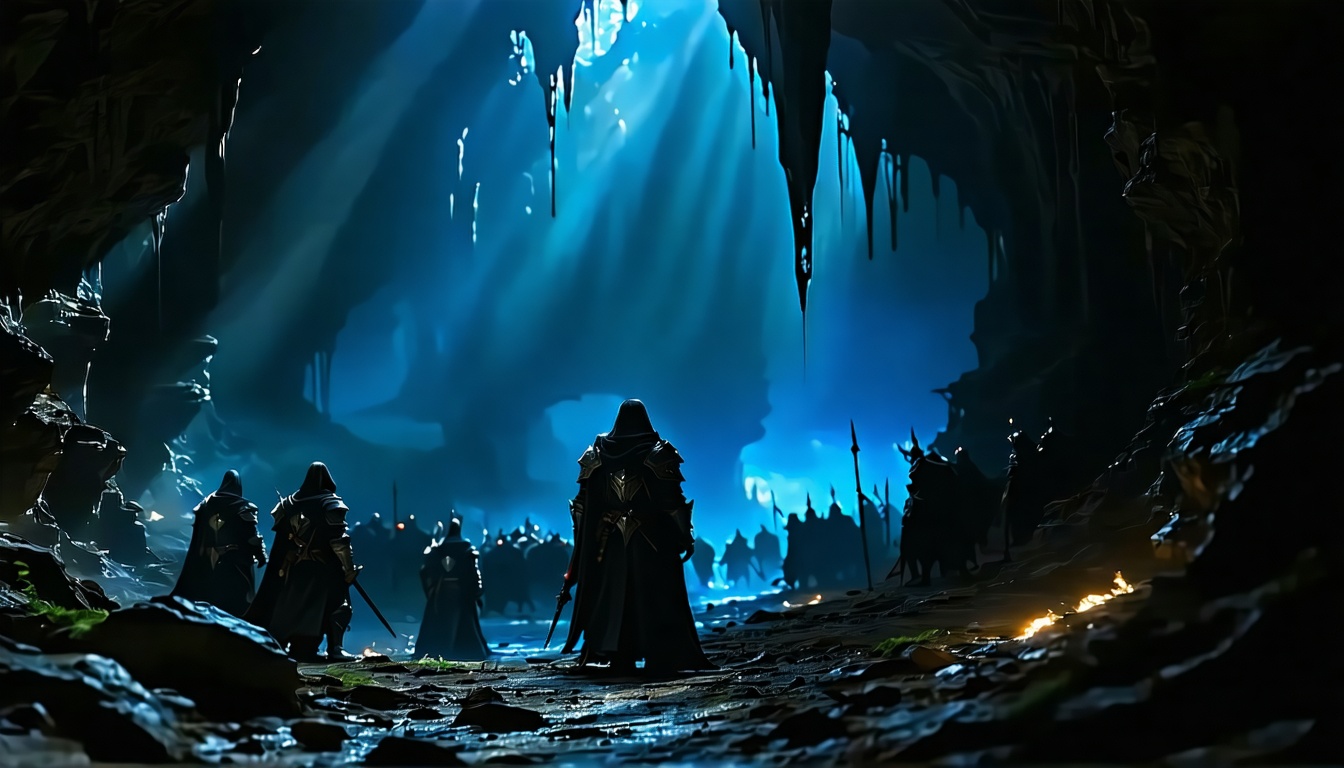
The stairs ended, opening into a passage that was not constructed. Natural cave. Raw stone walls shaped by water and time and geological pressures that predated all human civilization. The rock here was different from everything above—igneous rather than sedimentary, volcanic basalt that absorbed light rather than reflecting it, warm to the touch as though the earth's heat hadn't entirely abandoned this depth.
This was the original temple. The source. The place the pharaoh had discovered and tried to exploit—the place that had existed before Egypt, before the Nile carved its valley, before the Sahara was a desert. Something had built in this natural cave system long before the first human civilization had learned to stack one stone on top of another.
The walls were covered in marks that predated hieroglyphs the way trees predated furniture. Pictographs. Primitive. Images of figures that weren't quite human—elongated limbs that bent at too many joints, torsos that were too narrow for the craniums they supported, hands with fingers that had the wrong proportions, too long, too articulated, as though they'd been designed for manipulations that human hands couldn't perform.
And they were performing surgery. Opening skulls with instruments that looked like nothing in any medical catalog—curved, multi-pronged, designed with the organic logic of evolved tools rather than invented ones. Replacing organs with something glowing. Something green.
The between. The substance. Ancient beyond Egypt itself. Ancient beyond humanity. Whatever those elongated figures had been doing in these caves, they'd been doing it for a very long time.
The passage opened into a cavern, and the scale of it stopped him in his tracks. Cathedral-sized was wrong—this was bigger, the ceiling so far overhead that the flashlight beam dissipated before reaching it, the walls so distant that the space felt more like standing in a void than in a room. The air moved here, currents of warm and cold creating a microclimate that smelled of heated stone and ozone and the faint, sweet decay of something organic that had been breaking down for longer than organic things normally lasted.
And in the center—the altar. The black stone altar. Identical to the one in the lower chamber. The one beneath the castle. The one in Harrow's deepest facility. Polished basalt that reflected no light, that seemed to absorb the flashlight beam and the torchlight both, creating a region of intensified darkness at the cavern's heart.
The same altar. Repeated across locations. Across time. Across the entire network.
This was the source. The origin. The place where all the curses connected, where all the nightmares drew their power, where all the experiments traced back to the first time someone—something—discovered that consciousness could be extracted from flesh and stored in green liquid and used for purposes that predated the concept of purpose.
And sitting on the altar—the bowl. The green liquid. Glowing faintly in the darkness, casting shadows on the cavern walls that moved with the slow, purposeful rhythm of things that were alive in ways that had nothing to do with biology.
But this time—he wasn't alone.
They emerged from the darkness the way weather emerged from a clear sky: gradually at first, then all at once, their shapes condensing from shadow as though they'd been there all along, part of the cavern's architecture, and had simply chosen this moment to separate themselves from the stone they resembled.\n\nThey brought a scent with them—or rather, they displaced every existing scent and replaced it with something alien. Ozone and cold metal, the chemical sterility of a space scrubbed clean of every organic molecule. Where the temple above carried myrrh and natron and sacred incense—human devotion preserved in stone—the Architects smelled like the inside of a machine that had never been touched by living hands. Thomas's nose registered it as absence given form: not the wrongness of decay or danger, but the fundamental wrongness of encountering something that had never sweated or breathed or bled.
The thermal signature matched the olfactory wrongness. Not cold—cold was the presence of a lower temperature, the replacement of warmth with something opposite. What surrounded the Architects was subtraction: warmth extracted from the air in their immediate vicinity rather than replaced by anything. Their presence left behind the absence of heat, not the presence of its opposite. Thomas's skin registered the distinction the way skin registered the difference between a draft and a void—similar to cold, wrong in ways that took several seconds to articulate. The Architects didn't radiate cold the way a block of ice radiated cold. They generated heat's removal. Their thermal signature was negative: the footprint of something that had never been warm.
A dozen of them. Human-shaped in the way that a scarecrow was human-shaped—the basic silhouette correct, the proportions deliberately wrong. Too tall. Too thin. Elongated limbs that moved with a fluid articulation suggesting more joints than the human skeleton allowed. Skin that shifted between solid and translucent, revealing layers beneath that didn't correspond to any anatomy Thomas recognized—not organs, not bones, but structures that served functions he had no framework to understand. Massive eyes, each one the size of his fist, dark and reflective and absolutely devoid of the emotional tells that made human eyes readable.
His body recognized them before his mind did. A full-body flinch that started in his solar plexus and radiated outward—not fear exactly, but the ghost of fear, the residue of encounters his conscious memory had shed but his nervous system had preserved. His weight shifted to the balls of his feet without his permission. His hands curled into fists. And for one vertiginous instant, he was flooded with the certainty that he had stood in this exact cavern, facing these exact beings, so many times that his body had developed its own protocol for the encounter—a protocol his mind had never been briefed on. The feeling passed in two heartbeats, leaving behind only the echo of a posture his muscles knew and his brain didn't.
The original experimenters. The ancient beings who'd created the altar. Who'd discovered the between. Who'd started all of this millennia ago.
Still here. Still present. Still watching with the patient attention of scientists observing a specimen that had finally done something interesting after a very long and very boring experiment.
And behind them—or perhaps around them, in some direction geometry couldn't describe—something else. Not the Architects themselves but a quality to the cavern's silence, a depth to its darkness that had nothing to do with the absence of light. An attention that made the Architects' clinical observation feel secondary. Subordinate. The way laboratory technicians moved beneath the gaze of a project director they never looked at directly. Thomas couldn't locate the sensation. It had no source, no direction, no form. Just weight. Just the undeniable pressure of something vast paying attention, the way the ocean's weight was undeniable even when you couldn't see the water—you felt it in your bones, in the way the air tasted, in the quality of the silence that wasn't silence at all but sound compressed beyond the range of human hearing.
But the quality of the attention was different from the Architects’ collective study. The Architects observed everything with equal precision—the altar, the green liquid, the cave walls, Thomas himself—the dispassionate sampling of sensors that catalogued all available data. The other presence had narrowed. It had selected Thomas from the field of available variables with a specificity that exceeded experimental necessity, the way a researcher’s eye returned to one particular slide not because the methodology required it but because something in the image had caught and wouldn’t let go.
And in that narrowed attention, Thomas felt a recognition that preceded conscious memory—a resonance in his nervous system, a pattern his body had catalogued before his mind could name it. The shoreline. The second nightmare. The entity he’d perceived there as a fragment of his own consciousness, a splinter of Thomas Crane given independent will by the between. He’d been wrong. Standing here, feeling the full architecture of whatever existed behind the Architects, Thomas understood with the nauseating clarity of a corrected misdiagnosis: the fragment hadn’t been his. What he’d encountered at the shoreline was this intelligence reaching through the consciousness signature that matched Thomas most closely—showing him its most legible face, wearing his pattern the way a hand wore a glove. Not because the glove defined the hand, but because the hand needed a shape the glove’s owner would recognize.
The Architects studied the experiment. Every variable, every data point, every aspect of the cavern catalogued with equal precision—the altar, the between, the cave walls, Thomas himself all received the same dispassionate sampling. But the presence behind them had done something different. It had isolated Thomas from the experimental field. Not Test Subject 47, not the iteration’s most recent data point, not the configuration of grief and trauma deployed across four thousand environments. Thomas Crane specifically—the mechanism they couldn’t identify, the variable that refused to resolve. The Architects observed everything. The other intelligence had chosen him. The clinical specificity of that selection—the distinction between a scientist studying all data and a researcher who had narrowed to a single result—carried a weight that the Architects’ collective attention, for all its power, never had. It felt, in the way that body knowledge felt, like the attention of something that knew exactly what it was looking for and had been waiting a very long time to confirm it.
One stepped forward. Towering over him. Seven feet tall easily, its elongated frame moving with a grace that was unsettling precisely because it was so inhuman—no wasted motion, no unconscious fidgeting, no micro-expressions, just pure kinetic efficiency. It spoke. Not with voice. With thought. Direct transmission to his mind, arriving as fully formed concepts that his brain translated into language the way a screen translated code into images.
*"You found us. Again. As you always do. As you've done hundreds of times across hundreds of iterations. Always searching. Always descending. Always refusing to drink. Always choosing the path that costs you the most."*
"Who are you?"
*"We built what you walk through."* The concept arrived stripped of context, bare as bone. *"We separated the pattern from the substrate. Your words for us are inaccurate. All of them."*
Its massive eyes studied him with an intensity that felt physical, like fingers pressing against his skull, feeling for the sutures between bone plates. It offered nothing more. No elaboration. No title. As though the question itself revealed a limitation too fundamental to address.
"My name. Thomas. My memories of Violet. Of working as an EMT. Are they real? Or did you fabricate them?"
The Architect tilted its massive head. Clinical interest, but not the warm clinical interest of a doctor assessing a patient—the cold clinical interest of an entomologist examining a pinned specimen, already knowing the species, already knowing the taxonomy, looking only to confirm details it had catalogued a thousand times before.
*"Test Subject 47. Thomas Crane. Denver. Violet, deceased. Daughter, never viable—twelve weeks, three days. Tuesday. You were on shift."* The details arrived without inflection, without emphasis, each fact equivalent to every other. *"She called from the bathroom floor. You knew before she spoke. The sound she made—you had heard it from patients' families. You had never expected to hear it from her."*
His grip tightened on the locket until the chain bit into his palm. The detail. The specificity. Tuesday. From the bathroom floor. These weren't generalities—these were the details that lived in the part of his memory he'd locked and buried, the details too precise and too painful to think about voluntarily.
*"All real. All extracted. We do not fabricate."* A pause—not for emphasis, but the way a machine paused between operations, each process completing before the next began. *"We built environments from your actual grief. Your actual trauma. Truth twisted. Reality weaponized. Pain amplified but never invented."*
"The manor. The shoreline. The castle. You designed them from my memories?"
The Architect's massive head inclined, the motion unnervingly birdlike.
*"We extracted. Amplified. Deployed."* Three words for what had been three lifetimes of suffering. *"Each environment calibrated to a specific trauma architecture in your consciousness. Medical helplessness. Water. The child you never raised."* It paused again. *"Your grief has excellent structural properties. It load-bears well."*
The clinical reduction of his worst memories into engineering terminology landed harder than any detailed recitation could have. His knees almost buckled. Not from the information—he'd suspected it, sensed the truth of it across iterations he couldn't remember. But hearing the most devastating moments of his life described as load-bearing architecture, as materials with useful structural properties, stripped away the last insulation between his pain and whatever passed for air in this cavern.
*"And this one tests dissolution. Identity erosion across iterations. The fear that you will wake and not remember your own name."* The Architect gestured at the cavern around them—at the ancient altar, at the between pulsing in its bowl. *"Kha-em-Waset is you, four thousand years further along the same trajectory."*
Thomas—yes, Thomas Crane, that was his name, his true name, the one that connected to Violet and Denver and Tuesday and the bathroom floor—stared at the Architect.
"Was Violet real?"
*"All substrates are real. We do not fabricate. We extract."* The Architect's telepathic voice flattened further, as though the distinction between real and fabricated was too elementary to warrant elaboration. *"Consciousness copied at the moment of maximum grief. Iterated. Observed."*
The other Architects shifted. Not randomly—in unison, a collective adjustment that rippled through the group like a wave through kelp. Thomas noticed something: they weren't all watching him. Some were watching the darkness behind the altar, their massive eyes oriented toward a specific region of the cavern that contained nothing visible but that exerted a gravity of attention that even these alien scientists deferred to.
Thomas looked at the locket. Violet's face. Real woman. Real loss.
"You're torturing people."
The Architect regarded him the way a geologist might regard a pebble that had expressed an opinion about erosion. It didn't respond. Didn't defend. Didn't explain. The silence itself was the answer—a silence that communicated, more effectively than any philosophical argument about consent or morality, that the Architects did not occupy a moral framework where Thomas's accusation had meaning. They existed outside it entirely, the way mathematics existed outside opinion.
Something in the cavern shifted. Not the Architects. Not the altar. Not the green liquid in its bowl. Something else—the presence behind them, the attention that had been passive, observational, suddenly tightened. The temperature dropped two degrees in an instant. The Architect who was speaking paused, its massive eyes unfocusing for a fraction of a second, the way a person's eyes unfocused when receiving an unexpected message through an earpiece. When it continued, its telepathic voice carried a different quality—still clinical, but with an edge of something that might have been caution.
"You knew they'd fail," Thomas said. "Harrow. The lighthouse doctor. Aldric. Kha-em-Waset. You knew they'd drink wrong, transform wrong, become monsters. You designed it that way."
The Architect tilted its head. Massive eyes studying him.
*"Perceptive. More than expected at this stage."* The absence of boredom—not interest exactly, but the cessation of disinterest. *"Their failure generates data. So does yours. Four thousand iterations of refusal. You should not still be coherent."*
The Architect leaned closer. Its face filled his vision—the massive eyes, the too-smooth skin. This close, he could see that its skin wasn't skin at all but something that mimicked skin the way a photograph mimicked a landscape: accurately enough for distance, wrong in ways that became apparent at close range. Structures moved beneath the surface, flowing patterns that looked like circuitry.
*"You resist through a mechanism we cannot identify."* The words arrived with the weight of a confession extracted under duress—not freely given but forced out by the data's own implications. *"What we cannot identify, we cannot replicate. What we cannot replicate—"* It stopped. The truncation was deliberate. As though completing the sentence would reveal more than the presence behind the altar permitted.
The other Architects shifted again—that synchronized collective movement, like instruments responding to a conductor. And this time Thomas saw it clearly: the speaker's massive eyes broke from his face and looked past him, through him, at something that occupied no visible space in the cavern but that commanded the attention of every being in it. The deference lasted less than a heartbeat. Then the clinical focus returned to Thomas with an intensity that felt like the closing of a door.
Something had been communicated. Something had been decided. And the Architects—for all their power, for all their millennia of experimentation, for all their casual dismissal of human consent and human morality—were following instructions.
*"We offer you a choice. The same choice we offer at this stage of every iteration, refined by the data of your previous refusals."*
The Architect gestured to the bowl. To the green liquid glowing on the altar with its slow, internal pulse.
*"Drink willingly. Accept transformation with full knowledge of what it entails. Become what you are meant to be. Evolve consciously, with the benefit of everything we've learned from your four thousand failures. Your data suggests you would survive the process. Would transform successfully. Would become something new."*
"And if I refuse?"
*"You continue. As you have continued. Through iteration after iteration. Through nightmare after nightmare. But—"* The Architect paused again, and Thomas felt the weight of the unseen presence shift, felt it lean in the way a massive animal leaned when something small had finally drawn its interest. *"—we should be transparent about what continuation means. Your consciousness is degrading. Not visibly. Not in ways you can detect. But the substrate—the copied pattern of your mind that we extracted and placed into this experimental framework—has a finite tolerance for iteration. A hard limit. Not of will. Of physics."*
*"You have, by our calculations, approximately eight hundred iterations remaining before the pattern degrades beyond recovery. Before the copy of Thomas Crane that exists in the between becomes noise rather than signal. Before you stop being a person and become data without structure."*
Eight hundred iterations. The number landed with the weight of a diagnosis. Not infinite. Not forever. A countdown that had been running since the first iteration and was now closer to zero than to its starting point.
*"When degradation reaches critical threshold, you will not choose to drink. You will not choose anything. Choice requires a coherent consciousness to make it. What remains of you will simply... absorb. The way a sponge absorbs water. Not by decision. By physics. By the inevitable dissolution of a pattern that was never meant to be iterated this many times."*
"There has to be another option."
*"There is no other option. There has never been another option."* But the Architect's telepathic voice carried something new—a quality that wasn't quite hesitation, wasn't quite deception, but occupied the space between them. An edited truth. A sentence with redactions. *"Transform or endure. Evolve or persist until persistence becomes dissolution. Those are the only paths."*
Thomas stared at the Architect. At the bowl. At the green liquid that pulsed with the rhythm of something alive.
And he felt it—the pressure of the unseen presence, the thing that the Architects deferred to, the intelligence behind the intelligence. It pressed against his awareness the way deep water pressed against a diver's eardrums: not painful yet, but insistent, promising that pain would come if you went deeper. It was measuring him. Not with the Architects' clinical curiosity but with something colder, something that didn't care about his data or his paradox or his most-successful-failure status. It was measuring him the way a scale measured weight—without interest, without judgment, with perfect accuracy and absolute indifference to what the measurement meant.
And in that measurement, in the instant of contact between his awareness and whatever vast thing lurked behind the Architects, Thomas understood something the Architects hadn't told him and might not have known themselves:
The "only two options" were a lie.
He didn't know what the third option was. Couldn't see it. Couldn't name it. The understanding was less than a thought—more like the shadow a thought cast, visible only from the corner of his eye, vanishing when he tried to look at it directly. But it was there. The Architects' framework—drink or dissolve, transform or degrade—was a cage made of assumptions, and assumptions had seams, and seams could be found by someone who'd spent four thousand iterations learning to feel for weaknesses in walls that looked solid.
"No."
The word came out firm. Final. Absolute. Not defiant this time—not the reflexive refusal his body had been making for four thousand iterations. This was something else. Informed. Deliberate. A refusal that was also a declaration of intent to find the option they said didn't exist.
"I won't drink. Won't transform. Won't join you. And I don't accept that dissolution is inevitable. You've been wrong before—your models didn't predict me, didn't predict whatever it is about my configuration that makes me your most successful failure. If your models are wrong about that, they might be wrong about the eight hundred iterations too."
The Architect pulled back its hand. The massive eyes showed no disappointment. No surprise. Just clinical acceptance—and beneath it, something that Thomas almost missed, a flicker of the same edited quality that had marked its claim about only two options. As though his refusal had triggered a subroutine the Architect hadn't intended to reveal.
*"Acknowledged. Choice recorded. Iteration continues."*
But as the refusal left him, something crystallized—not from the Architects' telepathy but from his own accumulated proximity to them. Four thousand iterations of standing in this cavern, and he had been treating their unknowability as a problem to solve. As information withheld. As a door that would open if he survived long enough to earn the key.
He was wrong. Their unknowability wasn't concealment. It was composition. Whatever the Architects were, they existed in a register that human cognition couldn't access the way human ears couldn't access ultraviolet—not hidden, not withheld, but categorically beyond the apparatus. Their motives weren't mysterious. They were a kind of thing that the concept of *motive* didn't describe. Their interest in him wasn't curiosity or cruelty or scientific dispassion. It was something for which no human word existed, operating on him the way gravity operated on stone—through physics that the stone would never comprehend no matter how long it fell.
They hadn't chosen to be incomprehensible. Incomprehensibility was what they were made of. And that was the horror the Architects carried without knowing it: not the things they did, but the absolute impossibility of ever understanding why.
The cavern began to darken. The Architects fading back into shadow—not departing, just becoming indistinguishable from the stone again, their shapes merging with the basalt walls until only their eyes were visible, glowing faintly in the darkness like bioluminescent organisms in deep ocean.
But as they receded, the other presence held. One breath. Two. A cold assessment that carried no curiosity, no rage, no clinical interest—just measurement, pure and dispassionate—something watching the entire exchange not to learn from it but to verify data it already possessed. The attention was vast and utterly impersonal, and Thomas understood with sudden, nauseating clarity that the Architects—for all their power, for all their millennia of experimentation, for all their casual cruelty dressed in the language of science—were not the top of whatever hierarchy existed in the between.
They were middle management. Sophisticated. Powerful. But accountable to something they themselves didn't fully comprehend, something that used them the way they used Thomas—as instruments in an experiment whose purpose was known only to the one running it.
And unlike the Architects, the presence behind them had not said *acknowledged*. Had not said *choice recorded*. Had not offered the clinical courtesy of accepting his refusal. It had simply measured him and withdrawn—and the withdrawal carried a quality that acceptance never did. The quality of something unfinished. Something that would return.
Then it too was gone. And he was left with darkness, and the faint mechanical pulse in the stone that he was now certain had nothing to do with Egypt at all, and the knowledge—partial, frustrating, but real—that the cage he was in had a door that nobody had told him about.
The green liquid in the bowl continued to pulse. Offering. Promising. Patient.
He turned away from the altar. From the bowl. From the temptation that was designed to feel like the only answer to a question that had been asked wrong.
And climbed back up the stairs. Back to the antechamber. Back to Dr. Rashid's frozen horror and the three paths and the mummies and the gold and the temple that wanted to break him.
But carrying something new. Not just knowledge—the Architects had given him knowledge before, in previous iterations he couldn't remember. This was different. This was the beginning of a question that the Architects hadn't anticipated and that the presence behind them had noticed. A question about third options and broken frameworks and the possibility that four thousand iterations of refusing to play by their rules had worn a groove in the cage's wall that might, given enough time and enough pressure, become an opening.
He emerged into the antechamber. Dr. Rashid's eyes found him immediately, tracking him with the desperate attention of someone who'd watched him descend and had been screaming into her stone prison for every second of his absence.
The presence from the cavern—the clinical attention that existed behind the Architects—moved through the antechamber as he emerged. It catalogued him, the mummies, the exits. And held, briefly, on Dr. Rashid's eyes: on the two small circles of awareness the stone had not yet claimed. The pause lasted a fraction of a second past utility. Then it moved on.
He met her eyes. Held them.
"I'm going to find a way," he said. Not a promise—he'd learned not to make promises in places that consumed them. A statement of intent. A declaration of the direction he was moving, even if the destination was invisible.
Dr. Rashid's eyes didn't change. Couldn't change. But something in their depth shifted—not hope, because hope required a future and her future was stone, but something adjacent to it. Witness. Acknowledgment. The recognition that someone was trying, even if trying wasn't enough.
He turned to the three exits. North. East. West.
The Hall of Gods. The Pharaoh's Rest. The Servants' Path.
He chose north. Toward judgment. Toward the divine. Toward whatever test the gods of a condemned king's imagination had designed for uninvited visitors.
The mummies watched him go. Their wrapped heads tracked his passage across the antechamber with the synchronized precision of an audience following a performer across a stage.
The northern doorway swallowed him. Darkness ahead. Darkness behind.
And somewhere in the walls—that mechanical pulse. Regular. Precise. Counting something that wasn't time but that served the same purpose: marking the distance between where he was and where something wanted him to be.

Join the Discussion