The World Beneath the Lie: A Lore Deep-Dive into The Darklands

The World Beneath the Lie: A Lore Deep-Dive into The Darklands

A deep-dive into the cosmology of The Darklands — the Church of the Lord of Light, the Mithras faith and the doctrine of dormant magic, the lie about the Collapse, and the property machine underneath thirty years of witch hunts. Spoilers for the entire trilogy.
A note before you read this

The Darklands is a finished trilogy. Everything below assumes you have read all three books — Ashes of Innocence, Flames of Doubt, and Embers of Hope. If you haven't, this post will spoil the spine of every book and the meaning of the ending. Come back later. The trilogy will still be here.

For everyone else: this is the document I wished I could have stapled to the back cover of book three. The trilogy is told from inside the lie — Petro grows up believing what the Church told him, and the books only shed that belief at the same pace he does. As a result, a lot of the world stays implicit. Here, with the spoilers off the table, I can lay it out flat.


The Empire and the Church of the Lord of Light

The world of The Darklands is, on the surface, a late-medieval imperial state. There is an Emperor in name. There is a House of Lords. There are provinces, dukes, magistrates, an Imperial Army. None of these institutions are the load-bearing wall.

The wall is the Church of the Lord of Light.

The Lord of Light is, in Church doctrine, the only god — the source of order, mercy, restraint, and the moral architecture of the human soul. He is also, in Church doctrine, the only god who has ever mattered, the only god who has ever told the truth, and the only god who has not driven mortal beings to ruin. The Church does not say there are no other powers. It says other powers are demonic — every one of them, without exception, regardless of which face they wear or which sweet promises they offer.

Practically, this means three things at once.

First, the Church owns the Empire. Inquisitors outrank dukes. Knight Captains can countermand sheriffs. A priest's signature on a heresy writ moves provincial troops. The Imperial Army exists, but it does not deploy without a chaplain attached.

Second, the Church owns property. A heresy conviction is a forfeiture conviction. Land, mill, livestock, hearth — all of it goes to the Church on the day the accused burns. The Order of Knights Inquisitor is not paid out of an imperial budget. It is paid out of confiscated estates. This is the load-bearing economic fact of the trilogy, and Suzanne spends thirty years of marriage proving it on paper.

Third, the Church owns the past. The official history of the world, the official cosmology, and the official version of who started which war are all housed inside one institution. There is no rival academy. There are no preserved heretical archives outside the Citadel itself. When Suzanne digs, what she finds is stitched together from blank spaces — three years of internal correspondence missing, a property petition denied seven months before a witchcraft conviction, the same template confession used by two different inquisitors a hundred miles apart. The truth in this world is reconstructed from absences. That is on purpose.

Mithras, magic, and the doctrine of dormancy

Magic in The Darklands is not the wand-waving kind. It is closer to a fault line under a person's skin — something dormant and inherited that, in certain conditions, surfaces.

Church doctrine names it precisely. Dormant magic is the formal term, and the whole catechism is built around it. Every human being is presumed to carry, in some hidden chamber of the soul, the capacity for the demonic. Most live and die without it ever waking. Some are woken by trauma. A few wake on their own. When dormancy ends and the magic surfaces, the Church calls it a Spontaneous Manifestation.

A Spontaneous Manifestation is rarely controlled. The seamstress in Westminster's market does not choose the wave of force that kills eleven people. Hank does not, at age twelve, choose the blue fire that burns the priest who cut his father's head off. Manifestations are involuntary, terrifying, and almost always lethal — to the wielder, to bystanders, or both. This is the empirical fact the Church builds doctrine on top of, and it is the fact that, in the world of the trilogy, makes ordinary people genuinely afraid of magic users. The fear is not invented out of nothing. The fear is what the doctrine grows on.

Where the doctrine lies is in what comes next. The Church teaches that anyone who survives a manifestation is now demonically infested and must be burned, no exceptions, no triage. It teaches that there is no such thing as control, no such thing as study, no such thing as a child who might be helped to live with their own gift. It teaches that compassion in this matter is itself heresy.

Inside the Citadel of Light, none of that is true.

The other faith — Mithras worship, in Church language — does not understand magic as demonic. It understands it as a gift, a dangerous and grief-heavy one, and it teaches the practice of control. Lydia, the teacher Petro watches in book two, runs what is essentially a remedial school for children whose powers woke too early. The work is unglamorous. Breathe in. Breathe out. Hold the small flame. Don't let it grow. Most of her students never become anything more than ordinary people who can light a candle without a flint. A few do more, but the school does not aim for power. It aims for survival.

Mithras worship is, in other words, what the Church looks like to its enemies — a faith with rituals, scriptures, schools, and saints — except that its central liturgical act is teaching frightened children not to die.

This is the symmetry that makes the trilogy work. The Church and the Citadel are not light versus dark. They are two readings of the same human fact, and only one of them is willing to teach restraint.

The Collapse, and why the Darklands are dark

Long before book one opens, the world ended once.

The official Church history calls it the Cleansing — the moment the Lord of Light scoured the eastern continent of demonic infestation, leaving behind a wasteland called the Darklands as a permanent reminder that magic and life cannot share a hearth. The Cleansing is taught in every parish school. It is the foundation myth of the entire imperial moral order.

It is also a lie. Not in the sense that nothing happened — something catastrophic did happen, the eastern continent is a glassy waste, the maps are accurate. The lie is in the agency. The Church did not save the world from magic. The Church and the Mithras faith together destroyed half of it.

The deepest archive in the Citadel of Light, the one Elder Miriam shows Petro and Hank on the night before the siege, holds the version that survived. The pre-Collapse world had two religions and one continent. They coexisted, then they competed, then they fought a resource war over fertile land in the east. In that war, the Church blessed the imperial armies, and the Mithras faith built weapons of magical mass destruction. The collision of those weapons — the Church's Godsbane relic and the Mithras Voidcaller working — broke the eastern continent open and left it geologically dead.

Both sides walked away from that war with the same lesson and a different cover story. The Mithras faith retreated into the Citadel and went small — a school of restraint and refugee work, allergic to its own past. The Church retreated into doctrine and went large — a single permitted reading of history, a permanent demonization of magic, and an internal economy that lived off persecution.

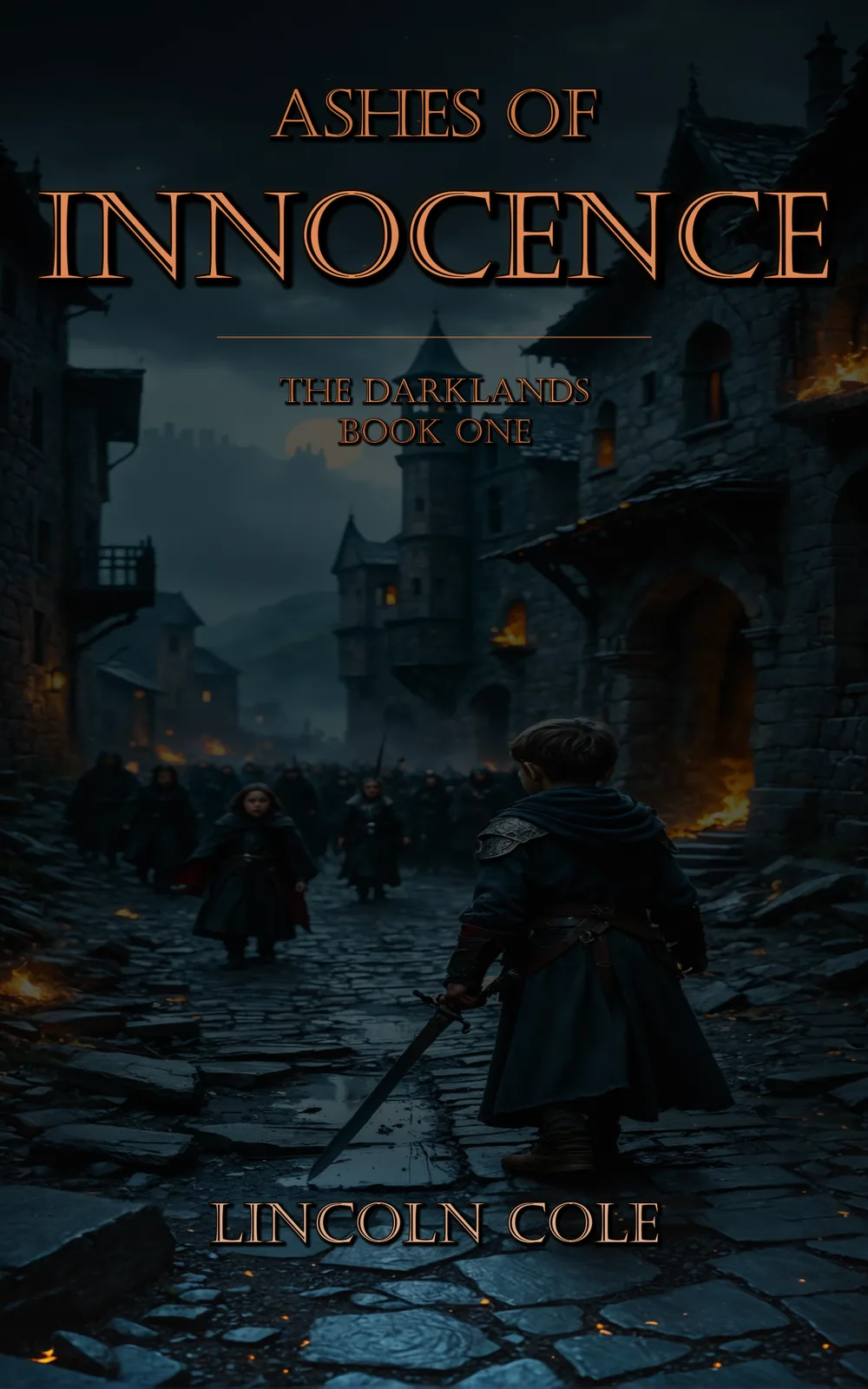
The Darklands, the actual physical waste between Westminster and the Citadel of Shadows, is the scar. Nothing meaningful grows there. The wind has the wrong sound. Petro's first march into the Darklands in book one — fifty soldiers, eight dead before the cult is reached — is a march across the literal corpse of a war neither side wanted to remember.

Two citadels, both real

The geography of the trilogy is organized around two named citadels, and readers who finish book one without confusing them are doing the work I tried to make sure they could do.

The Citadel of Light is the Church's seat in Westminster. It is the cathedral, the inquisitorial chambers, the archive vaults, the Knight Tower, and the formal name of the Order of Knights Inquisitor. When characters speak of the Citadel in book one, they almost always mean this one. It is the place Petro is raised inside.

The Citadel of Shadows is the ruin in the eastern Darklands. It is what the Mithras faith built before the Collapse and what one cult tries to reactivate in book one's climax. Petro burns it down at the end of book one. It is, by book two, rubble.

The Citadel without an adjective is the third one — the living Mithras refuge in the eastern foothills, hidden behind valley geometry and old wards, the place Petro walks into in book two and never quite walks out of. This is the home of Elder Miriam, of Lydia's school, of the survivors. It is also, the trilogy is careful to note, not the same building as the ruin. It is what the Mithras faith rebuilt after the Collapse, on a site safe enough to be forgotten.

Three citadels. One of them burns Petro's gods. One of them Petro burns. One of them takes him in.

The economy of accusation

If you want to understand book three's politics, the thing to read first is the file Suzanne builds across thirty years.

The pattern is simple. Take a pious, productive smallholder — a miller, a healer, a widow with good land. Find a Church official, often a deacon, who has filed a property petition for that smallholder's land within the last twelve months. Wait. Within seven to fourteen months of the denied petition, a witchcraft accusation will arrive. The accused will be tried. The accused will burn. The land will transfer to the Church and, often, end up administered by the same official who filed the petition.

Suzanne's archive ends with forty-seven confirmed cases across four provinces. Inquisitor Voss alone is responsible for, by her count, thirty-one of them. The template confession is identical in twenty-four of them, down to the wording of the demonic name the accused supposedly invoked.

The witch hunts of The Darklands are, in other words, not primarily theological. They are theological at the surface. They are land transfer underneath. The Church is sincere — most parish priests believe what they preach — but the institution is built on top of a property machine, and that machine cannot stop running without breaking the institution that depends on its income.

This is also the reason book one's Petro can be a sincere believer and a tool of corruption at the same time. He is killing people who really did manifest magic, sometimes. He is also killing people who never did, often. The doctrine teaches him not to ask which is which. The economy makes sure the doctrine is never reformed.

The pendant

A small craft note, because readers ask.

The gold sun pendant Petro takes from the priest's ashes in book one is, on one level, a literal Church ornament — the Sun of the Lord of Light, the standard pectoral worn by ordained priests of the high rite. On another level, it is the trilogy's central object.

Petro picks it up in chapter three of book one as a child, after the priest who wore it has burned to death in the chaos of the Ashwick massacre. He wears it for the next forty years as a knight inquisitor. He does not realize, until he is alone with it in his rented room at the Citadel in book two, that he has spent his whole adult life wearing the symbol of the man who started his life by killing everyone he had a name for.

He becomes that priest. The pendant is a closed loop. He walks into the Citadel as a hunter, and the pendant is on his chest.

He takes it off in book two, chapter eight. He does not throw it away. He sets it down. The trilogy is, in the end, about the difference.

Where the lore lives now

The peace at the end of book three is fragile. The Church fractures eight-to-seven on Councilor Marcus's deciding vote. The Citadel is a ruin. The survivors scatter — Petro and Suzanne south, Hank north, Martin and Reyna back to Westminster — and the work of rebuilding the next thirty years is not a sequel I plan to write. The trilogy ends where it ends on purpose.

But the world keeps. New Haven exists, by book three's epilogue, with four hundred and twelve families. Sarah, Petro's daughter, learns the healing path her mother kept her safe enough to choose. The first generation of children who will grow up with both faiths in the room is born inside the closing pages of the book.

If there is a continuation in this lore, it is theirs.

Subscribe to LLitD newsletter and stay updated.

Don't miss anything. Get all the latest posts delivered straight to your inbox. It's free!
Great! Check your inbox and click the link to confirm your subscription.
Error! Please enter a valid email address!
\n\n\n\n