Chicago as a Theological City
Most urban fantasy uses a city as a backdrop. The Covenant Files uses Chicago as a thesis.
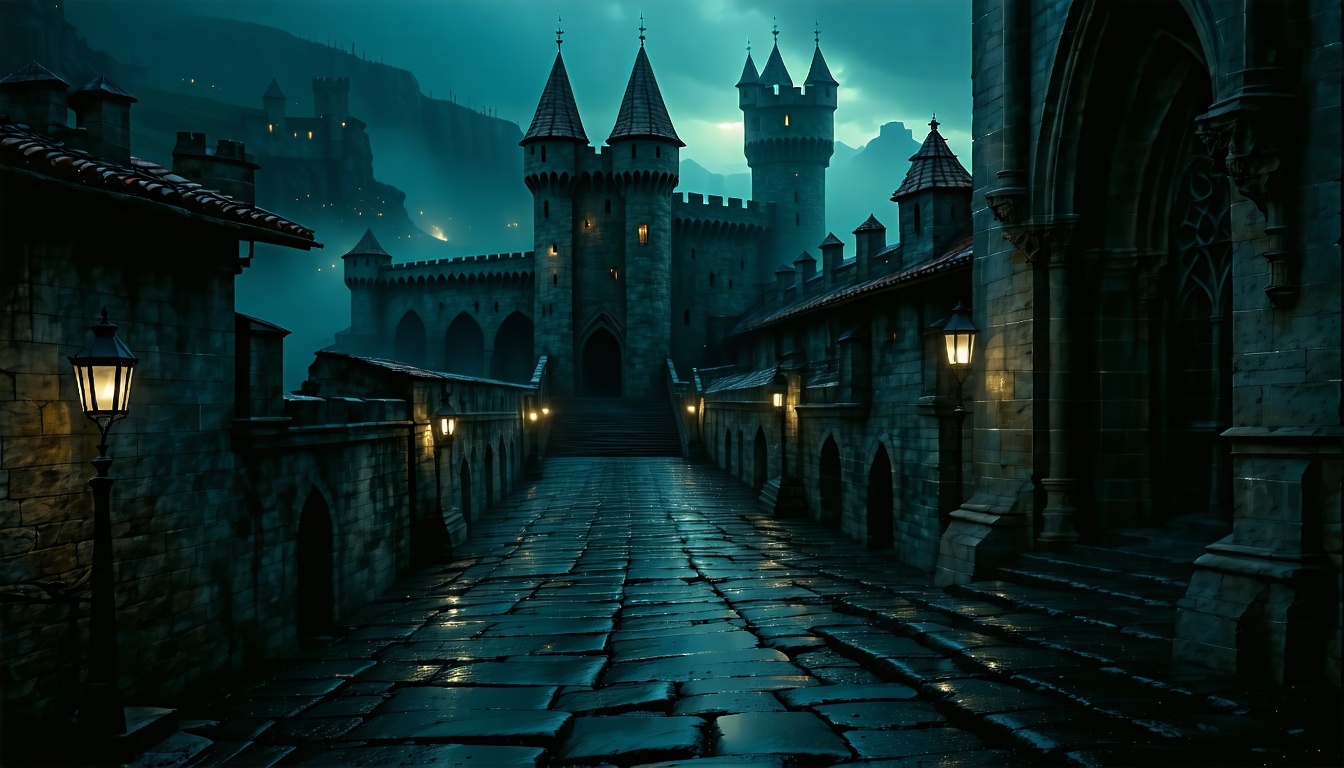
The Chicago of Marcus Kane is a city built in layers, each one carrying a different jurisdiction. Down at street level, it is the Chicago you would recognize: the L rattling overhead, the Pilsen sidewalks salted in winter, the South Side basements of condemned churches that the Archdiocese has officially forgotten. Climb the LaSalle Street financial canyon and you reach the seventy-fifth floor of Morningstar Babel and Associates, a high-end legal practice that does not appear on any tenant directory because the building does not, technically, have a seventy-fifth floor. Step into a jazz bar called The Last Hour and you are drinking with Death — first as Ray, the exhausted bartender who has watched the same human dramas play out for ninety-five years, and later as the proprietor of Liminal, the renamed sanctuary that survives the Sword of St. Michael's raid in book two.
Chicago in this series is a "thin" city. The Veil — the membrane between human reality and everything else — wears down at predictable points: St. Bernardine's Cathedral, where Jonathan Kane consecrated a hellmouth and died for it; the abandoned subway tunnels under the Loop; the basement of Holy Redeemer, the condemned church Marcus rebuilt as a base of operations; and, by book five, the Merchandise Mart, where two hundred people experience seven timelines at once before breakfast.
The series treats this thinness as architecture, not metaphor. The reason Chicago becomes the center of the cosmos is not narrative gravity. It is because Jonathan Kane spent fifteen years quietly mapping the points where reality bent, and his son inherited the map.
Heaven, Hell, and the Bureaucratic Cosmos
If there is one phrase that defines the world of The Covenant Files, it is this: every cosmic faction is a bureaucracy.
This is not a flippant joke. It is the load-bearing premise of the series. Heaven and Hell did not arise as armies of light and darkness. They arose as institutions, and like all institutions, they are dominated by procedure, paperwork, jurisdictional disputes, and the human (or angelic, or infernal) tendency to mistake the form for the substance.
Hell, as represented by Brimstone and the firm of Morningstar Babel and Associates, is the most honest of the three. Hell does corporate law. Souls are assets. Contracts are sacred — not because they are holy, but because the entire infrastructure of damnation depends on enforceability. Lucifer himself, when he finally appears in the series as Luke Morningstar, conducts the most honest negotiation Marcus has ever had. Hell is what it says it is. That is its strange dignity.
Heaven is harder. Heaven is the institution that has spent the longest time forgetting it is one. The angels — Metatron, Seraphiel, Raphael — operate from the assumption that their authority is self-evident. When the Bridge office is created and Marcus begins enforcing convergence limits, Heaven discovers that "self-evident" is not the same as "binding," and the discovery is, theologically, devastating. Raphael's withdrawal at the Temple of Ascension in book two is the first time in twenty thousand years an angel of his rank has admitted fear.
The Church — represented by Cardinal Rossetti, Father Torretti, the Sword of St. Michael, and the Vatican archivists — is the third faction, and the most morally compromised. The Church in The Covenant Files is not the enemy. It is the institution that, twenty-five years before the series begins, decided the only acceptable response to angelic-human hybrids was extermination. The 1987 Massacre, in which Jonathan Kane's first wife was killed, is the original sin the entire series is unwinding. By book five, the Church has split into two formally recognized paths — a schism that occurs in the climactic ritual of book three, the Undoing — and the question of which path Marcus belongs to is the first genuine theological question of his life.
Nephilim, Grigori, and the Biology of Grace
The angelic-human hybrids at the heart of the series are called Nephilim — the children of fallen angels and humans, taking their name from the Book of Genesis and the apocryphal traditions around it. The series treats them not as a race of magical superhumans but as a tier of biological inheritance: a recessive trait, inactive in most carriers, capable of expressing as anything from minor psychometric ability (Lily Kane's ability to read sin from physical contact) to full-blown probability sight, dimensional awareness, or therapeutic manifestation.
Above the Nephilim sit the Grigori — the original twelve fallen angels who fathered the bloodlines. By book two, we learn that several Grigori still walk the earth in human disguise. Victoria Cross, the proprietor of The Last Hour, is in fact Azazel: Marcus's father's first wife, the mother of his half-brother Michael, and the architect of a ninety-five-year sanctuary protecting Nephilim from the Church's extermination program.
The "magic system" of the series is built on a few rules that are stated plainly and never violated:
- Consent matters. The Ritual of Transference that opens book one — Joseph Kramer's method for laundering Nephilim souls into Heaven — fails for cosmic reasons rooted in consent. Heaven cannot accept a soul transferred without the host's full, informed agreement. This is the loophole Kramer was trying to exploit, and the loophole that destroys him.
- Grace is not forgiveness, it is forgetting. Kramer's interlude in book one, the chapter titled "The Weight of Grace," is the cleanest articulation of the rule. The accumulation of righteous murder does not destroy you because you are guilty. It destroys you because grace requires your participation in your own forgetting.
- The Veil thins where memory accumulates. Sites of mass death, sites of consecration, sites of inherited trauma — these are where the dimensional fabric wears through. This is why Chicago, a city of immigration, segregation, and architectural ambition, is structurally suited to convergence.
The Three Cosmic Crises
Each book in the series is built around a specific cosmic crisis, and each crisis escalates the institutional question at the heart of the series.
Book One — Sins of the Father. The Ritual of Transference. A single rogue priest weaponizing a theological loophole. The crisis is contained: eighteen victims, one cathedral, one moral reckoning. But the resolution introduces the Bridge office — a formal jurisdictional position recognized by all three factions — and the Bridge is the institutional spine the rest of the series builds on.
Book Two — Blood of Angels. Divinity. A pharmaceutical-grade Nephilim integration drug distributed through the Temple of Ascension by Marcus's half-brother Michael Throne. The crisis kills 1,047 people in a single afternoon at the Grant Park distribution event — the burnout cascade — and forces the creation of the Integration Oversight Commission, the first formal multi-faction governance body in cosmic history.
Book Three — The Judas Gospel. The Undoing. Thomas Iscariot, the last living descendant of Judas, completes the ritual his ancestor could not, splitting Christianity into two valid theological paths. This is the most theologically audacious move in the series and the one that permanently breaks the assumption that Heaven holds a monopoly on righteousness.
Book Four — The End Testament. Hope. The birth of Marcus and Lily's daughter — a child whose probability signature matches Pre-Categorical records, meaning she predates Heaven and Hell as concepts. Hope is the bridge made flesh. Her arrival forces the introduction of a fourth cosmic option: the Void, the primordial non-existence that voluntarily stepped back to allow creation, now requesting institutional recognition of cessation as a valid choice.
Book Five — The Final Covenant. Convergence. The dimensional fabric thins globally. Seventeen convergence zones span four cities. The Orthodoxy — a human resistance movement led by a Vatican intelligence operative known only as Brother Saul — attempts to sever the binding network with refined Prometheus-amplifier ordnance. The crisis is no longer a faction. It is the architecture of reality itself, and the resolution is a transfer ceremony that ends the original anchors' burden and passes it to a new generation.
The Found Family
Underneath the institutional cosmology, the series is, structurally, a found-family story. Marcus Kane's chosen family — Detective Sarah Chen, Lily, Thomas Iscariot, the eventual reformed Father Torretti, Ray, Brimstone, the reluctant Victoria, and finally his daughters Rachel and Hope — is the actual unit that holds the cosmic order together. Every cosmic faction in the series is, by book five, deferring to the Bridge not because the Bridge has authority but because the Bridge has coherence. Marcus's family does not fragment under cosmic pressure. The factions do.
That is the world of The Covenant Files in one sentence: a city where every institution is failing, and the only thing that holds is the people who chose each other when the institutions threw them out.
📖 Go deeper into The Covenant Files world
The End Testament
Read The End Testament on Amazon →Free with Kindle Unlimited.
More from this world:
- Deleted Scene: The Cinnamon Roll Confession
- Marcus Kane: A Character Dossier
- The Covenant Files — World Guide
Get the next story before the world does — join the Vanguard →


Join the Discussion