Route 89 climbed out of the valley the way old men climb stairs, a switchback at a time, and Frank Halloran took it slow because the Ford deserved it. The truck had ninety-eight thousand miles and a coolant leak he kept meaning to fix, and this winter would probably be its last. Frank had been telling himself that about everything lately. The winter, the truck, the job. The house in Salida he had not opened up since Marla died.
The sun broke over the east ridge and laid a sheet of gold across the highway. He squinted and flipped the visor down and took a sip from the thermos on the seat beside him. Coffee. Black. Two sugars, because Marla was not here to scold him about it.
Raven's Peak was a ten-minute descent from the top of the switchbacks, and the smoke from its chimneys should have been visible by now. That was the first thing Frank noticed, though he did not yet understand he had noticed it. He was thinking about Marla, and about the slim paperback he had been meaning to finish for a month, and about whether the Rivera boy down in district seven had finally cleared his chain saw certification. He was thinking about small things, the way a man will when he has fifty-eight years behind him and a Tuesday morning ahead.
No smoke. Not from Hal's place. Not from Millie's stovepipe. Not from the twelve or fifteen houses scattered up the hill.
Frank let the truck roll the last quarter mile in neutral and coasted into the gravel lot behind the diner. He killed the engine. He sat with his hand on the key.
It was eight-fifteen in the morning and nothing moved.
A crow called somewhere up the slope and then thought better of it.
Frank told himself he was being an old woman. He got out. He left the radio on the dash and the thermos in the cup holder and his rifle in the rack behind the seat, because a man does not walk into Millie's with a rifle. That was not a law so much as a covenant, and Frank Halloran had kept it every Tuesday for nineteen years.
***
The bell over Millie's door rang the way it always rang, a thin, foolish note, and Frank stepped into the smell of bacon grease and burned coffee and something else underneath. He could not name it. It was close to copper.
Millie was not at the counter. Millie was never not at the counter.
A girl was there instead. Sixteen, maybe seventeen. Frank had seen her before but did not know her name. Holderman's niece, he thought. She was looking at the sugar dispenser with the focused, patient attention of a person trying to read a word in a language she did not speak. Her hands rested flat on the formica. The sleeves of her apron were pushed up to the elbow. There was a line of blood along the hem, thin, already dried, a brown stripe.
"Morning," Frank said.
The girl did not look up.
He cleared his throat. "Millie around?"
"She's in back," the girl said.
Her voice was flat. Not sleepy, not sad. Flat the way a stone is flat.
Frank stood a moment with his hand on the doorframe. He felt, for no reason he could identify, that he should not walk any further into the room.
The only other customer was Hal Ettinger. Hal ran the hardware store across the street and owed Frank forty-two dollars on a bet about whose daughter would graduate first, and Hal's daughter had won three years ago and Hal had never paid. Frank made a point of bringing it up every Tuesday. It was how they said hello.
Hal was in the booth by the window. There was a plate of eggs in front of him. He was not eating. He was looking at the window, but not through it. He was looking at the window the way the girl was looking at the sugar dispenser.
"Hal," Frank said.
Hal did not turn.
Frank took two steps and stopped. The thing underneath the grease and coffee was stronger here. He recognized it now. He had smelled it the day he found the hiker off the Forbes Trail in ninety-four, the one the bears had opened up before the rangers found him. It was not quite that. It was the cousin of that.
"Hal, you all right?"
"The wall is thin," Hal said.
He said it to the window.
Frank waited for a follow-up. There was none.
He backed up a step. He did not mean to. His body did it for him. He put his hand behind him and found the doorframe and opened the door and was on the street again with the bell jingling behind him and the cold dry air of the mountain in his throat.
He stood on the boardwalk and listened.
Somewhere, two streets over, a dog was barking. It was not the kind of barking a dog did at a squirrel or a stranger. It was the kind of barking a dog did at a thing it could not see and did not have the language to name.
***
The hardware store was locked. A sheet of notebook paper was taped inside the glass.
CLOSED FOR FUNERAL. BACK SOON.
Frank read it twice. He knew every funeral within sixty miles of Raven's Peak because he had known every old miner who had died in the last fifteen years, and nobody was being buried today. He put his palm flat against the glass and peered in. The register was open. The drawer was open. Bills were scattered on the counter like somebody had started a game of cards and walked away.
He turned and walked up Main Street past the post office and the shuttered Mason's Lodge, which had been shuttered since the seventies, and past the feed store where old Carl used to stand out front on the barrel rolling a cigarette and waiting for anybody to talk to him. Carl was not there. The barrel was turned over on its side.
Frank's boots sounded loud on the boardwalk.
He came around the corner of the laundromat, and that was where he saw Linda Gossen.
Linda was forty. She cut hair out of her kitchen. She had been married to Pete Gossen for nineteen years. Frank knew because he had gone to their wedding. Pete had given a terrible, drunken, funny speech and Linda had laughed and cried and Frank had always liked them, in the way you like people you see three times a year and never quite get around to knowing.
Linda was dragging Pete by the ankles.
Frank's first thought, the thought that came before any other thought, was that Pete had had a heart attack and Linda was trying to get him to the truck and Frank should help. Frank took a step forward with his hand up, ready to offer, ready to be useful, and then he saw the back of Pete's head and he stopped.
Linda dragged her husband another foot and stopped to breathe. The breath sounded wet. Her hands were red to the wrists and her hair was in her face. She looked up. She saw Frank. She did not look surprised.
"He wouldn't stop talking," she said.
Frank could not speak.
"He wouldn't stop," Linda said, conversationally. "You ever notice how he wouldn't stop?"
She smiled. It was not a mean smile and it was not a crazy smile, and that was the worst part. It was the smile of a woman describing an ordinary annoyance at a cookout. A mosquito. A drip in the sink.
Frank took two steps backward. Three. He turned and walked, not ran, back around the corner of the laundromat, and when the corner was between them he started to run.
***
He tried the radio in the truck first, because that was what you did, because nineteen years in the Service had taught him that the radio was the first thing you reached for. The handset hissed. He cycled through three channels. The hiss did not change.
He picked up his cell phone. No signal. That was nothing unusual in Raven's Peak. The mountain ate signals. He had always liked it about the place.
He turned the key. The Ford started. He sat a moment with his hands on the wheel.
He knew the road out. There was one road out. You came down Route 89 from the switchbacks and you left by going back up Route 89 to the switchbacks, and there was nothing else except a forest service two-track that dead-ended at the old Halverson mine and was impassable half the year. Frank had driven the logging road once in seventy-nine and he still had a scar on his shin from it.
He backed out of the gravel lot and turned the Ford uphill.
Three hundred yards up, around the first bend, he saw the truck.
It was a logging rig. A big one. A Peterbilt with a forty-foot load of lodgepole pine, and somebody had jackknifed it across the road at the narrowest point of the pass, and the trailer had come uncoupled and rolled and spilled timber across both lanes. The truck's engine was still ticking, a faint metal sound as the block cooled. The cab door was open. There was no driver.
There was nobody on this road who could have done this. Raven's Peak did not have a logging rig. The nearest outfit worked out of Salida.
Frank sat in the Ford with the Ford idling and he watched the empty cab and he understood, the way a man understands a thing without being told, that the rig had not been jackknifed. It had been parked. Somebody had driven it out from somewhere and put it here on purpose.
He turned the truck around.
***
Ray Dallimore had lived in the old mine office for thirty-one years. The company had pulled out in eighty-four and forgotten to take Ray with them, and Ray had stayed on as an unpaid caretaker because he had nowhere else to go and because he loved the mine the way some men love a dog or a wife. He kept the weeds cut and the door hinges oiled and the copper kids from stripping the wiring. Frank brought him a bottle of Old Crow every Christmas.
The mine office sat on a rise above the town, a low clapboard building with a tin roof and a stovepipe that Ray kept painted silver. Frank parked the Ford behind the building so it could not be seen from Main Street. He did not think about why he was doing that. He did it.
He knocked. No answer. He tried the handle. The door opened.
Ray was in the front room.
He was hanging from the exposed rafter over the bookshelf, and he had used the length of anchor chain he kept in the shed, and the chain had cut into his throat the way a length of chain will when a man weighs a hundred and ninety pounds and has worked up his nerve.
Frank closed the door behind him and leaned on it with his eyes shut and breathed through his mouth. He counted to ten. He opened his eyes.
Ray's desk was by the window. There was a revolver on the desk. It was Ray's father's service piece from the war. Ray had shown it to him once, in ninety-six, and had said he had never once fired it and had never once intended to. It was sitting next to a box of cartridges that had been opened.
The Bible was open on the desk.
It was a cheap leatherette one Ray had owned since he was a boy. The pages were foxed and thin. The spine was cracked. It was open to the end of Revelation, and Ray had written in the margin with a carpenter's pencil in the unsteady hand of a man who had not held a pencil in years.
THE WALL IS THIN. THEY ARE HERE. DO NOT LET THEM TAKE YOU IN.
Frank stood at the desk for a long time.
Then he loaded the revolver.
He loaded it slowly, because his hands were shaking and the cartridges were old and he was not going to drop one, not this morning, not today. Six rounds. He put the box of spares in the pocket of his Forest Service jacket and the revolver in his belt. He walked over to Ray and he took his hat off, and after a little while he put it back on, because he could not think of anything to say that would be equal to what had happened.
He went to the window and looked down at Main Street.
There were people on the street now.
Not many. Seven or eight. They were walking without any particular hurry, spreading out in a loose line across the road, the way a search party spreads out in the woods when it is looking for a lost kid. Linda Gossen was one of them. The girl from the diner was another. Hal Ettinger walked at one end with something in his hand that Frank could not make out at that distance.
They were coming up the hill.
They were coming to the mine office.
***
Frank went out the back. He left the Ford where it was, because the Ford was uphill of the office and the only way down to it went past the front door, and whatever else was happening, he was not going to try to start an engine within fifty feet of those people on the street.
The back door of the mine office opened onto a strip of yellow grass and then onto the mine itself. The mouth of the shaft had been boarded up in eighty-six and re-boarded in ninety-four, and the boards were gray and split. Frank did not want to go into the mine. He wanted to go up. The slope behind the office climbed hard and fast to a ridge that ran north-south above the town, and if he could get to the ridge he could walk it, and if he could walk the ridge he could come down four miles on into the next valley and the Halverson road and maybe, maybe, a passing truck.
He started climbing.
He was fifty-eight years old and he had run track in high school and for forty years he had hiked these mountains for a living and he thought he knew what he had left in him. He was wrong about some of that. He made it two hundred yards up the slope before his chest felt like a barrel of lit kindling and his left knee, the one that had been waiting thirty years to betray him, decided that this was the morning. He put his back against a lodgepole pine and he wheezed and he tried not to throw up.
Below him he heard the mine office door open. He heard it close. He did not hear any shouting. They were not shouting for him. They were just coming.
He pushed off the tree and kept climbing.
The ridge was maybe four hundred more vertical feet. The slope was loose scree, ankle-breaking stuff, and he went up it in a long crooked zigzag, grabbing at scrub and swearing at his knee. Once he looked back. He could see them moving through the trees below. They were not moving any faster than he was. They did not have to.
He reached the ridge with his lungs on fire and the taste of copper in his mouth and his right hand closed so tight on the grip of the revolver that his fingers had gone numb.
From the ridge he could see the whole of Raven's Peak.
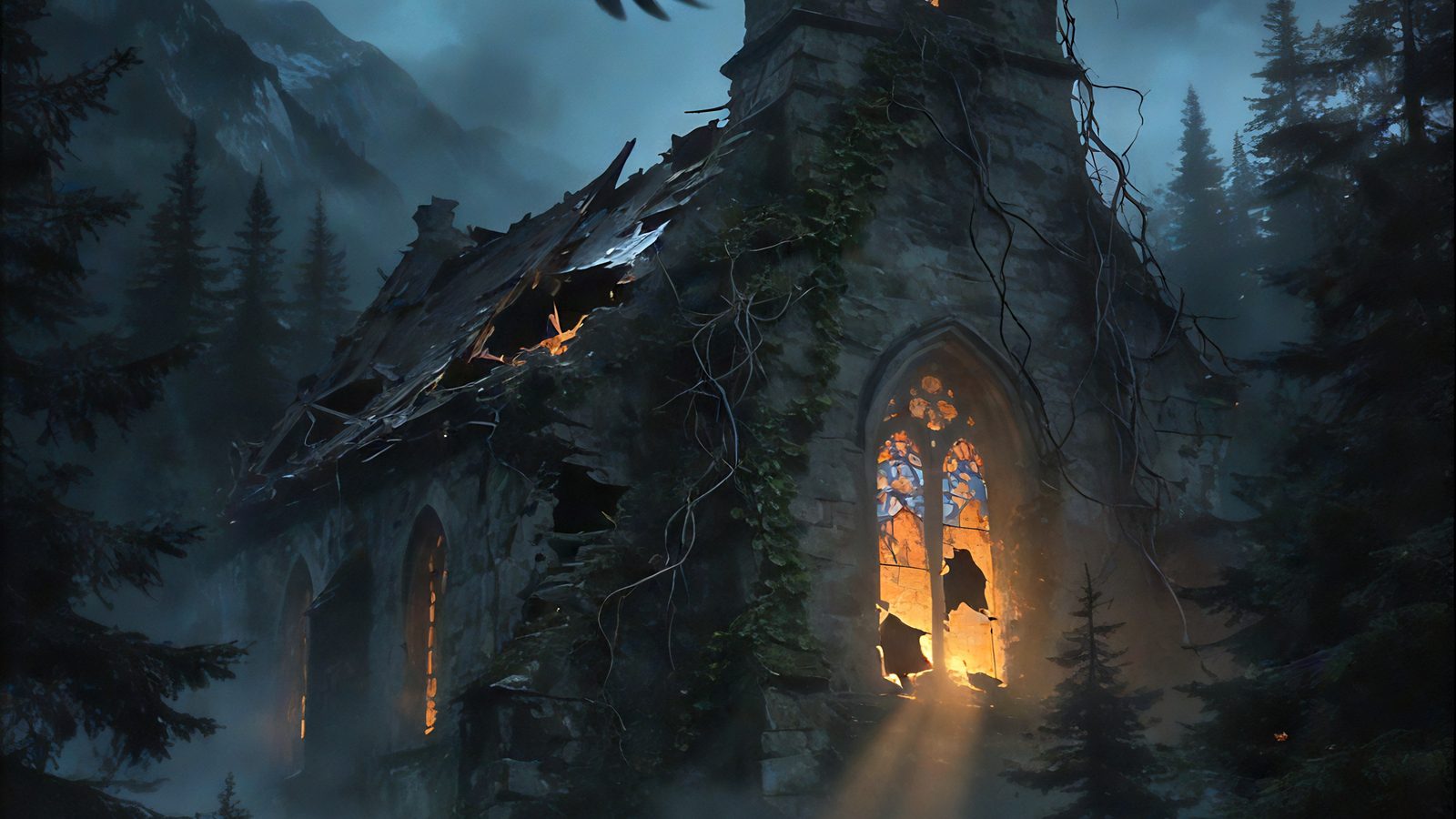
He stood there and he looked down at it. The town lay in the narrow crease of the valley the way a body lies in a casket, a long quiet shape, smokeless, the sun still climbing and laying a clean gold light across the roofs. There were more people out now. Thirty. Maybe more. They were gathered in clusters in the street and in the yards and in front of the church at the south end, and they were doing things he could not fully see and did not want to. One group had built a fire in the middle of Main Street. Another had carried something out of a house and put it in the bed of a pickup truck. He could not tell what the something was.
A figure was walking along the tailings pile north of the mine. The tailings pile was a heap of yellow-gray rock a hundred feet high and three hundred feet long. The figure on top of the pile was the wrong shape. Frank wiped his eyes. He wiped them again. The figure was still the wrong shape. It walked the way a man walks, on two legs, but the proportions were not right, and it was too tall, and the way the arms hung was not the way a man's arms hang. It stopped at the north end of the tailings and looked down into the town. It stood there a long time.
Frank realized he had been holding his breath.
He turned away from the ridge and started walking north.
***
He walked for an hour. Maybe longer. He lost track. The sun was still climbing, which meant it was still morning, which meant he had been down there no more than two hours, and that did not seem possible. Two hours was a blink. Two hours was a coffee and a crossword. A man could not lose a world in two hours.
He was halfway along the ridge, moving through a stand of bristlecone pine that had probably been old when Jefferson bought Louisiana, when he heard the jets.
He stopped walking.
They were coming from the north. Two of them. He knew the sound of a fighter jet; he had lived under the approach to Peterson for six years in the nineties. These were F-16s or near enough. They came in low and they came in fast, and the sound of them arrived before the sight of them did, a long hot rip of air that split the sky and came down into the valley.
Frank dropped flat in the pine needles.
He should not have. There was no reason to. They were not coming for him. But the body does what the body does, and his body knew that thirty years of mountain quiet had been unzipped from the sky, and it put him on the ground.
The jets passed overhead. They were nothing but a pair of dark slivers against the blue. They banked, lazy and precise, and came around from the south.
They dropped the payload on the second pass.
It was not ordnance Frank recognized by sight, but he had been in the Service long enough to know what napalm looked like when it hit a valley. He had been twenty-three years old in an orientation film in Missoula watching footage from a Montana slash-burn that had gone wrong, and he had never forgotten it. The footage had shown a long orange flower blooming slowly out of a hillside, blooming and blooming, and then the hillside was gone.
Raven's Peak bloomed.
The diner went first, or it seemed to go first. A gout of orange rose up where Millie's had stood and then the flame ran, poured, poured the way water pours, a kind of liquid fire that followed the street and jumped the boardwalks and ate the church and the post office and the laundromat and the hardware store and Hal Ettinger and Linda Gossen and Ray Dallimore swinging in his front room and every house on the hill. A black column climbed into the sky. Heat rolled up the ridge and touched Frank's face from a mile away. He smelled pine resin cooking.
The jets were gone.
He lay in the needles and watched Raven's Peak burn.
After a while he noticed he was crying, and after a while longer he noticed he had stopped. He sat up. He looked at the revolver in his hand. He looked at the smoke.
He would tell himself later that he had looked for the tall figure on the tailings and had not seen it. He would tell himself that. He was not sure it was true.
He stood up. His knee screamed at him. He told it to be quiet.
He started walking north again.
***
He reached the Halverson road at dusk. He had fallen twice and cut his palm once and he was so dry that his tongue had gone thick in his mouth, and the light had gone the soft purple that the high country gets in October, and he was not thinking about much of anything by the time he saw the road.
He walked another half a mile along the road before the truck came.
It was a beat-to-hell blue International Harvester, older than the Ford by a decade, and it was going slow because the driver was hunting. Frank stepped out into the middle of the gravel and held up his hand, and the truck stopped, and a man leaned out the window. The man had a gray beard and a thermos cap in his hand. He looked Frank up and down.
"You all right, friend?"
Frank opened his mouth. He closed it.
"I got turned around," he said. "Hiking."
The man in the truck looked at him a long moment. Then he looked at the column of smoke still hanging over the south ridge, which was darker now against the purple sky.
"Hell of a fire over there," the man said.
"Yes," Frank said.
"They'll have crews on it by tomorrow."
"Yes."
"You need a ride?"
"Yes."
The man reached across and opened the passenger door. Frank walked around the front of the truck. Before he climbed in, he turned aside and stepped into the creek that ran along the shoulder, and he took the revolver out of his belt and the box of spare cartridges out of his pocket and he let them go into the water. They disappeared in the dark between the stones. Then he climbed into the truck and he shut the door.
They drove north.
Frank watched the road and he watched the dashboard and he did not once look back toward the smoke, and he thought about Marla, and he thought about the wall that was thin, and he thought about the thing on the tailings pile, and he thought that some fires are not meant to be put out. He thought that some towns are not supposed to be mapped. He thought that a man does not see what he has seen and go back to being the man he was before he saw it.
He did not know yet that his radio had never been jammed at all, and that the hiss he had heard had been something else listening on the channel. He did not know yet that a young woman named Abigail Dressler was at that moment in a rental car ninety miles to the south, arguing with a terrified young Indian man about whether they could reach Raven's Peak before the Council burned it. He did not know that the Council was a thing that existed, or that Hell was a place with gates, or that the wall Ray Dallimore had written about in his Bible was a real wall, and had been cracking for longer than anyone in the valley had been alive.
He did not know any of that.
He knew only that he had been a man of the woods for fifty-eight years, and that the woods were not what he had thought they were, and that the light going out of the sky above the International Harvester that evening was the last clean light he was going to know.
He rode north into the dark. He did not speak. He did not look back.
Outside, above the ridge behind them, the smoke of Raven's Peak climbed and climbed and was at last lost in the deeper darkness of the coming night.
📖 Want more of this world?
This story lives in the world of World on Fire. If you liked it, the novel goes deeper.
Get Raven's Peak on Amazon → (free with Kindle Unlimited)
Join the Discussion