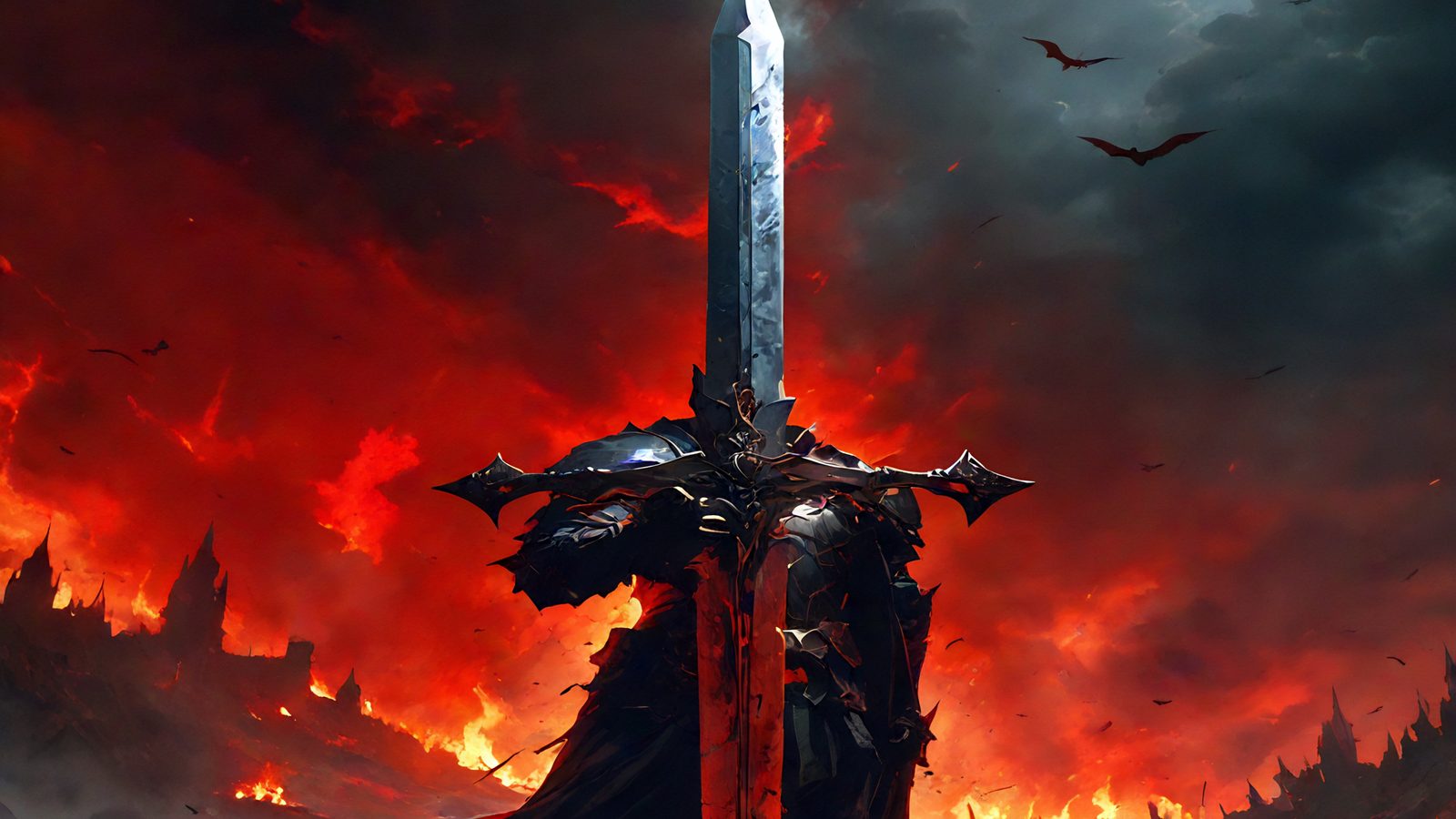

A side tale from The Ashen Kingdoms. Before the survivors of Blood and Belief ever reached the ruins beneath the world, an old hedge witch in a Karthian village read the embers for the mothers of conscripted sons — and saw more than she meant to see.
Vesna had not slept.
She sat on the packed earth floor before her hearth and fed the fire the last of the good applewood, and she watched the coals for the shape of what was coming. The shape was there. It had been there for a month, since the frost broke early and the crows came down out of the hills in numbers that did not belong to any season she knew. She had tried to read it honestly and had given up. Some shapes you could not read honestly. You could only wait for them to finish drawing themselves against the back of your teeth.
Outside, the track from the village was still dark under the elms. She listened for the first footfall and did not hear it yet. Dew dripped off the thatch. The goat shifted in its pen behind the cottage and the chain clicked against the post. Ordinary sounds. The ordinary world, doing its ordinary work, in the hour before the mothers came to her with their tokens and their quiet, knotted faces.
She spat into the fire. Salt, for hearing true. Then a twist of her own white hair, for hearing kindly. She had learned both from her mother and her mother had learned them from a Valorheim slave-woman who had washed ashore at Karthian Point with a broken jaw and no teeth, back before Vesna was born, back before Karthian and Valorheim decided they had always hated each other. That was the joke, if you could call it a joke. The woman who had given Vesna's line its second sight had come across the strait in chains, and now the boys of Vesna's village were being marched across that same strait to kill the grandchildren of whoever had chained her.
The track creaked. A shawl moving through the last of the dark.
"Come in, Orla," Vesna said.
Orla stooped through the low door and did not look at her. She held out a small thing wrapped in sacking and laid it on the edge of the hearthstone. Then she sat on the stool across from Vesna and folded her hands in her lap the way women fold their hands when they are being very careful not to beg.
Vesna opened the sacking. A child's tooth, a scrap of wool from a much-mended coat, a lock of dun-colored hair. Rell. Fourteen years old last Saint's Eve. Too young, by the old recruiter's code, but nobody had read from the old code in six seasons.
"You want to know if he comes back," Vesna said.
"I want to know what I feed him tonight," Orla said. "If it's his last meal I want it to be a good one."
Vesna looked at her. Orla kept her hands folded. She had a face like a winter pear, brown and shrunken down to the pit, and she had buried two already, an infant and a husband, and she did not cry when she spoke of Rell because she had used her crying up.
"Put the tooth on the coals," Vesna said.
Orla did. It hissed. For a moment the smell was only burning bone, and then it wasn't, and Vesna leaned forward and let her eyes go loose the way her mother had taught her. The coals were not coals anymore. The coals were a country. She walked into it.
She saw a road. She saw the road had no end, only a fold where it turned into another road that went back the other way, and along the fold a line of boys were walking with their backs bent under packs. Rell was in the line. She knew him by the patched shoulder of his coat and by the way he walked with his feet turned out, because his mother had set his legs wrong when he was a baby and no one had ever had the coin to set them right. He was walking. He kept walking. Then the road folded and Rell was walking the other way, only he wasn't Rell anymore, he was a thing that wore Rell's coat and had Rell's shoulders, and its mouth was full of something dark that dripped.
She pulled back. The kitchen came up around her like cold water.
"He comes home," she said.
Orla's shoulders loosened by the smallest degree. "Whole?"
"Hungry," Vesna said, before she could stop herself. She saw Orla flinch and she reached across the hearth and took the woman's wrist. "Feed him stew tonight. Feed him the good lamb, the one you were saving. Feed him bread with the butter on it thick as your thumb. You understand me, Orla? Thick. Send him off fat."
"And when he comes back?"
Vesna thought about lying. She had lied before. She had lied for pay, and she had lied for pity, and she did not believe in either one much anymore.
"When he comes back," she said, "lock your pantry at night. Keep a knife under the pillow. And if he asks you to come close so he can whisper something, don't."
Orla sat very still. Then she picked up her sacking, tied the remaining tokens inside it with a hand that did not tremble, and left a copper on the hearthstone. The copper was warm from being carried in her palm since the dark.
"Thank you, witch-wife," Orla said from the door, which was more than most of them gave her, and she stepped out into the thinning dark. The birds had started. The first of them, the grey ones that sang for nothing in particular. Vesna listened to them and then she turned and spat in the fire again, harder.
They came one after another. They came the way the village made the pilgrimage to the saint's well in the dry year, each woman a little distance behind the last out of some obscure shame, and each one carrying something small and terrible that had once belonged to a boy. Hair. Teeth. A milk-tooth strung on a cord. The rim of a wooden cup he had chewed as a baby. A shoe. A shoe with the sole half worn through on the outside edge, because he walked the way his father had walked.
Mera came second. Her son Jost was seventeen, a big slow boy who had been apprenticed to the tanner and smelled of the tanner even after a bath. Mera laid his tokens on the hearthstone with hands that shook so badly Vesna had to steady the little wooden cup for her. The cup had been his first. His name was carved on the bottom in a father's clumsy knife-work.
Vesna put a sliver of the cup on the coals.
She saw the road. She saw Jost walking it. She saw him reach the fold and turn, and this time she made herself watch longer, and what she saw on the other side of the fold was ash falling upward. That was all. Just a steady, slow rain of grey ash going up out of the earth into a sky that couldn't hold it, and Jost standing under it with his tanner's arms raised and his mouth open like a man drinking from a downspout.
"He's hungry," Vesna whispered. "They're all hungry."
"What?" said Mera.
Vesna opened her eyes. Mera's face, close.
"Nothing," Vesna said. "A dream I had last night. He comes home, your boy. He comes home thinner. Feed him."
Mera left a copper and a small twist of honeycomb. The honeycomb was old and half crystallized and it had probably been saved for a baby's birthday that would not come. Vesna put it in the crock on the mantel and she did not look at it.
Annike came fourth. The widow. Her boy was her last thing. His name was Brin and he was twelve, and Vesna had argued herself hoarse in the village square when the recruiter came and struck his name on the list, because twelve was twelve no matter what the old code had become, and the recruiter had looked at her with eyes like two river stones and said the Empire did not observe hedge calendars.
Annike did not bring tokens. She brought the boy.
He stood behind her in the doorway with his hands in his sleeves and his hair cut wrong for the parade they were going to march him in. He had his father's long face. His father had been a cooper and had died of a wet cough two winters past, and there had been no coin for the dying and no coin for the burying and no coin left afterward for anything at all, and now there was no coin for keeping Brin either.
"Sit him by the fire," Vesna said.
Annike sat him. Brin sat. He looked at the fire and not at Vesna. He was shy of her, as boys were shy of her, because the village told stories about her that she had mostly earned.
"Give me your hand, boy," Vesna said.
He held it out. His palm was cold. His pulse was a small bird in his wrist. She pressed her thumb to it and closed her eyes and let herself go down the road of his blood, which was a thing she did not do often because it cost her for days afterward, and she went deeper than she meant to.
She saw a hall. She had never seen a hall like it. The roof was broken in a dozen places and through the breaks she could see not sky but more roof, level on level of stone that went up into a darkness that was not the darkness of night but the darkness of things unlit for a very long time. In the floor of the hall there was a seal. She knew it was a seal because every hair on her body knew it was a seal, the way a hound knows a hot stone it has been whipped off once. The seal was a ring of iron set into the rock and bound around with old letters that were not in any alphabet she had been taught, and the letters were bleeding. Not blood. Something else. Something grey and thin that ran into the cracks of the floor like water and sang as it ran.
A boy was lying across the seal. His throat was open. The singing was coming out of his throat.
Vesna tried to see the boy's face. She could not see the boy's face. She could only see that his feet were turned out and that one of the soles of his shoes was worn through on the outside edge.
She broke the grip. She must have cried out, because Annike had her by the shoulders and was shaking her, and Brin had gone very pale and small on the stool, and the fire had guttered down to almost nothing although it had been roaring a moment ago.
"Vesna," Annike was saying. "Vesna, Vesna, stop."
"Take him home," Vesna said.
"He comes back?"
"Take him home, Annike."
"Does he come back."
Vesna looked at Brin. Brin looked at the fire. His jaw was set. He was twelve years old and he understood he was going to be killed, and he had decided that he would not cry in front of the witch-wife because the witch-wife, too, was a kind of stranger, and a man did not cry in front of strangers. That was what they had taught him. That was all anyone had taught him.
"Take him home," Vesna said again, very gently. "Take him home and keep him a week longer than the list says and then run him north. Up past Thol. Past Thol and into the peat country. No one comes up there in spring. No one."
Annike stared at her.
"I can't," Annike whispered.
"Then don't ask me to lie to you, woman."
Annike took Brin's hand. Brin stood up. He did not look at Vesna as he left. Annike did not leave a copper on the hearthstone. Vesna did not blame her.
There were more. There were always more. In a village of two hundred souls the recruiters had named sixteen, and of those sixteen, twelve had mothers living, and of those twelve, eleven had come to Vesna's cottage, because the twelfth was a woman named Urla who had cut off her left ear when her oldest was taken three seasons back and had not since spoken a word to anybody, not even to the boy who was now going too. Urla sat on her porch and cut turnips into smaller and smaller pieces, and the pieces accumulated in a bowl that no one ate from.
Vesna read for all eleven. She read and she read and she read, and the coals became a country and she walked and walked, and somewhere before noon the thing she had been trying not to see all month finally stopped hiding from her.
The eighth mother was a stranger to the village, a woman who had come in two harvests back to marry a cousin of the blacksmith, and her son was a stepson and not even of her blood, and she had brought a scrap of the boy's shirt and a tear of her own captured on a rag. Vesna had put them both on the coals. And the coals, this time, had done something they had never done before in her fifty years of reading. They had opened.
Not the country. Not the road. The coals had simply opened downward, a black shaft falling away under the hearthstone, and Vesna had toppled forward into it before she could stop herself.
She fell. She fell a long way. She fell into a place where there was no fire and no stone and no air, only a pressure like deep water, and under the pressure there were voices. Not one voice. Many. Many many many. They were not speaking any tongue. They were eating. They were eating and the eating made a sound that her mind translated, because her mind needed to translate it or go mad, and the sound her mind gave her was:
More.
More. More. More. More. More.
She saw them. She did not see them with eyes. She saw them with the old part of herself that her mother had woken and named and told to be quiet unless summoned. She saw seven of them, great worm-shaped hungers coiled under the bones of the world, each one pinned at one end by a seal like the seal she had seen through Brin's blood, and each one tugging slowly against the seal the way a tethered bull tugs against a post that has begun, at last, to give.
The seals were old. The seals were iron and word and blood and all three were tired. The seals were fed on the singing of throats opened in ritual, yes, but more than that, the seals were fed on the long feast of war, on every field where boys fell with their mouths full of mud, on every siege where women starved slowly enough to dream, on every village burned at dusk so that the smoke could rise through the night and sift down, ash on ash, into the cracks of the stone and down to the mouths below.
The war was not a war. The war was a meal. Karthian and Valorheim had not chosen to hate each other. Karthian and Valorheim had been taught to hate each other by long, slow teachers with no mouths, who whispered into the ears of kings in the small hours and shifted, by a degree, the angle of a treaty, the tone of an envoy, the price of salt. The kings believed they were making history. The kings were being farmed.
And under every field her village had lost a boy to, under every boy whose tokens had been laid on her hearthstone this morning, under every coin Orla and Mera and Annike had pressed into her palm, there was a mouth, and the mouth was a little wider today than it had been yesterday, and a little wider tomorrow than today.
Vesna screamed.
She screamed in the country of the coals and she screamed in her cottage, and the stranger-mother dropped the rag and scrambled back from the hearth with the noise of a chair being knocked sideways, and Vesna came up out of the fire on her hands and knees, and she was old, she had forgotten how old she was, and her nose was bleeding, and her ears were bleeding, and the stranger-mother was at the door with her shawl pulled up over her face, saying something, saying witch, saying mad, saying God between her teeth as if Vesna's madness were something catching.
"Get out," Vesna said.
The stranger-mother got out.
Vesna sat on her hearth and wiped her nose with the back of her hand and looked at the blood on her knuckles and she thought, for a long, hard moment, about walking out of the cottage and down the track to the village square, where the recruiter would be sitting at his table under the saint's tree, and telling him what she had seen. Telling him that his war was a trough and his kings were swine and every conscripted boy of every village from here to the coast was being carried on the back of a long slow hunger that would, when the seals finally let go, eat the world.
She thought about it. Then she thought about the recruiter's eyes, which were two river stones, and about the cart that came once a season to take the mad away to the house in Thol, and she put the thought aside. She put it in the same box where she kept the lie she had told Orla about Rell coming home, and she closed the box, and she sat on her hearth and waited for the next mother.
There was one more.
Halla Grenn came at the hottest part of the afternoon.
She came alone. She was a tall woman, taller than Vesna by a head, and she walked like a woman who had spent her life leaning into a forge's heat, which she had. Her hair was iron-colored and tied back with a strip of leather. She had hands like a man's hands and an apron that smelled of charcoal and quenching-oil even now, even today, even on the day the recruiter had taken her only son.
She did not sit. She stood in the middle of Vesna's kitchen and she laid her tokens on the hearthstone with the care of a smith laying down a nail she had heated perfectly and did not want to spoil.
The tokens were a baby tooth, a fingernail paring, and a single thick hair from the crown of a head. The hair was blacker than the others Vesna had read today. It was the black of smith-work, of wet iron, of a well at night.
"Tomas," Halla said. "Tomas Grenn. Son of Halla and Orik. He's fourteen and a summer, and he's my only."
"Sit, Halla."
"I'll stand."
"Sit."
Halla sat. She sat as if the stool had offended her.
Vesna put the fingernail on the coals. She did not put the hair. She did not put the tooth. Just the fingernail. She was tired. She was more than tired. She had read eleven readings and seen the mouths under the world, and she had decided, some hours ago, in a quiet room inside her own head, that she was done telling the truth today. She would tell this last mother what this last mother could carry home, and not one word more.
She closed her eyes. She let her vision loosen. She waited for the country.
The country did not come.
Instead, she saw the boy.
She saw him standing at a forge. Not his mother's forge, not the village forge — a different forge, somewhere far, in a hall of pale stone she had never seen in any waking life, with a roof of old iron struts and a light coming sideways through a hole knocked in a wall, and he was standing at the anvil with his shirt off and his arms scarred and his shoulders much, much wider than the shoulders of any fourteen-year-old she had ever put a hand on, and he was older. He was years older. He was years older and he was alive.
He was alive, and beside him, working the bellows, was a boy Vesna did not know. A dark-haired boy. Younger-looking. Narrow in the hips, with the rolling walk a sailor has even on stone, and a Valorheim accent in his voice when he spoke, which he was speaking, though Vesna could not hear the words. An enemy. A Valorheim boy at Tomas Grenn's bellows. And the two of them laughing — laughing, in the middle of everything — like men who had agreed, some long while back, to keep living.
Vesna opened her eyes.
Halla was watching her.
"Well?" Halla said. Her voice did not break. Her voice was the hammer going steadily down on the hot iron.
Vesna looked at the fire. The fingernail had already burned away.
"He comes home," Vesna said.
"When?"
"I can't say when."
"Whole?"
"Changed," Vesna said, and she saw Halla's jaw move, and she said quickly, "Not in the way the others will be. Listen to me, Halla. Your boy comes home. Not soon. Years, maybe. And he'll bring someone with him. A stranger. A southerner, by the sound. You take that stranger into your house, Halla Grenn. You take him in like he was yours. Do you understand?"
"A Valorheim," Halla said flatly.
"Do you understand."
Halla looked at her a long time.
"I understand you, witch-wife," she said at last. "I don't know that I believe you. But I understand you."
She stood. She laid a silver on the hearthstone, which was more than Vesna had earned in a season, and she gathered her tokens and wrapped them carefully and put them in the pouch at her belt.
At the door, she stopped.
"My boy is a good boy," she said, without turning around. "He's a soft boy. He cries at the slaughter yard. He won't do well out there."
"He'll do better than most, Halla."
"How?"
Vesna did not answer. She could not tell Halla Grenn that somewhere in the country of the coals she had glimpsed a forge in a hall of broken stone, and a sailor boy at the bellows, and the two of them laughing in a world that had by then already ended. She could not tell Halla that there was a road that folded and the things that came back were not the things that had gone, and that her son, for reasons Vesna did not understand and was afraid to understand, was one of the very few walking points in a long, long dark.
"He'll do better," Vesna said. "That's all I can tell you. He'll do better."
Halla nodded once and went out into the sun.
They marched at dusk.
Vesna stood in her doorway and watched them come down the track from the square. The recruiter at the head, on his bay, with his sash of Karthian green. Then the boys, two abreast, sixteen of them, roped at the wrist in a long loose line that was meant to look ceremonial but was, in truth, a rope. Rell with his feet turned out. Jost with his tanner's smell. Brin at the back, small, so small, his mother's face Vesna could not bear to look at on the road behind him.
Tomas Grenn in the middle. Taller than the others. His mother's iron-colored hair and his father's shoulders, already. Walking straight. Not looking at Vesna as he passed, though his mother must have told him about the visit, and though he must have wanted to look.
A good boy. A soft boy. Who would, somehow, survive.
Vesna stood in her doorway and watched the line of boys until the elms took them, and then she listened until the hoofbeats of the recruiter's horse were gone too, and then she stood a long time more and listened to nothing.
The sun went behind the hill.
The first of the evening ash began to fall.
She noticed it on the back of her hand first — a grey flake, soft as moth-wing, that was not the grey of her hearth-ash and had no business being in the air. Then another, on her shawl. Then another, on the threshold-stone, where it settled and did not blow away. The sky above the elms was clear. There was no fire anywhere she could see.
Vesna looked up at the clear sky and felt the ash fall gently on her face, and she understood, with the last unclouded part of herself, that somewhere under the world a seal had just given a little. Not broken. Given. The way a rope gives, one fiber at a time, long before it parts.
Sixteen boys. A hundred villages. A hundred thousand boys, across two kingdoms, across a season of war that had not yet begun in earnest and would not end in her lifetime or in the lifetime of any child born this year.
She thought of Halla Grenn's son, walking straight, and of the forge in the broken hall, and of the Valorheim boy at the bellows, laughing.
From ashes, she thought. It was an old phrase. Her mother had used it. Her mother's mother. It meant, in the old tongue, that something was ending; and it meant, in the newer tongue that had grown up beside the older, that something was beginning. She had never been able to decide which meaning she preferred. Tonight she decided she did not have to.
Vesna stepped back inside her cottage and closed the door against the falling ash, and she sat down at her hearth, and she fed the last of the applewood to the fire, and she watched the coals, and she waited — as she would wait, now, every night for the rest of her life — for the shape of what was coming to finish drawing itself against the back of her teeth.
📖 Want more of this world?
This story lives in the world of The Ashen Kingdoms. If you liked it, the novel goes deeper.
Get Blood and Belief on Amazon → (free with Kindle Unlimited)
Join the Discussion