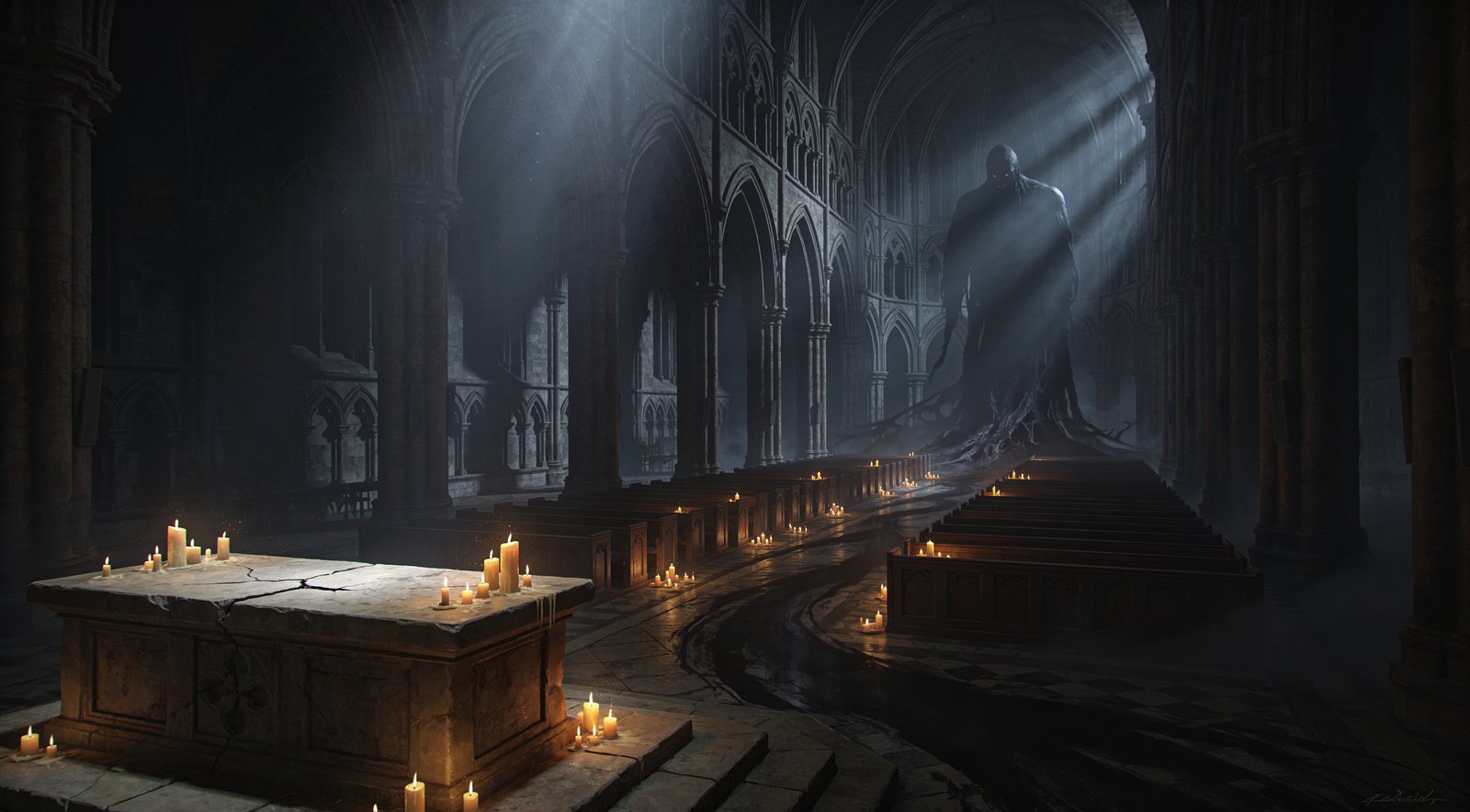

When readers ask me which World of Shadows character I most want to come back to, the answer is always the same. It isn't Niccolo, much as I love him. It isn't Bishop Glasser, who I happen to think is the trilogy's best villain. It isn't even Jeremy, who walks out of Book Three carrying half the unwritten Raven War in his head. The character who refuses to leave me alone is Arthur Vangeest — a man who introduces himself in Book One by knocking out a possessed teenager in a basement and saving Niccolo's life on what is, at that point in his own timeline, possibly the worst week of it.
This is the dossier I keep in my notes. I'm publishing it now because the trilogy is closed, and because Arthur is going to walk into other books, and because I want you to understand exactly what Arthur is carrying when he gets there.
Origins
Arthur Vangeest was born in the United States, but not in any single place he would tell you about. His childhood took him through three countries and at least seven schools. His father was Council-adjacent — never an active Hunter, but the kind of man whose phone rang at three in the morning often enough that Arthur learned to sleep through it. His mother was a translator who specialized in liturgical Latin and ecclesiastical French. They were not religious people in any devotional sense. They were fluent in religion the way people who grow up around a port are fluent in shipping.
Arthur drifted toward the Council in his early twenties for the most ordinary of reasons: he was good at it. He was good at violence the way some people are good at music. He could read a room, read a body, read a fight. He understood instinctively that the threat is almost never the man holding the weapon, but the man waiting at the next door. He was recruited and developed by Frieda Gotlieb, who saw in him something she has, in three decades of operational work, only seen twice before.
He was, at one point, an exemplary Hunter.
The Manor
Three years before the trilogy opens, Arthur was married. Her name was Sarah. He had a daughter named Emily.
In a single night, in a remote West Virginia manor, the cult that the Council had been quietly hunting for nine years walked into Arthur's family home and killed everyone in it. The cult — a Ninth Circle cell, although Arthur did not know the name yet — believed they were eliminating a Hunter family before that Hunter family could be turned against them. The address had been provided to them, in a small piece of clerical paperwork, by a Vatican clerk named Emily Glasser.
Arthur was on a Council operation in Brussels at the time of the murders. He returned to a house he could not enter. He returned to a future he no longer recognized.
For nine months he hunted that cell. He found them in a second manor, a different one, this one in West Virginia. He killed twenty of them in a single night. Some of them had been there. Most of them had not. The Council closed ranks and protected him. The Vatican did not. His name became, in certain rooms, a synonym for what happens when grief is given a gun.
He has never spoken about that night, in front of any of the trilogy's characters, in detail. He references it. Niccolo asks about it. Frieda alludes to it. Arthur does not describe it. This is not authorial coyness. He genuinely cannot find the words. Trauma in his particular grammar is not a story. It is the thing the story refuses to fit around.
The Vow
Sometime in the months after that second manor, Arthur made a vow. He has, on occasion, called it a vow against killing. This is not strictly accurate. The vow is more specific and more breakable than that.
The vow is: I will not let grief decide for me.
When Arthur draws his weapon and chooses non-lethal force in the trilogy — and he does this constantly, in the Sacramento nightclub, in the Arizona tunnels, in the shipyard container maze, in the Akron parking lot — he is not refusing to kill. He is refusing to kill because the corruption inside him wants him to. He calls it the corruption. He never calls it anything else. It is the thing that opens its mouth when he sees Garfield Tesfay's trunk arsenal at the Arizona facility, the thing that pulls him toward headshots in the container maze, the thing that whispered to him for nine months in the manor.
The corruption is not demonic, in the strict sense. There is no anchor, no possession, no formal vector. It is grief in its most recursive shape. It is the version of Arthur that wants to make the world pay for what it took. The vow is what holds the corruption in place. Every non-lethal shot Arthur fires is a small act of self-imprisonment.
Niccolo does not understand this in Book One. He understands it by Book Two. By Book Three, Niccolo is the one who breaks his own version of the vow — by killing Bishop Glasser in the shipyard trailer — and Arthur is the one who walks the road afterward beside him. The trilogy's central exchange is Niccolo trading away the cleanliness Arthur is fighting to keep. Arthur knows the cost of that trade. He paid it once.
Abigail
The other thing Arthur is carrying, by the end of Book Three, is a daughter.
Abigail came to him in the months between the second manor and Everett. The full circumstances are a story for another book — she was found, not chosen, and the finding is its own complete arc — but what matters here is that Arthur's first instinct, when he met her, was to leave her with someone else. He gave her to Frieda. He told himself he had nothing to give her. The Council, with Frieda's brisk and unsentimental clarity, became Abigail's guardians on paper.
She is also, the trilogy strongly implies and Book Three confirms, a Vatican Child.
Arthur's relationship to her changes across the three books. In Book One she is a phone call he forgets to make. In Book Two she is a sixteen-day deadline — a Council adoption vote that will decide whether she becomes a permanent ward of the order or returns to the system. By Book Three she is the reason he calls her, finally, from the road outside his old family home in Athens, Ohio, in a scene that I think might be my favorite thing I have ever written. He does not say "I am going to be your father." He simply asks how her day was. She is eight. She is afraid of her own mind. He listens.
In the epilogue of Book Three, the adoption paperwork is complete. He is her father. She is his.
If the trilogy has a single answer to the question can good men stay clean, her name is on it.
What He Is Not
A few things Arthur is not, that readers sometimes assume he is.
He is not a man of faith, in any orthodox sense. He has watched too many institutions fail too many children. When Niccolo prays in his presence, Arthur does not mock the prayer. He also does not join it. He is, by the trilogy's own term, Council-shaped — formed by an order that takes the supernatural seriously without taking the theology personally.
He is not invulnerable. He is repeatedly outmatched, in the trilogy, by Jeremy's telepathic gifts. He survives the shipyard only because he expected the attack and trained for it. An unprepared target, the trilogy is careful to say, would have been a puppet.
He is not, at the end of Book Three, healed. The trauma is not resolved. It is load-bearing now. He has built a life that the trauma supports rather than collapses. This is the most honest answer the trilogy could give and it is the answer it gives.
Where He Goes Next
I will not spoil the books that come after. I will say that Arthur Vangeest's name appears in three other Lincoln Cole series, sometimes by reference and sometimes in person, and that the version of him you meet in the Raven Saga is the version of him after Abigail. He is calmer there. He is more frightening there, too — calmer for the same reason a man with a loaded weapon is calmer than a man with an empty one.
The thing he is carrying, when you meet him next, is the thing he was carrying when you met him first. He has just figured out how to walk with it.
That, in the end, is the dossier. Arthur Vangeest is a man who decided, in the worst week of his life, that the world should not be allowed to decide who he becomes. The trilogy is the long argument between his decision and the world's response.
So far, he is winning.
📖 From the world of World of Shadows
The Everett Exorcism
Read The Everett Exorcism on Amazon →Free with Kindle Unlimited.
More from this world:
- The Architecture of a Hidden Faith: World-Building Inside the World of Shadows
- Abigail — World of Shadows
- Deleted Scene: Father Glasser, the First Time He Lost Faith
Get the next story before the world does — join the Vanguard →

Join the Discussion