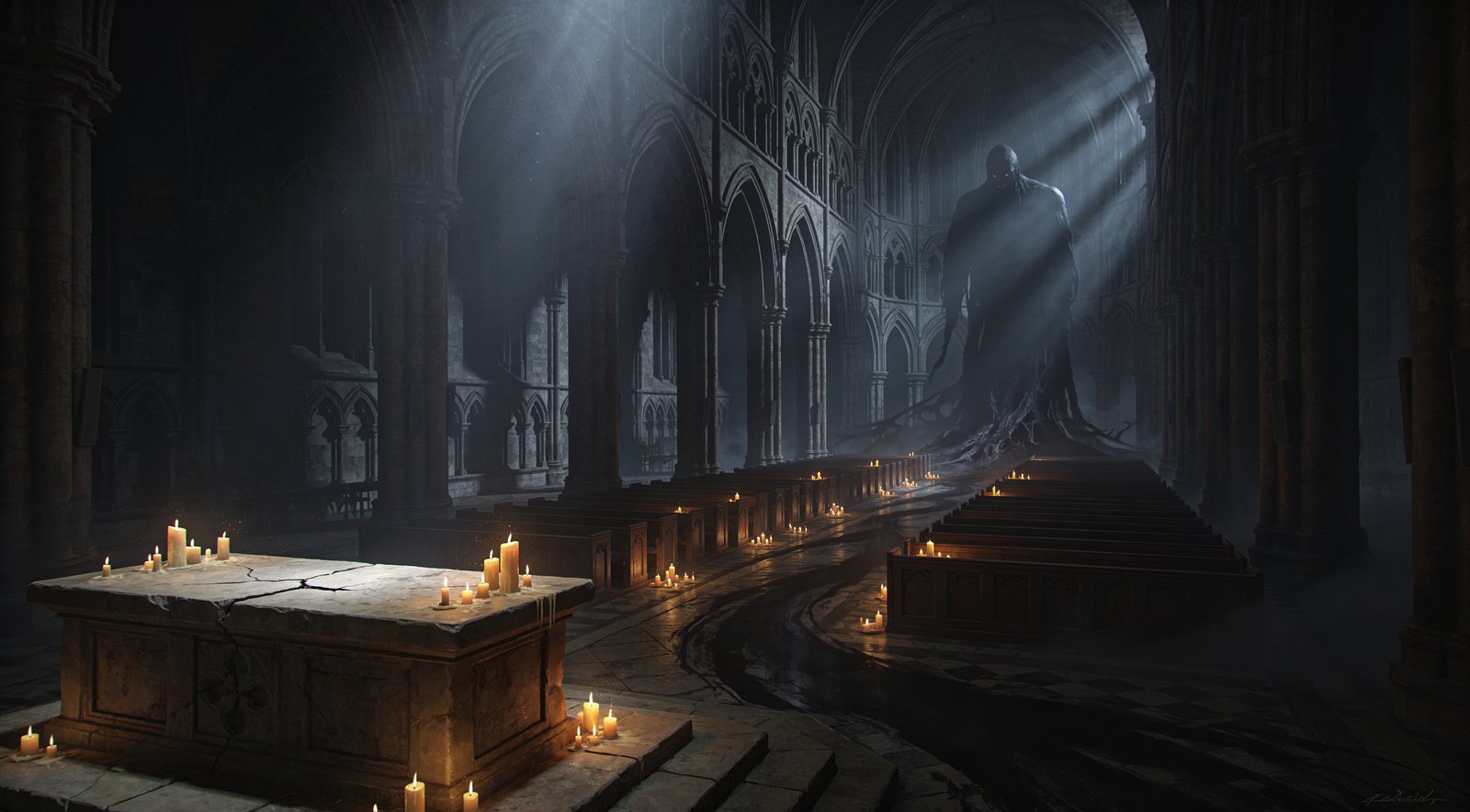
If you've finished the World of Shadows trilogy, you've watched three priests, two hunters, a runaway, and one extraordinarily dangerous fifteen-year-old try to pull a single thread out of a tapestry that the Vatican has been weaving since long before any of them were born. The thread came loose. The tapestry did not. That is, in some ways, the entire shape of the trilogy: institutions are older than the people who serve them, and they outlive the people who fight them.
This is the wiki entry I always wanted to write for new readers — the one that sits behind the curtain and shows you the ropes and pulleys. None of it changes the books. All of it deepens them.
The Three Pillars
Every World of Shadows scene runs on the friction between three institutions. They are not allies, exactly. They are not enemies, either. They are three competing answers to the same question: what should mortals do about the supernatural?
The Vatican. Old, layered, built on the assumption that revelation is dangerous and that secrecy is a kind of love. The Vatican of these books is not a monolith of villainy. It contains Father Affretti, who tries to extract Niccolo from Everett at considerable institutional cost. It contains Cardinal Richter, who calls Arthur with intelligence at four in the morning and asks for nothing in return. It also contains the Cardinal who funded Bishop Glasser's Arizona compound and remained untouched after the operation collapsed. The Vatican is not corrupt. The Vatican is vulnerable to corruption from within, which is a more interesting and more frightening thing.
The Council of Chaldea. A standing ecumenical body of professional Hunters — the Vatican's left hand, more or less, with informal jurisdiction over supernatural threats that the Church cannot officially acknowledge. Frieda is Council leadership. Arthur is Council muscle. Garfield Tesfay is Council artillery. Jun Lee, in Yokohama, is Council oversight: the institutional conscience that extracts oaths from grief-broken operatives before they go off the leash. The Council exists because the supernatural exists, and someone has to do the work, and the official Church cannot be seen to do the work. Seventy-five percent of the Council's budget, in the present-day timeline of the trilogy, comes from a single donor: Bishop Leopold Glasser. This is not a coincidence. It is the entire plot.
The Ninth Circle. A demonic cult operating in twelve cities, with serious groundwork laid in four of them. Its members include corrupted clergy, occult financiers, and the demons themselves, who are treated by the cult less as masters and more as collaborators. The Ninth Circle's long-term goal is exactly what Bishop Glasser articulates from his shipyard office in Book Two: catastrophic revelation. They want the supernatural exposed. They want the world to know. They believe — and this is the part that matters — that a Church which has spent a thousand years hiding the truth has forfeited any moral standing to keep hiding it.
You can disagree with the Ninth Circle. Niccolo certainly does. But the trilogy refuses to let you write the cult off as nihilists. They have an argument. The argument is wrong, but it isn't stupid.
The Vatican Children Program
Every meaningful villain in this trilogy is, at some point, trying to control or rescue the same set of children.
The official program is exactly what its name suggests: a centuries-old Vatican catalog of children born with measurable supernatural gifts. Three hundred and twelve names, the last time anyone counted. Telekinesis, telepathy, biochemical interference, projected emotion, animal command, the rarer abilities that don't have names yet. The Vatican's reasoning, unspoken but consistent, is the same reasoning it has used for every dangerous thing it has ever cataloged: better us than someone else.
The children are taken young. They are placed in monasteries, in seminary preparatory programs, in quiet rural retreats. Their families are compensated. Their gifts are documented and, as far as the Vatican is concerned, contained.
Bishop Glasser was once a parish priest in Oregon. He found a girl named Maria. He watched the Vatican take her away. He spent the next several decades investigating where she went and what was done with her, and at the end of that investigation he had built a parallel system: his own underground compound, his own conditioning protocols, his own seven children. By the time the trilogy starts, that number has expanded toward thirty. Of them, the finale accounts for all but eleven: twenty-two are recovered alive at Akron General, three remain missing, and eight are filed by the Vatican as merely unaccounted for — a category that exists mostly so the institution never has to admit it lost count in the first place.
Glasser is not, in his own mind, a kidnapper. He believes he is rescuing the Vatican Children from the Vatican. He believes the Church catalogs them so that they can be erased and he is collecting them so that they can be used. He is, depending on the day, half right and half monstrous.
This program is the spine of the trilogy. It is the reason Niccolo's loyalty fractures. It is the reason Arthur is willing to spend three books violating Council protocol. It is the reason a fifteen-year-old named Jeremy can, at the end of Book Two, hijack a network of thirty enhanced minors with a single phone call.
The Demonology
A few things are stable across the trilogy and worth pinning down for new readers.
Possession in this universe is not a clean thing. It is contested, layered, and often anchored to physical objects. The doll in Rose Gallagher's guest room. The artifact Bishop Glasser carries out of Everett. The demonic vials in Glasser's office. These are not props. They are scaffolding. Destroy the anchor and the demon weakens; destroy enough anchors and the demon retreats; never destroy the anchor and the demon will hold the host until the host's body fails.
Faith works, but unevenly. Niccolo's first exorcism in Everett succeeds — but only after he abandons the prescribed Latin rite, only after he speaks his own words, only after Rose's anchor doll is burned. The implication, never stated outright, is that the Church's centuries of liturgical refinement matter less than the priest who performs them. This is a heretical reading. The trilogy does not retract it.
Tranquilizers work too, and this is one of the trilogy's quiet ideas. A possessed body, sufficiently sedated, loses contact with the demon. The host falls unconscious; the demon retreats. Arthur develops the theory in Book Two and tests it in the cargo container maze. It is a deeply secular answer to a sacred problem, and it is one of the reasons Arthur is who he is. The Council's most effective exorcist is a man with a tranquilizer gun and a vow against killing. It is a small, telling detail that both of the trilogy's most reliable defenses against the supernatural — the tranquilizer and the vow — belong to the same man, and neither one is remotely holy.
Children, in this universe, can be conditioned into willing demonic vessels. Glasser is grooming Jeremy for exactly this purpose at the end of Book One. By Book Three, Jeremy himself is summoning demons in a hospital basement using ritual ingredients made from harvested organs. The trilogy does not flinch from this. It also does not let you mistake Jeremy for a monster — only for a child raised inside one.
Geography of Corruption
The trilogy moves through Everett, Colorado, Yokohama, Sacramento, the Arizona desert, a California shipyard, Manila in flashback, and Akron in the finale. This is not arbitrary. Every city is a node in the Ninth Circle's twelve-city map. Everett was the public test. Sacramento is the financial laundromat. Arizona was the manufacturing floor. The shipyard was the export terminal. Akron is what happens when the manufacturing floor's most successful product walks out the door with the keys.
Manila, glimpsed only in the case-file short story, is the trilogy's hint that this network reaches well outside North America. There are cells we never see. There are children we never meet. By the end of Book Three, twenty-two of Glasser's recruited minors are recovered and three remain missing — and eight are unaccounted for, a category the Vatican uses when it does not want to admit it never knew the count to begin with.
Two more coordinates matter, even though the trilogy visits them only briefly. Athens, Ohio — Arthur's abandoned family home — is where he calls Abigail for the first time as her future father, a single chapter that does more work than its length suggests. And Brussels, where Arthur was stationed on Council business the night his own family was murdered, resurfaces at the very end as the drop point for the third courier packet carrying Glasser's dead-man switch — delivered to a recipient the trilogy never names. Both cities are minor on the map and load-bearing in the story.
Connection to the Wider Universe
World of Shadows is a companion trilogy to World on Fire, and longtime readers of the Raven Saga will catch the Council references that thread through both series. Frieda, Garfield, and Arthur all operate in the same shared institutional space as the Hunters of Raven's Peak. The Ninth Circle's twelve-city map is, eventually, the geography against which the larger Raven War is fought. Haatim Arison — the one, the most powerful Vatican Child, the boy whose name Glasser dies protecting — is not in this trilogy. He is the trilogy's last unanswered question, and the answer lives in a different series.
If you have not read the Raven Saga, World of Shadows works perfectly as a self-contained horror trilogy about institutional rot. If you have, the trilogy is the seismograph reading from the same earthquake, taken from a different city.
The Thing the Trilogy Is Actually About
A few things the trilogy is not about, despite appearances. It is not about whether God exists. (He might. The texts don't decide.) It is not about whether the Church should exist. (It should. The texts are unambiguous on this.) It is not even about whether Bishop Glasser was wrong. (He was, in every line of the books, although the trilogy gives him his fairest possible defense.)
The trilogy is about whether good men can stay clean. By the end of Book Two, Niccolo has answered: no, not always. By the end of Book Three, Arthur has answered: yes, but at a cost most people would refuse to pay. The cost is named Abigail. She is the trilogy's grace note and its longest argument with itself, and she is the reason Arthur drives away from Akron a father.
Welcome behind the curtain. The tapestry is bigger than three books. It always was.
📖 Go deeper into the World of Shadows world
The Everett Exorcism
Read The Everett Exorcism on Amazon →Free with Kindle Unlimited.
More from this world:
- Abigail — World of Shadows
- Deleted Scene: Father Glasser, the First Time He Lost Faith
- Case File: Manila
Get the next story before the world does — join the Vanguard →

Join the Discussion