Behind the Scenes: World Lore Deep-Dive
When I sat down to build the universe of Graveyard of Empires, I had a problem to solve. I wanted a sprawling space opera — empires, fleets, decades of war — but I also wanted cosmic horror sitting underneath all of it. Two genres that don't always like each other. Space opera tends to be about agency: politics, choices, fleets clashing over the future of civilizations. Cosmic horror tends to be about the absence of agency: things older and larger than you, indifferent to anything you do.
The trick was to make those two layers depend on each other. The political war had to look total — galaxy-spanning, generation-shaping — so that when the cosmic layer finally surfaced, the entire scaffolding of empires and rebellion would feel small. That meant building three systems carefully enough that they could each carry weight on their own and still ladder up.
This post goes deeper than the public world guide. The world guide is the wiki. This is the workshop floor — the design notes for three of the load-bearing systems that hold the whole series up.
1. Neural Implants and the Vanguard Program
The Vanguard implant is the technology that lets the rest of the series exist. Without it, Traq is just a kid with strange powers. With it, you have a Republic-wide military program, a generation of enhanced soldiers, and — eventually — the realization that humanity has been quietly reverse-engineering alien hardware for three centuries without knowing it.
What the implant actually does
The Vanguard implant is a neural augmentation that grants telekinesis, object manipulation at line-of-sight range, defensive barriers against kinetic and energy weapons, and combat-grade reflex enhancement. It is surgically installed at the temples or skull base, and the device is visible. There is no hiding what you are.
Using the implant has costs. The first signs of overuse are a copper taste in the back of the mouth and a tightening headache that radiates from the implant outward. Push past that and you get nosebleeds, peripheral neuropathy, and eventually neural breakdown. Recovery time is hours for normal use and days for sustained combat work. Vivian Drowel, in Convergence Book 2, walks Traq through these limits explicitly because I wanted readers to understand: this is not a magic system without rules. Every Vanguard who survives the surgery is on a clock.
The surgery itself kills most candidates. The Republic accepts that attrition rate as the price of admission. The Ministry uses Vanguards as weapons and calls the program service. Maven Ophidian was assessed as psionically negligible during selection and redirected to intelligence work — a detail that becomes important later, because it means the only major figure in this series operating at her level without an implant is the one who builds the architecture of the post-Republic order.
The thing the Republic didn't know
The implants are not Republic technology. They are reverse-engineered alien hardware, salvaged from a wreck in Sector Six and adapted by the Ministry over the course of three centuries. Grand Archivist Solomon Krey identified this in a classified document in Echoes of Time, then was executed for his findings. His paper survives because Traq finds it.
This matters because every Vanguard implant is, in effect, a receiver. The alien intelligence behind the original technology — the Harbinger — has been broadcasting on that frequency for six hundred years, waiting for someone on the other end to learn how to listen. The Republic built a military program out of the antenna and never asked who was on the other side of the call.
Traq is the exception. He is the only known natural Vanguard — a child whose telekinetic capacity manifested without surgery, without implant, without antenna. The Harbinger cannot speak directly to him. Everything the entity does in the series, it does through second-hand pressure, through dreams, through other minds. Traq's untethered status is what makes the cognitive defense protocol possible at the end. The technology that sold the Republic an army also handed humanity its only path to surviving first contact.
2. Republic Politics: The Architecture of a War That Didn't Have to Happen
The political structure of the early books took the longest to design, because I needed a system that produced atrocity without needing a single villain to engineer it. Real bureaucracies can do enormous damage through structural pressure alone. I wanted that on the page.
The three power centers
On paper, the Republic looks like a federal civilian government. Underneath the paper, three power centers actually run things, and each one is convinced the other two are the problem.
The Ministry of Truth is the intelligence and propaganda arm. It controls which children are conscripted into the Vanguard program, which archives stay sealed, which planets are visible on official star charts and which are not. It is staffed by men like Argus Wade, who joined believing they were preserving civilization, and by men like Cassius Vane and Givon Mielo, who joined believing they were the civilization. The Ministry's institutional reflex is to bury problems. By the time Firelight opens, the things the Ministry has buried over three hundred years include: Project Prometheus, the sterilization of Novum, the alien origin of the Vanguard implants, and the ongoing existence of the Arcadia.
The military command sits adjacent to the Ministry but does not answer to it. Captain Kristi Grove of the Denigen's Fist, High General Nicolai Oppenheimer, and the eventual Emperor Gaius Benedict are the figures who matter most here. The military's relationship to the Ministry is the relationship of a sword to the hand that polishes it: necessary, mistrustful, and capable of cutting either way. The Tellus bombardment — the moment the Empire kills thirteen billion people — happens because Oppenheimer authorizes it under Ministry pressure with the Emperor's tacit consent. Nobody in the room thinks of themselves as the person who killed thirteen billion people. They all think of themselves as the person who had to make a hard call.
The First Citizen and the political class are the nominal civilian leadership, and they are the ones with the least real power in the early books. Senator Delacroix, who carries Alaina Naylor's Trevmarch evidence to the Union summit, represents the rare politician who still believes the system can correct itself. The summit vote of 289-131-39 is the one moment in the early series where civilian governance does what civilian governance is supposed to do — and it triggers a war that consumes everything for the next two books.
The Outcast counterweight
Darius Gray's rebellion isn't just a political movement. It's a Ministry creation that escaped containment. The Ministry's Order of Mens Rea trained Darius and discarded him. He came back with a movement of three hundred trained operatives and the moral authority to declare independence on Tellus.
Maven Ophidian builds the Union's military power base in parallel, but she is doing something different than Darius. Darius wants to win the war. Maven is already thinking about what governance looks like after the war ends, and the answer she keeps arriving at is: not this. Not the Republic in different colors. Her independent supply networks, her humanitarian aid on Jaril, her insistence on cultivating settlements rather than conquering them — that is the framework she carries into the post-war period.
The political tragedy of the first three books is that none of these power centers can see the cosmic threat. They are arguing about who controls the antenna while the Harbinger is patiently broadcasting through it. By the time Traq forces a ceasefire in Traq's Resistance Book 5, the political war has cost so much that the Empire and Union sit at the same table mostly because there is no longer the money or the men to keep fighting each other.
3. The Ancient Alien Station: What the Arcadia Actually Is
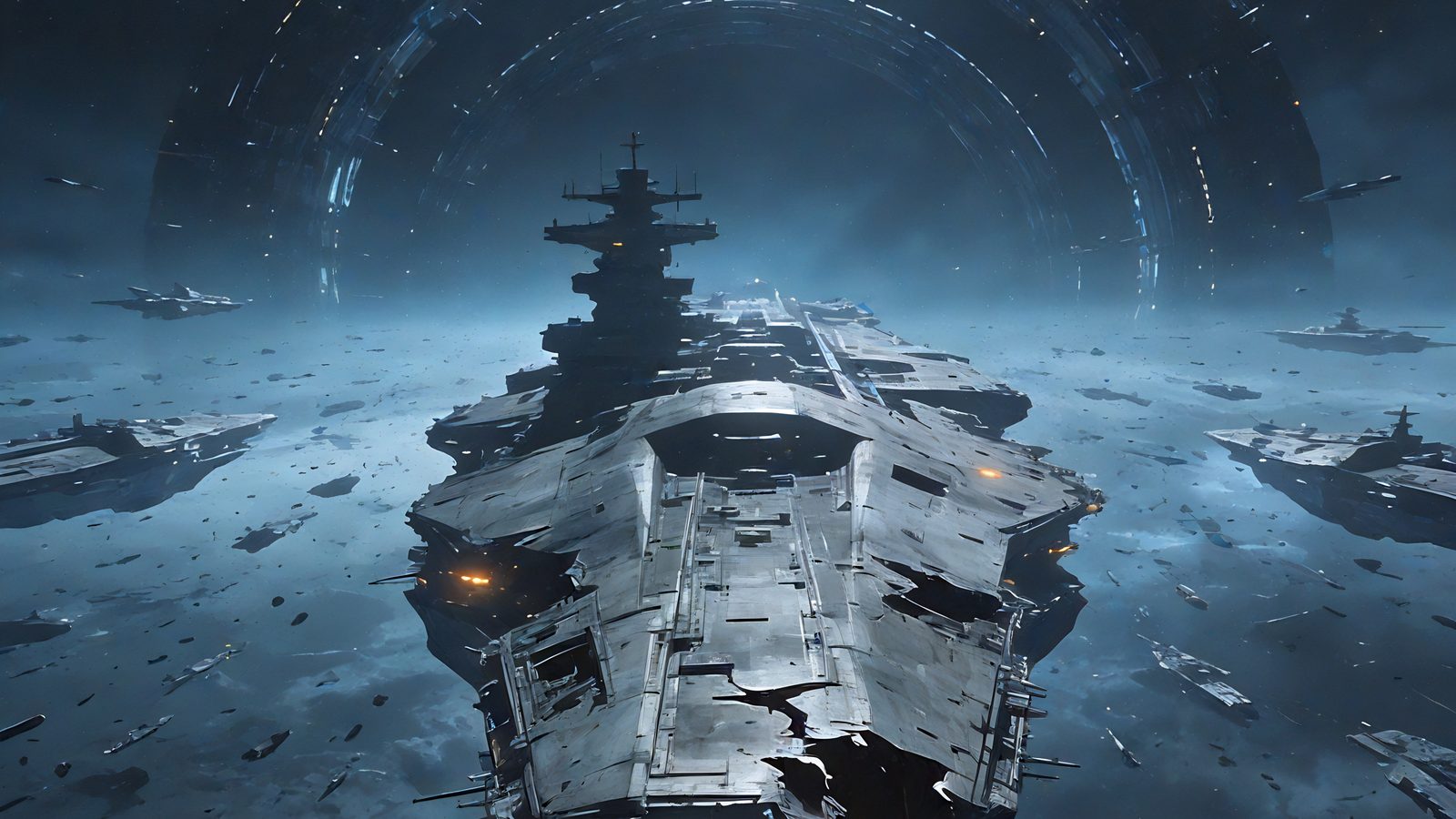
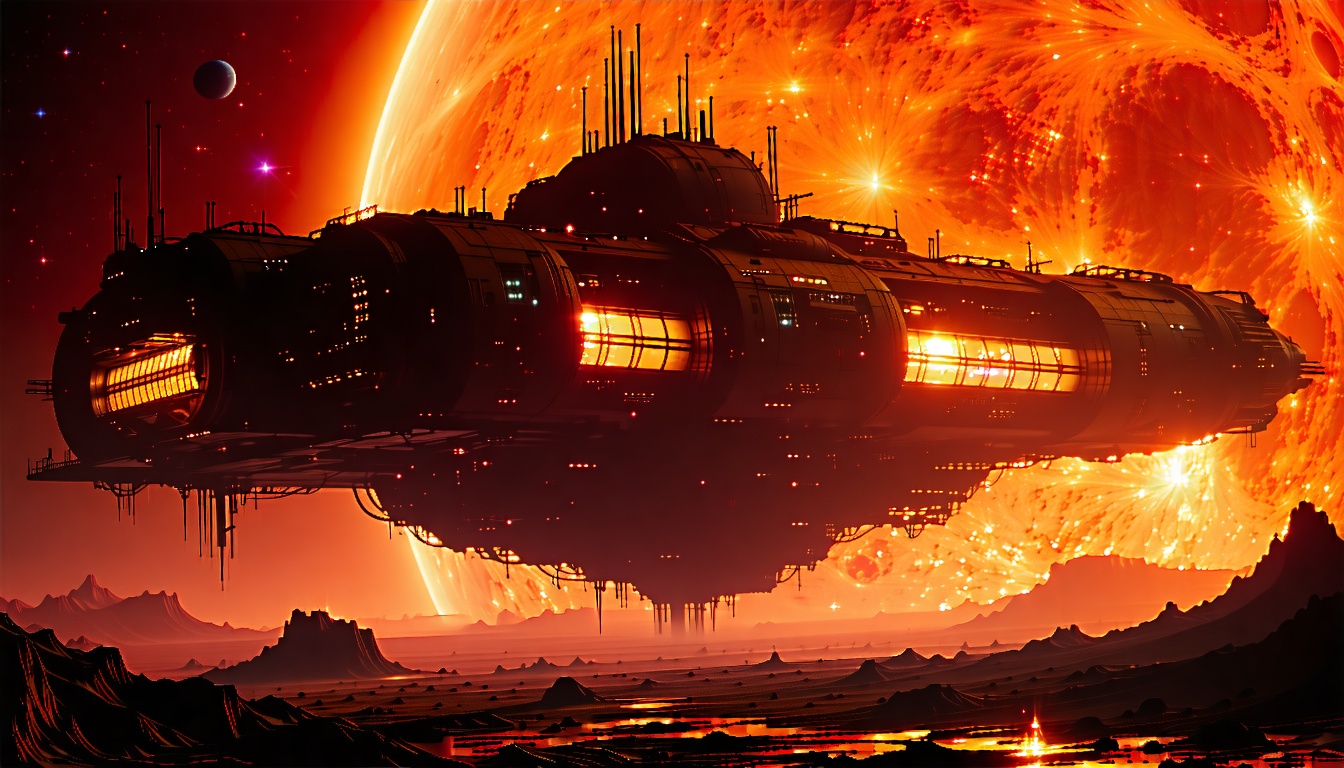
The Arcadia VII is the load-bearing piece of the cosmic horror layer. Sixty thousand meters long. Lost six hundred years before the events of Book 1. Seven hundred thousand crew aboard. Orbiting the gas giant Phargus in dead silence.
What happened in Year 0
The public version of the Arcadia disaster is that the ship entered a nebula, suffered catastrophic systems failure, and was lost with all hands. The Republic's archived version is a little more honest — the ship was a research vessel attached to a long-range mission, the systems failure was preceded by anomalous psychic events, and contact was lost over a forty-eight-hour window rather than instantly.
The truth is the version Chief Medical Officer Elena Voss recorded into a barricaded log in Medical Bay Seven, which Traq finds in Echoes of Time. The Arcadia entered an unmapped pocket of deep space. The crew began experiencing vivid shared nightmares. An ancient intelligence, present in that region, began systematically harvesting minds at the rate of approximately fourteen thousand crew per day. Voss's log was made when she was the only person left in her section who still recognized her own face. She knew what was coming. She recorded what she could and stopped recording when the recording was no longer hers.
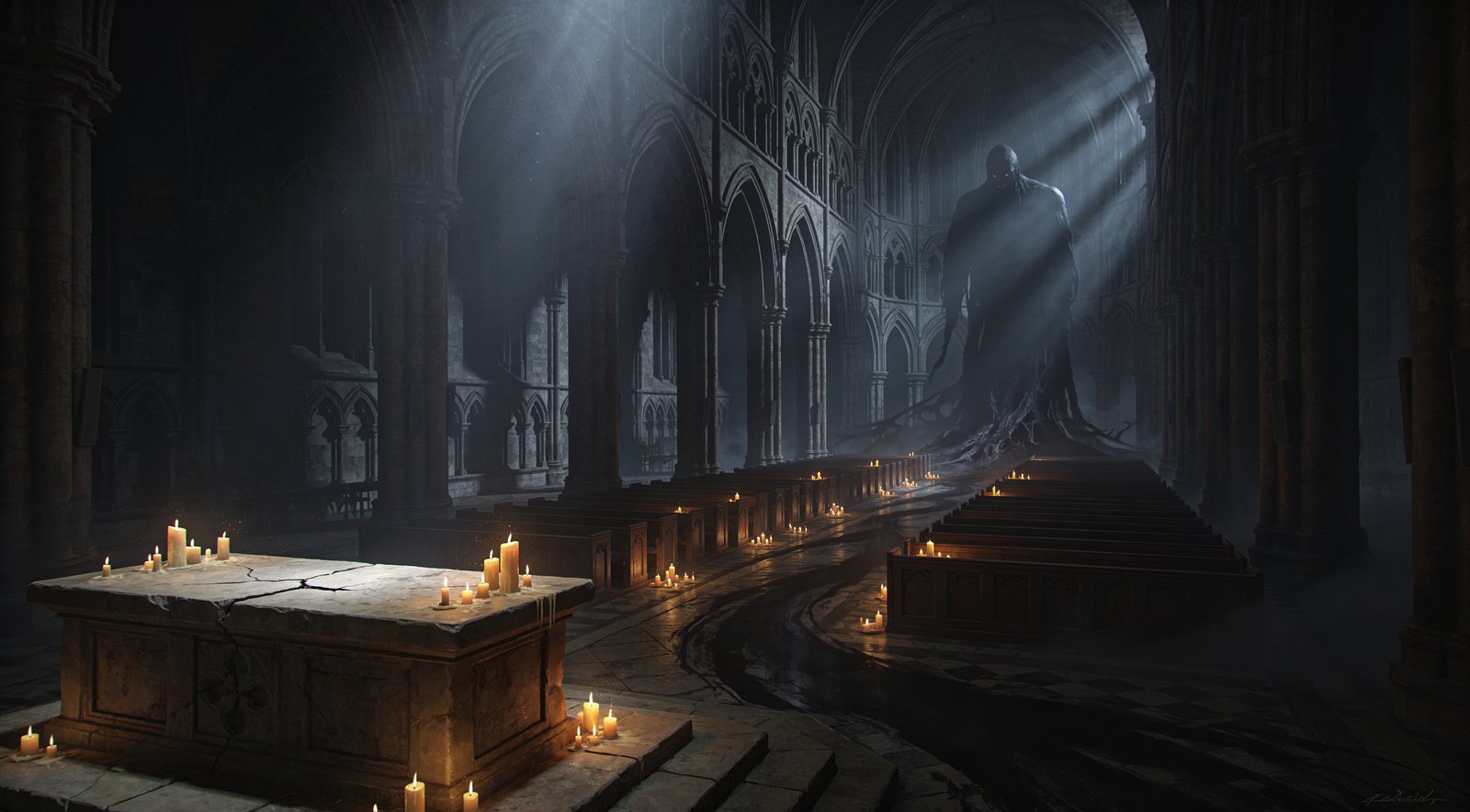
Seven hundred thousand minds went into the Harbinger that day. The bodies remained. Some still walk the corridors. The station itself became the seed of the entity's presence in the galaxy.
Why it stayed where it was
Here is the design decision that I am the most attached to: the Harbinger does not move. After Year 0, the Arcadia stays in orbit around Phargus. The entity could presumably extend itself into other systems through any vector that gives it access to a sufficiently complex consciousness — which is precisely what it eventually does through the Vanguard implants — but it does not relocate physically.
It is patient. It has six hundred years to wait. It is also, I think, bored in a way that an entity that has consumed seven hundred thousand minds and run out of things to think with might be bored. The implant network gives it something new — a slow drip of complex human consciousness, distributed across thousands of soldiers, none of whom know they are being read. That is a richer feast than a single station of converted minds. So it waits, and it tastes, and it positions pieces.
It also signals to whatever else is out there. The cosmic horror in this series is not the Harbinger by itself. It is what the Harbinger is talking to. The fleet that arrives at Vaalin in Book 5 is not the entity's army. It is a peer. The Harbinger is a foothold. The thing it serves is the actual scale of the threat, and the series ends with humanity having pushed back the foothold and barely understanding what is on the other side of it.
What the builders left
The Sanctum, on the other side of the rim, is the antithesis of the Arcadia. Where the Arcadia is a conquered station, the Sanctum is a defended archive — the last work of a civilization that fought the Harbinger's lineage to a draw and chose to encode their solution into crystalline storage rather than die without leaving the next species something useful.
The builders' weapon is paradox. The entity feeds on organized neural activity. A coherent mind is a meal. A fragmented mind — one capable of holding contradictions, irrational defiance, multiple unintegrated layers of thought running in parallel — is indigestible. The builders engineered their consciousness to be uneatable. Humanity, with its messy combination of enhanced and baseline minds, its enhanced soldiers running cognitive defense protocols against its unenhanced civilians' parallel networks, accidentally has the architecture for the same defense.
Traq does not invent the cognitive defense protocol. He steals it. The distinction matters. The builders gave up a civilization to encode that knowledge. Traq pays for the theft with permanent neural damage and the loss of the builders' communicative presence — when the Sanctum releases him at the end of Chapter 13, that is a goodbye. The builders are not coming back. Humanity has the weapon now, and the bill for it is humanity's to carry from here.
Why all three matter together
The three systems above were the first three things I designed for this series, and I designed them in this order on purpose.
The implants gave me a tactile, military-grade magic system that the political war could be fought with. The Republic gave me a civilian engine that could produce atrocity without needing a moustache-twirling villain to drive it. The Arcadia gave me the patient cosmic threat that makes both of the above feel — by the end — like footnotes on a much larger story.
The series works, when it works, because those three layers are interlocked. Pull out the implants and the political war loses its weapon. Pull out the political war and the cosmic threat has nothing to harvest. Pull out the cosmic threat and the political war is just another grim space opera. They have to all be on the page at once, and the reader has to feel each one rising as the others recede.
This is the universe Traq Lane gets handed at age five. The next post in this series goes into him — what I built him to carry, what I cut from his arc, and where he ends up.
Want the public-facing tour? Read the Graveyard of Empires World Guide. For the full series — start reading here.
📖 Go deeper into the Graveyard of Empires world
Graveyard of Empires
Read Graveyard of Empires on Amazon →Free with Kindle Unlimited.
More from this world:
- Graveyard of Empires — World Guide
- Behind the Scenes: Character Dossier — Traq Lane
- Behind the Scenes: Deleted Scene — Mikael's Last Tea
Get the next story before the world does — join the Vanguard →

Join the Discussion