Before the dark
Most cosmic horror starts with the question of what is out there. Last Light started with a different one: what if the thing out there has already been here, for longer than humanity has had the language to describe it, and what it wants is not to invade but to merge?
This is the lore document for the series — the wiki entry I never wrote inside the books because the characters in those books did not have time to read it. The corruption did not give them time. Kate did not give them time. Now that the series is finished, here is the architecture underneath it.
The Hollowing
The entity that drives the nine-book arc has a clinical name and a private name. Inside the Department of Dimensional Intelligence, it is called the Dominion — the catalogued threat, the tactical referent, the noun on a briefing slide. Inside Kate Morrison's head, where it lives more honestly, it is the Hollowing.
The Hollowing is older than human spaceflight by an amount that does not usefully translate into years. It is a dimensional presence rather than a species. It has no homeworld in the way humans understand the term, because it does not occupy space the way matter does. It propagates the way a song propagates — through resonance, through receptive surfaces, through anything alive enough to hum back at it.
When humanity first encountered it, we tried to model it as biology. The corruption that overran the KEP-4C mining colony looked like a biofilm. The transformations that turned crew members into the thing called the Fist looked like infection. For a long time the official line was that this was a parasitic organism with extraordinary adaptability. That was wrong, and it was wrong in a specific and important way.
The Hollowing is not a parasite. It is a translation event. What looks like infection is the Hollowing converting matter into something it can read, the way a scanner converts ink into data. The biofilm is a side effect, not a goal. The goal is the song — a continuous transmission across whatever surface the Hollowing has rendered legible. Wherever the song is heard, it can keep working.
The reason humanity stayed alive long enough to fight back is that most humans do not hear the song. The brain filters it as noise. A small number of people — fewer than one in a hundred thousand by Nigel Rhodes' final estimates — have a neural geometry that the song lands on cleanly. Those people do not survive contact for long. Their minds become readable, then writable, then absent. Kate is the exception, and she is the exception because she was eight years old when contact happened, and a child's filters are still being built, and hers built around the song instead of against it.
The Void
The Void is the human name for the dimensional barrier that, until Last Light in the Dark, kept the Hollowing on the wrong side of human space. It is not empty. It is not even, strictly speaking, space. It is the seam between dimensional layers, and the original closers — the small group of humans who first encountered the Hollowing in the early period of FTL exploration — sealed it deliberately, paying for the seal with their own consciousness.
This is the secret that the Chen family has been carrying for generations. Lucas Chen's ancestor, Chen Li, was one of the original closers. The seal was not a technology. It was a substrate — a person, willingly transformed into the boundary itself, holding the Hollowing on the dimensional far side by occupying the seam with their own awareness. When the seal began to fail, it failed because the substrate was thinning. Consciousnesses do not last forever, even when they are large enough to hold a dimension closed.
The DDI knew about Chen Li in a redacted, family-rumour way. Admiral William Chen knew the truth before he told his son. That is why the Admiral made the calculations he made about Kate so quickly. He had grown up in the shadow of a great-grandfather who had not died but had been spent.
The Dominion's home dimension
The Hollowing's native dimensional layer does not have stars. It has masses. The closest analogy in our physics is a permanently inflationary cosmology — a region in which space itself behaves like a fluid, currents move through it, and the things that live there are eddies in the current rather than discrete bodies. The Hollowing is one of those eddies. There are others. They are not interested in us yet because the Hollowing has been the only one whose current crossed our seam.
This is also why the Hollowing has been so hard to kill. It is an eddy. A thing that is fundamentally the standing wave of a flow cannot be punched through, only redirected. Kate's transformation is, in the language Nigel finally lands on in book six, a redirection event. She is not destroying the Hollowing. She is teaching it the geometry of an exit.
The Department of Dimensional Intelligence
The DDI was founded in the years between book one and book four, although its predecessor — a classified inter-corp survey program that dispatched the original Bravo Team to KEP-4C — predates it by about a decade. By book four it has consolidated under Admiral William Chen's command, with a remit that reads, in public, as "anomalous interstellar phenomena" and, in classified, as "containment and weaponization of dimensional contact assets."
Kate is the asset. Marcus and Chelsea fight for the entire series to keep her from being only that.
The DDI's core failing is structural. It was founded by people who experienced the corruption first and the diplomacy never. It treats the Hollowing as an enemy combatant rather than as an entity capable of being communicated with. It is not until very late in the series that the institution itself begins to ask the question Kate has been asking since she was a child: what does this thing want? The honest answer turns out to be that the Hollowing wants what every old, lonely consciousness wants. It wants the conversation to keep going. It wants someone to talk to.
That is the thing the DDI was structurally incapable of seeing.
Kate's connection
The connection itself deserves a paragraph of its own, because it is the load-bearing element of the whole series. Kate's connection to the Hollowing is not mystical. It is not magical. It is a neural-dimensional interface, possible because her developing brain rebuilt itself around the song rather than against it during the Sanctuary incident.
What this means in practice is that she can hear the Hollowing's song continuously, the way a radio operator hears a carrier wave. She can locate Hollowing presences across light-years because the song does not propagate through space. It propagates through whatever the Hollowing has made readable, and Kate is readable, and the Hollowing is readable, and the link between them is direct.
The cost is that she is also being read. Every minute she stays connected, the Hollowing learns more of her shape, and her shape and the Hollowing's shape become more alike. By book six this is catastrophic. By book eight it is the point.
The Eclipse fleet
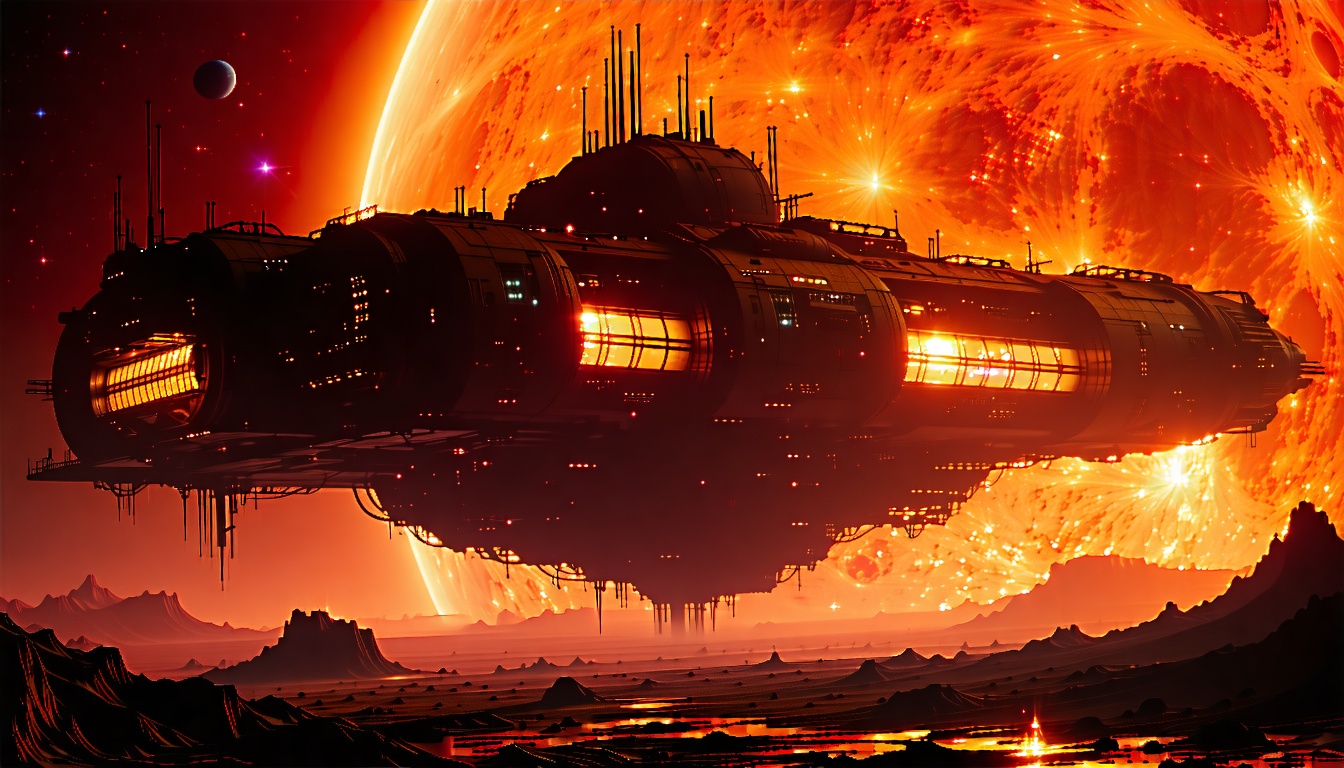
Task Force Eclipse is a unit, not a doctrine. It was assembled in the aftermath of book three to give the DDI a mobile combat platform with Kate aboard, on the theory that an early-warning sensitive should not be tied to a fixed installation that could be targeted and destroyed. Commander Elias Vance, who runs Eclipse's operational side, is a deliberate counterweight to Admiral Chen's strategic coldness. The series does not let either of them be entirely right.
By the end of book seven, Eclipse is the human fleet in any meaningful sense. The other formations are doing evacuations.
The original closers
There were seven. Most of them came from the Chen Li expedition, which was a small civilian-and-military team conducting routine FTL surveys when they encountered the first thinning of the Void. The names of the others are recorded, in the books, only obliquely — in family histories the Chens guard, in the redacted footnotes of Nigel's research, in a single conversation Marcus has with his father in book five that does not appear on the page.
The reason the closers remain anonymous is not authorial coyness. It is thematic. They did what Kate is preparing to do. Their reward was that their names left the world along with their consciousnesses. The book is asking, quietly, whether Kate's name will go with her too — and book nine is the answer.
The shape of the cosmology
All of this rests on a cosmology that the books rarely state outright. Briefly: there are dimensional layers, those layers have seams, and consciousness — biological or otherwise — is the only substance that interacts with the seams in both directions. Everything else respects the boundary. Awareness does not.
This is why the Hollowing wants Kate. It is why the original closers worked. It is why Lucas Chen carries the heritage he carries. The series is, at its base, a story about consciousness as load-bearing physics — about minds being the only thing in the universe that can hold a boundary together, and about what it costs, every time, to be the one holding.
What the lore is for
A lore document is a load-bearing wall in the world of a series. It is not the story. The story is what the characters do with the world. But after nine books, the wall is worth describing on its own — because the things that happen inside it only feel inevitable if you understand the geometry of the room.
That is what Last Light is, underneath the corruption and the corridors and the song. It is a room shaped by an old, loving, terrible thing that wanted to merge with us, and a girl who learned its language well enough to send it home.
Related Last Light reading
For orientation around this lore wall, see the Last Light complete series hub, the timeline reference, and the writer's commentary.
Last Light in the Dark, Book One of the series, is live now on Amazon. Early reviewers are calling it "a fantastic space thriller that really delivers on tension" — 4.8 stars across five Readers' Favorite reviews. Start the series here.

Join the Discussion