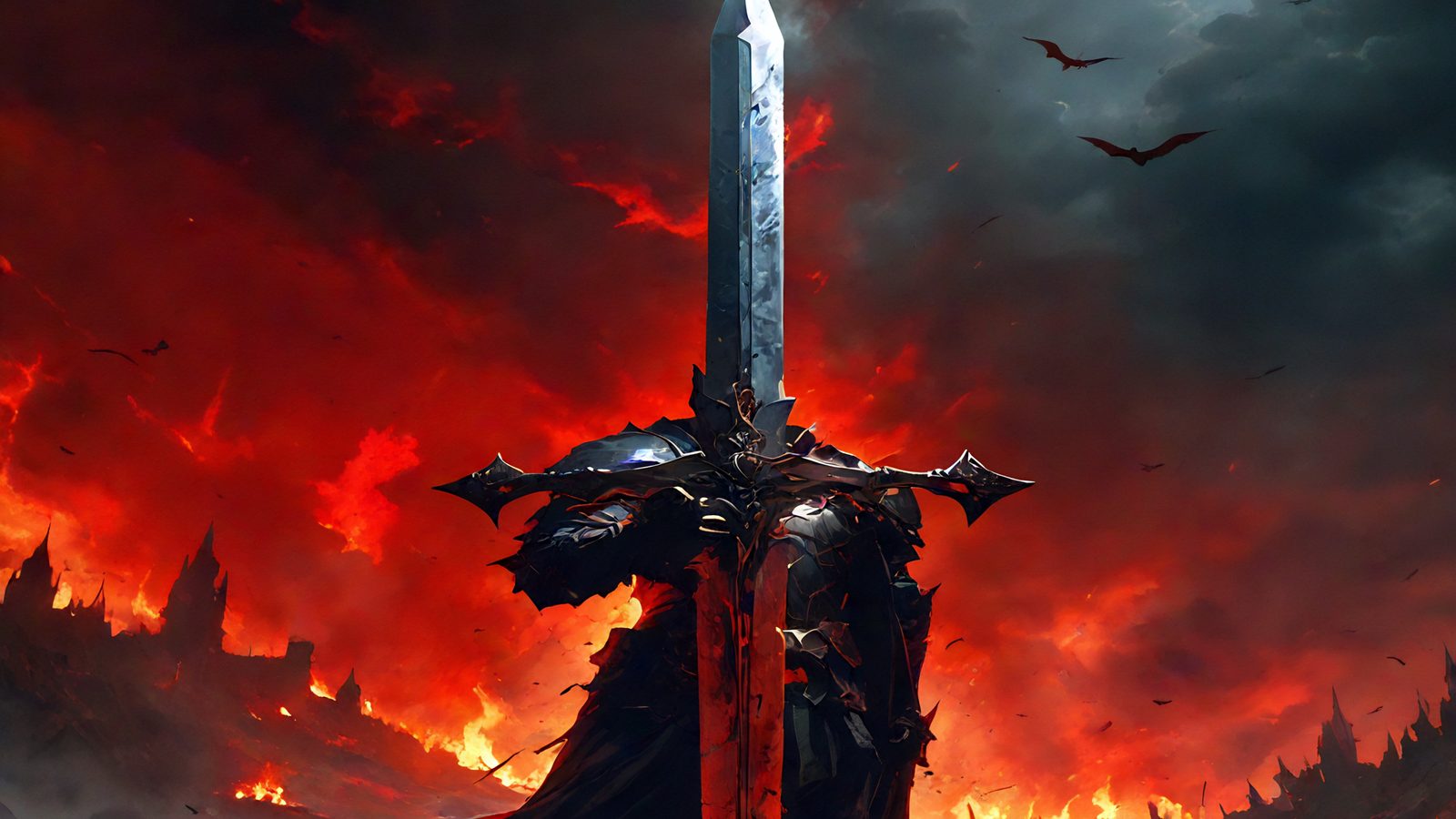
Character Dossier: Cael Morevan
This one is hard to write because I knew, by the third draft of Blood and Belief*, that I was going to leave Cael under a continent. There was never another version of the ending that survived the room. Everything in his arc is the long approach to that dais. — L.C.*
Spoilers for the entire series, including The Eternal Vigil*.*
I. Origin
Cael Morevan was born in a fishing town on the southern Valorheim coast. The town does not appear on any map in the books because, like most of the southern coast, it was a name people only said to other people who had also been born there. He learned to read on the back of his father's tide chart and to tie a bowline before he was tall enough to reach the rope cleat without standing on a crate.
His mother died when he was eleven. His father drank himself sideways out of grief, then sober out of stubbornness, then dead at sea two years later. By the time the conscription notice arrived at the Salt Daughter's port master's office, Cael had been a working sailor for nine years and a navigator for three. He did not consider himself a citizen of Valorheim. He considered himself a citizen of the Salt Daughter, and the Salt Daughter did not have politics.
The conscription sergeant disagreed.
I want to flag a piece of biography that the books only let me hint at. Cael's mother was a Morevan, and the Morevan line is not from the southern coast. They are from the eastern peninsula that, in the Progenitor era, was the academic district of the city now buried under the Ironworks. Cael's grandfather Edric Morevan was a brilliant engineer who specialized in Progenitor restoration—the reason Edric is the Progenitor researcher whose schematic the Architect inherits. Cael's mother left that life on purpose, married a fisherman, refused to talk about her family, and gave her son the surname Morevan as the only inheritance she would acknowledge.
This is why Cael, alone among the survivors of Valtherion, hears the seal hum from the first ritual in Blood and Belief. It is genetic. It is also the reason the Architect, in Legacy of Iron, recognizes Jorin (whose grandfather was Cael's uncle) as a Morevan: the family carries an unusual harmonic sensitivity that the Progenitors, ten thousand years ago, were quietly engineering for. Edric did not invent the bloodline. He found it and tried to perfect it.
Cael does not know any of this until very late. By the time he might have asked, the only people who could answer were dead.
II. The Sailor
The Cael Morevan who reports to Valorfen Barracks in Chapter One of Blood and Belief is twenty-six years old, six feet tall, sun-blacked, and carrying a grief he has not yet processed. The Salt Daughter went down with thirty-one hands. Eight survived. He is one. His best friend Jorik—and yes, this is the Jorik Cael talks about in his sleep through three books—did not.
Cael survives the war by accident at first, then by spite, then by something he cannot name and only Mira sees: a navigator's instinct for what is about to give way. He reads weather in faces, currents in conversation, sandbars in silences. Squad Two sticks together because, around Cael, staying together feels like the obvious thing.
He is not a leader yet. He is not even particularly self-aware. He is a man with a hole in him where a ship used to be, who keeps walking because walking is what keeps the hole moving.
The thing that breaks open in Chapter Twenty-five of Blood and Belief—the seal speaking his name—is not the moment Cael becomes the protagonist. It is the moment Cael becomes the responsibility. He hears the hum and understands, before anyone tells him, that something has noticed him specifically.
I sometimes think of the whole series as the long story of Cael trying, and failing, to give that responsibility back.
III. The Coordinator
By Ashes and Thrones Cael is the de facto first leader of New Haven. He hates the job. He is bad at speeches. He is worse at politics. He cannot cook (the books make a running joke of this; the truth is I gave it to him as a way to make sure his quarters were always full of other people's cooking, which is how an introvert becomes a community). He is, however, almost preternaturally good at the one skill the Confederation actually needs: he can stand in a room with two people who hate each other and identify the exact sentence that, if spoken next, will make them stop hating each other for long enough to keep working.
This is what Mira sees in him. It is what Theron val Mechas, in Legacy of Iron, eventually files as an "unresolved anomaly" in his personal data—the way Cael walks unarmed into the weapons archive and ends a confrontation by not raising his voice. It is the thing Tomas calls, in their last shared watch, the difference between a finder and a builder. Cael finds. Tomas builds. Same phrase, different work.
What I want to say in this dossier, because the books only show it sideways, is that Cael's diplomatic gift is not a personality trait. It is a wound. He learned to read rooms because his father was unpredictable. He learned to identify cracks because the Salt Daughter went down through one he should have seen and didn't. Every conversation he saves at the council table is a small private repair of an old failure. He does not know this consciously. He would deny it if you asked. But Mira, who has her own root cellar and her own three days under the dead, sees it as clearly as I do.
IV. The Civil War, the Scavengers, and the Cost
I do not want to recap the plot of the middle two books, but a few things I want to say about Cael that the books do not say outright:
- His decision in Ashes and Thrones not to execute Kael Thorne is not a moral decision. It is a navigator's decision. He looks at the chart and sees that executing Kael writes a story Kael's followers can use. Imprisoning him writes a story they cannot. The morality is downstream. (This is also why, in The Eternal Vigil, Cael visits Kael in prison and listens. He has never thought of it as forgiveness. He has thought of it as keeping a line open in case, one day, the line proves useful. In Book Five, of course, it does.)
- His relationship with Jorin Morevan in Legacy of Iron is the first time in the series Cael loves someone as a son rather than as a friend or a comrade. He does not know that Jorin is, by blood, his second cousin's child. He does not need to. The recognition is older than the genealogy. The chapter where he visits Jorin after the hospital failure—lights the lamp, brings food, watches Jorin's hands—is the chapter where Cael becomes, for the first time, a father in any real sense, six weeks before he loses that son to a self-detonated charge in the Ironworks core.
- He never marries. He never has children of his own. He is asked about this by Mira, by Petyr, by Sera, by half a dozen council members across thirty years, and his answer changes depending on who is asking and what year it is. The truth, which I think he only tells Mira and only on the night before the dais, is that he never figured out how to want a future for himself separately from the future he was trying to build for everyone else.
V. The Anchor
Here is what I want to say about the ending.
Cael does not become the anchor because he is the only person who can. He becomes the anchor because he is the only person whose entire life, when laid end to end, makes a single coherent shape that fits the dais. Thirty years of harmonic attunement. A Morevan bloodline he never asked for. A grief at the loss of the Salt Daughter that taught him to recognize, in any system, the place where the keel is going to give. A quiet decades-long preference for being the one who holds the rope rather than the one who climbs it.
When Petyr says "this isn't sacrifice, this is maintenance," that is Cael's voice borrowing Petyr's mouth. Cael does not consider what he does on the dais a death. He considers it a job for which he is, at last, fully qualified.
The thing that breaks me, every time I reread Chapter Twenty-three of The Eternal Vigil, is that Cael lays himself down willingly and does not feel relieved. He has been trying to stop being responsible for an entire continent for decades. The dais is, in a way, the deepest possible escape from that responsibility: he will no longer have to negotiate it with people; he will simply be it.
But on the dais he discovers, as the seven seals connect, that he is not escaping the responsibility. He is becoming the means by which the responsibility is met. There is no relief. There is only a deeper version of the same job.
I write a lot of grimdark, and the question I am most often asked is whether grimdark fiction can have hope without lying. The Anchor Chamber is my answer. Cael's foundation is the most hopeful thing I have ever written, and it is hopeful precisely because it is not relief. It is duty made permanent. It is the proof that someone, given the choice, will choose it.
VI. After the Dais
I want to leave you with the small private fact about Cael that does not, to my eye, fit anywhere in the books, and that I am setting down here for the readers who have come this far.
In the Anchor Chamber's harmonic, in Chapter Thirty-seven of The Eternal Vigil, Cael identifies "9,000 resonances as familiar companions." The number is not nine thousand round. It is exactly the count of the seal-ritual dead from Books One and Two: Tomas's two thousand from the first two rituals, plus the rest from rituals three through seven. They are not metaphors. They are there. The Progenitors built the lattice as a continuous standing wave that does not, in fact, throw away the harmonic signature of any consciousness it has ever held. Aethis is in there too, dissolved but never erased.
Cael, on the dais, is not alone. He has never been alone. The hum he heard at twenty-six in a Progenitor chamber was the sound of nine thousand voices recognizing their own.
That is the thing he does not say to Petyr in his farewell. It is the thing Petyr learns, at his last visit twelve years later, when the harmonic pulses warm and Petyr does not need to be told what the warmth means.
That is the character. That is the man.
— L.C.
📖 From the world of The Ashen Kingdoms
Blood and Belief
Read Blood and Belief on Amazon →Free with Kindle Unlimited.
More from this world:
- The World Beneath the World: A Lore Deep-Dive into The Ashen Kingdoms
- Deleted Scene: Aethis, Ten Thousand Two Hundred and Seventy-Three Years Ago
- What the Embers Showed
Get the next story before the world does — join the Vanguard →



Join the Discussion